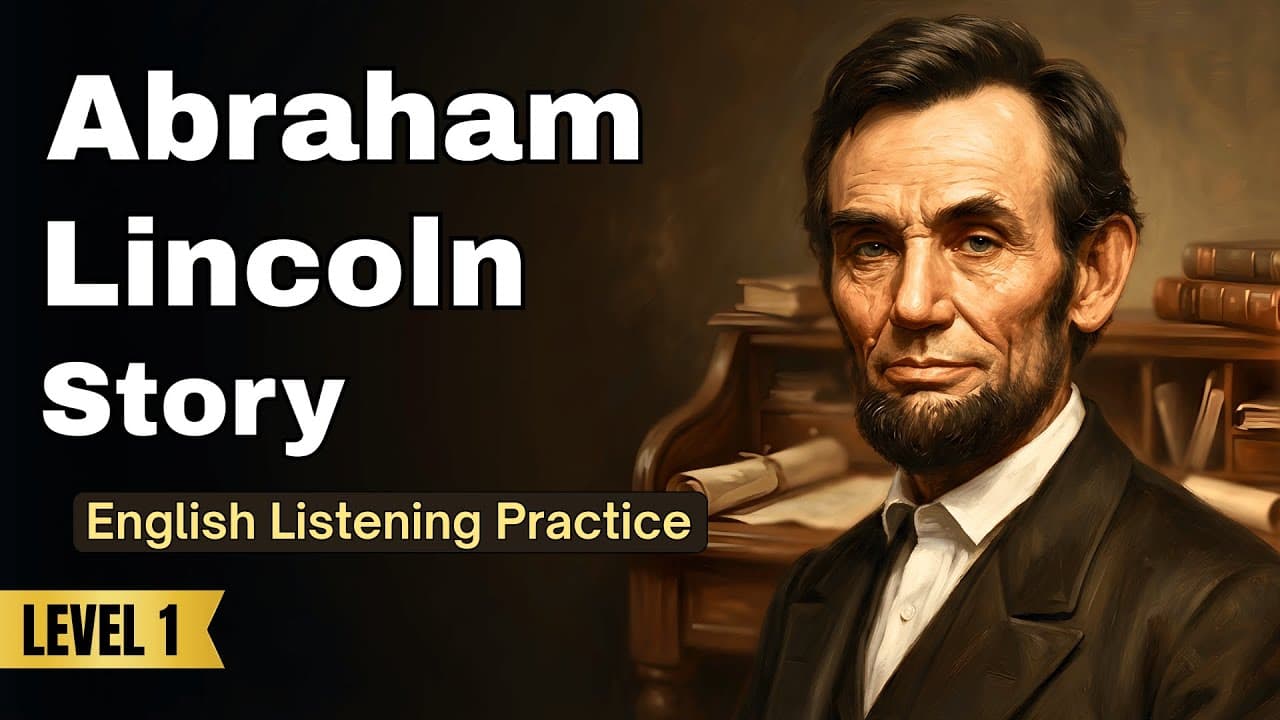
How Did Abraham Lincoln Rise to the Presidency?
TL;DR
Abraham Lincoln rose from poverty and limited schooling to become a lawyer, politician, and president through self-education, honesty, persistence, and powerful communication. Personal loss, his opposition to slavery, and the Civil War tested his leadership, while the Emancipation Proclamation connected the fight to preserve the Union with the cause of freedom.
Transcript
Hello my friends. I am happy you are here. Imagine a small boy sitting by candle light. He is reading a book. The book is very old. He borrowed it from a neighbor. The neighbor lives far away. The boy reads every night. He wants to learn everything. He wants to understand the world. This boy did not go to school very much, but he became a great man... Read More
Key Insights
- Abraham Lincoln was largely self-educated because nearby schools were scarce and his total formal schooling may have lasted only one year. He borrowed books, walked miles to obtain them, studied each word carefully, and practiced writing on boards or the ground when paper was too expensive.
- Lincoln's mother and stepmother strongly influenced his development. Nancy taught him kindness and honesty before dying when he was nine, while Sarah Bush Johnston brought books, encouraged his reading, recognized his potential, and protected the time he needed to continue learning.
- Lincoln learned that words could shape emotions and understanding through reading, storytelling, and entertaining friends and family. His ability to make people laugh and think later strengthened his simple, persuasive speaking style as a lawyer, political candidate, debater, and national leader.
- Lincoln's opposition to slavery was reinforced when he saw enslaved people being sold in New Orleans. The experience made him feel sick, remained in his memory, and contributed to his conviction that slavery was morally wrong and that people should live in freedom.
- Lincoln became a lawyer without attending law school because he lacked the money. He borrowed legal books, studied daily, questioned lawyers, passed the required test, and built a successful Springfield practice based on honesty, fairness, justice, hard work, and the trust of local people.
- Lincoln's political rise began with a desire to help his community and improve people's lives. He was elected to the Illinois State Legislature in 1834 at age 25, later served one term in Congress, and gained national attention through seven debates with Stephen Douglas.
- Lincoln won the presidency in 1860 while the United States was deeply divided over slavery. Southern states began leaving the Union before he started his duties, formed the Confederate States, and rejected his presidency, creating the crisis that developed into the Civil War.
- The Emancipation Proclamation changed the stated meaning of the Civil War by joining preservation of the Union with ending slavery. Issued by Lincoln in 1863, it declared enslaved people in the Confederate States free and represented a bold use of presidential leadership during the conflict.
Install to Summarize YouTube Videos and Get Transcripts
Explore YouTube Video Summarizer or Get YouTube Transcript Extractor
Questions & Answers
Q: How did Abraham Lincoln educate himself with little schooling?
Abraham Lincoln continued learning even though he may have received only one year of formal schooling in total. He borrowed books from neighbors, sometimes walking miles to obtain them, and read works about history, law, mathematics, George Washington, and the Bible. He studied slowly, considered words carefully, and practiced writing on boards or on the ground because paper was expensive.
Q: How did Abraham Lincoln's family influence his character?
Lincoln's mother, Nancy, taught him to value kindness and honesty, encouraged him to read, and told him stories that remained with him throughout his life. After Nancy died in 1818, his stepmother, Sarah Bush Johnston, treated him like her own son. She brought books into the home, encouraged his curiosity, and protected time for his education.
Q: Why did Abraham Lincoln oppose slavery?
Lincoln believed slavery was morally wrong and that all people should be free. As a young worker traveling down the Mississippi River, he saw enslaved people being sold in New Orleans and felt sickened by their treatment as property. He never forgot the experience. In public life, he opposed slavery and argued that it should not spread into new states.
Q: How did Abraham Lincoln become a lawyer without law school?
Lincoln decided to study law after moving to Illinois because he wanted to use his mind and help people, but he had no money for law school. He borrowed legal books, read them carefully, studied every day, and asked questions of lawyers he met. After several years, he passed the test and began practicing law in Springfield, Illinois.
Q: What made Abraham Lincoln a trusted lawyer and speaker?
Lincoln earned trust as a lawyer because people considered him honest, fair, hardworking, and committed to justice. His earlier love of books and storytelling also taught him how words could influence feelings and clarify ideas. He communicated in a simple way, used memorable stories, and developed a reputation for strong character that supported both his legal and political careers.
Q: How did the Lincoln-Douglas debates affect Lincoln's career?
Lincoln debated Stephen Douglas seven times during the 1858 campaign for the United States Senate. He spoke clearly about slavery, arguing that it was wrong and should not expand into new states, while Douglas held different views. Although Lincoln lost the election, the debates attracted listeners from many places, made him famous across the country, and highlighted his principles.
Q: Why did the Civil War begin after Lincoln's election?
The United States was already divided because the North and South strongly disagreed about slavery. Some southern states had warned that they would leave the Union if Lincoln won the presidency. After his election on November 6, 1860, southern states began leaving, formed the Confederate States, sought to preserve slavery, and refused to accept him as their president.
Q: What did the Emancipation Proclamation accomplish?
Lincoln issued the Emancipation Proclamation in 1863, during the Civil War. The document declared that enslaved people in the Confederate States were free. It also changed the meaning of the conflict described in the story. The war was no longer presented only as a struggle to keep the Union together, but also as a struggle connected to ending slavery.
Summary & Key Takeaways
-
Abraham Lincoln was born in Kentucky in 1809 and grew up in a poor farming family. Although he attended school for perhaps one year in total, he educated himself by borrowing books, reading carefully, and writing wherever he could. His mother and stepmother encouraged the kindness, honesty, and curiosity that shaped him.
-
As a young man, Lincoln performed physical labor, traveled on the Mississippi River, and witnessed enslaved people being sold in New Orleans. After moving to Illinois, he taught himself law and became a trusted lawyer. His honesty, fairness, storytelling ability, and clear speech supported his growing reputation and eventual political career.
-
Lincoln entered the Illinois State Legislature at 25, served one term in Congress, debated Stephen Douglas, and became nationally known despite losing the Senate election. Elected president in 1860, he faced secession and the Civil War. In 1863, his Emancipation Proclamation declared enslaved people in the Confederate States free.
Read in Other Languages (beta)
Share This Summary 📚
Summarize YouTube Videos and Get Video Transcripts with 1-Click
Try YouTube Summary with ChatGPT & Claude or YouTube Transcript Generator
Explore More Summaries from Storyline English 📚

Summarize YouTube Videos and Get Video Transcripts with 1-Click
Try YouTube Summary with ChatGPT & Claude or YouTube Transcript Generator