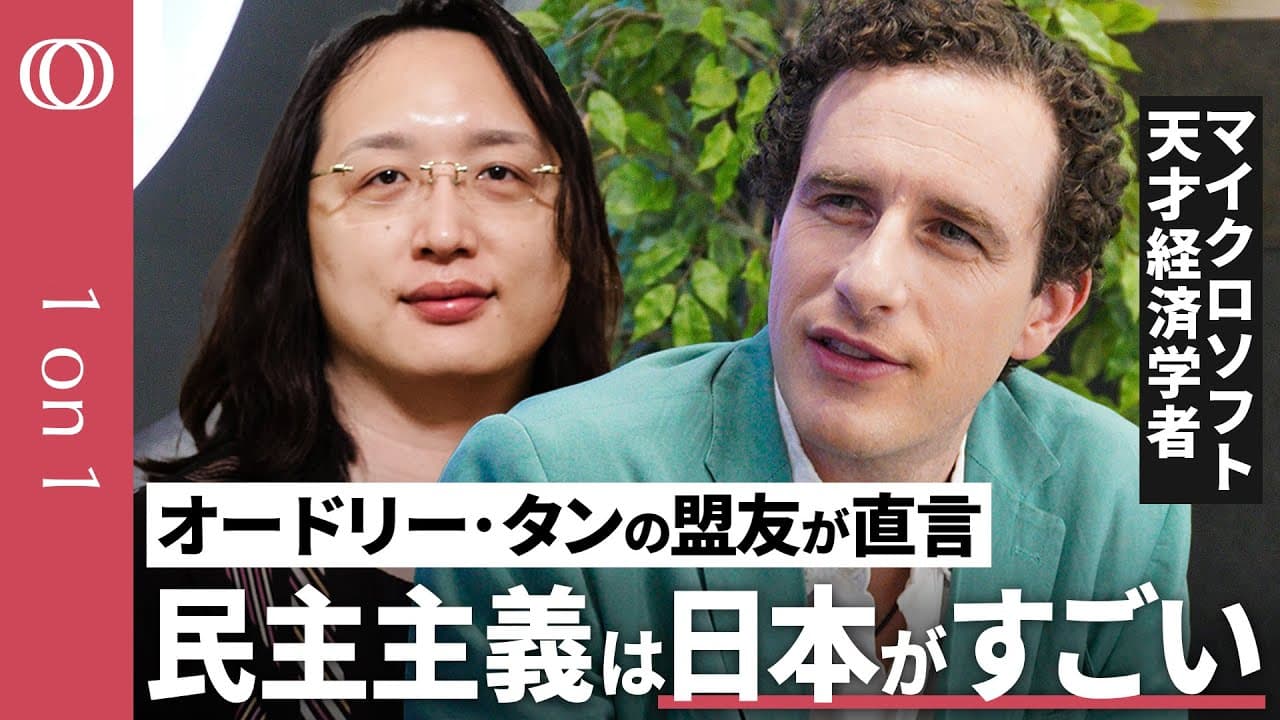
What Is Plurality? Microsoft Research Economist Glen Weyl on Audrey Tang, Democracy, and CROSSDIG 1on1
TL;DR
Plurality is a vision of democracy in which technology helps millions of people participate, while communities govern the networks they use. Glen Weyl argues that diversity can fuel progress instead of conflict, one-person-one-vote is a primitive decision method, and Japan and Taiwan could pioneer evolving democratic models. Read on for his examples involving Audrey Tang, Takahiro Anno, and digital democracy.
Transcript
we can innovate on democracy at least as much as we innovate on our computers or our phones you also mentioned about the one person one vote system do you think we need to change that system one person one vote is a very primitive way maybe the people with more people could kill the other people i hope that there will be countries like Japan and Ta... Read More
Key Insights
- Plurality is the idea that technology and democracy, often seen as in tension, can be two sides of the same coin. Weyl argues real democracy needs technology because you cannot converse with millions of people in person, but technology can make something like that possible.
- Plurality differs from diversity: diversity is a fact about the world, but plurality is what we make of it. Like oil that existed before engines harnessed it, plurality builds engines that turn the fire of conflict into the fuel of progress.
- One person, one vote is described as a very primitive way of deciding, because a larger group could simply overpower a smaller one. Weyl hopes countries like Japan and Taiwan will start questioning holding the same kind of voting for every election.
- Weyl rejects both optimism and pessimism, saying both leave no room for hope. He believes in agency, that people steer toward utopia or dystopia, and he believes in selling hope during this moment of tremendous disruption.
- Taiwan is uniquely positioned because it has long lived in a state of ambiguity about whether it is a country, jurisdiction, or China. It is also the most technologically intensive country, exporting mostly digital technology, making technology and democracy core to its identity.
- The plurality symbol shows distinct things that overlap, capturing the concept better than the word does. It represents China and Taiwan, democracy and technology, existing simultaneously rather than as black-or-white, zero-or-one choices.
- Democracy must constantly evolve because technology makes people interdependent in new ways. Weyl cites John Dewey's view that unless the newly interdependent people govern those technologies, democracy dies, requiring a dynamic vision that keeps up with technological challenges.
- Takahiro Anno demonstrated plurality in politics by building an open-source platform one month before the Tokyo election, using an AI avatar to explain positions and help citizens contribute views or build consensus, becoming the most respected platform despite him not winning.
Install to Summarize YouTube Videos and Get Transcripts
Explore YouTube Video Summarizer or Get YouTube Transcript Extractor
Questions & Answers
Q: What is plurality according to Glen Weyl?
Plurality means treating technology and democracy as mutually reinforcing rather than conflicting. Technology can support conversations among millions of people, while the people within technological networks can help govern them and provide input.
Q: How is plurality different from diversity?
Diversity is a fact about the world, while plurality is what people make of that diversity. Weyl compares plurality to building an engine that turns the potential fire of conflict into fuel for progress.
Q: Why does Glen Weyl criticize one person, one vote?
Weyl calls one person, one vote a very primitive way of deciding because a larger group can overpower a smaller group. He hopes Japan and Taiwan will explore alternatives instead of using the same voting method for every election.
Q: How can technology strengthen democracy?
Technology can make large-scale conversation possible when millions of people cannot meet in person. Weyl also says networks work better when their participants govern them and contribute input.
Q: Why does Glen Weyl have hope for democracy?
Weyl rejects both optimism and pessimism because he believes people have agency to steer events. He sees the current disruption, as old institutions fall away, as an opportunity for citizens assemblies, future design councils, and digital democracy.
Q: Why could Japan help reinvent democracy?
Weyl says Japan inherited a constitution from the United States and a form of democracy from the West, but promising democratic experiments are now emerging within Japan. He believes Japan has an opportunity to lead by developing a vision suited to the technological age.
Q: What makes Taiwan important to plurality?
Weyl says Taiwan has long lived with ambiguity about whether it is a jurisdiction, a country, or China. Its intensive digital technology and democratic identity create an opportunity to treat uncertainty as a source of strength.
Q: Who is Audrey Tang, and how is she connected to Glen Weyl?
Audrey Tang is Taiwan's digital minister and the principal co-author of Weyl's book, PLURALITY. Weyl says they first met in 2019 in Germany and describes Tang as brilliant, spiritual, adaptive, and deeply influential on his life.
Summary & Key Takeaways
-
Definition: Plurality treats technology and democracy as two sides of the same coin rather than opposing forces.
-
Definition: Diversity exists in the world, while plurality describes how people harness it for progress instead of conflict.
-
Number: One person, one vote is described by Weyl as a primitive decision method that can let a larger group overpower a smaller group.
-
Tool: Technology can enable democratic conversations among millions of people who cannot meet in person.
-
Compare: Democratic networks need participant governance and input, just as democracy needs technology for large-scale participation.
-
Who: Glen Weyl is a Microsoft Research economist and co-author of PLURALITY with Taiwan's digital minister Audrey Tang.
-
When: Weyl first met Audrey Tang in 2019 in Germany, where both have roots.
-
Who: Japan and Taiwan could pioneer democratic models that evolve with technological change.
-
Tool: Citizens assemblies, future design councils, and digital democracy offer positive visions during institutional disruption.
-
Who: Takahiro Anno demonstrated plurality through an open-source political platform and an AI avatar that invited citizen contributions.
Read in Other Languages (beta)
Share This Summary 📚
Summarize YouTube Videos and Get Video Transcripts with 1-Click
Try YouTube Summary with ChatGPT & Claude or YouTube Transcript Generator
Explore More Summaries from TBS CROSS DIG with Bloomberg 📚
Summarize YouTube Videos and Get Video Transcripts with 1-Click
Try YouTube Summary with ChatGPT & Claude or YouTube Transcript Generator