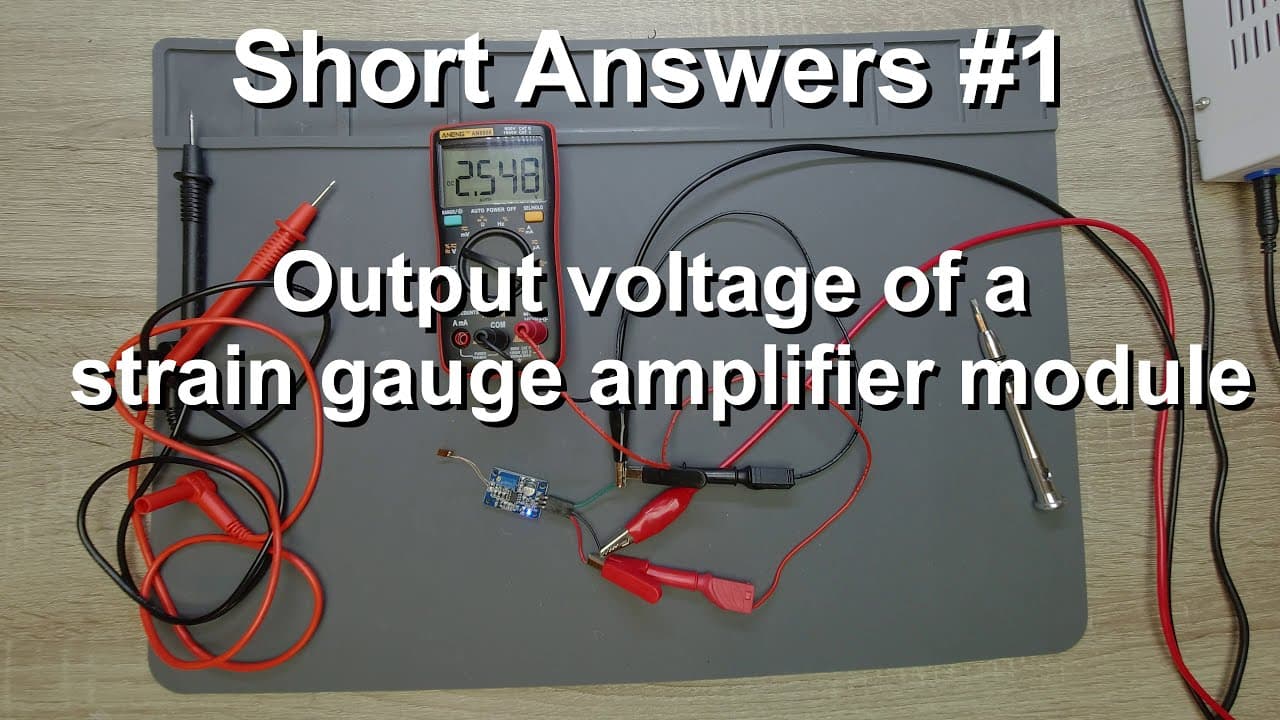
[Short Answers #1] Output voltage of a strain gauge amplifier module
TL;DR
The strain gauge amplifier should output half the input voltage, varying with strain direction.
Transcript
welcome everyone in this video i'm going to try a new format of videos which i will call short answers so the point of this video will be to give you a short answer and if i get some question in the comment sections which i can easily answer and i can easily demonstrate the answer then i will do that and i will upload a small uh short video about i... Read More
Key Insights
- 🫵 The video showcases a new format that aims to provide concise answers to viewer questions.
- ⚡ Bending a strain gauge in different directions causes measurable changes in the output voltage, demonstrating sensitivity and functionality.
- 😥 A potentiometer allows fine-tuning of the zero point output, which is crucial for accurate measurements.
- 🛟 The default output level serves as a baseline for monitoring changes, facilitating easy detection of stress variations.
- 🏂 Potential issues with circuit boards can stem from faulty connections or component malfunctions, emphasizing the importance of thorough testing.
- 🛀 The visual demonstration reinforces theoretical understanding by showing real-time voltage changes corresponding to physical manipulation of the strain gauge.
- 🫵 Viewers are encouraged to explore more content for additional troubleshooting and electronic solutions.
Install to Summarize YouTube Videos and Get Transcripts
Explore YouTube Video Summarizer or Get YouTube Transcript Extractor
Questions & Answers
Q: What is the purpose of the strain gauge amplifier unit?
The strain gauge amplifier unit is designed to measure small changes in electrical resistance, which correspond to physical strain or deformation when connected to a strain gauge. By converting this small change in resistance into a measurable voltage, the amplifier enables accurate detection and analysis of forces acting on the gauge, often used in various engineering applications.
Q: How is the output voltage affected by bending the strain gauge?
The output voltage of the strain gauge amplifier varies based on the direction the strain gauge is bent. When bent positively, the voltage increases from 2.5 volts towards 5 volts, while bending it negatively pulls the output down towards zero volts. This relationship allows for real-time monitoring of strain and stress on the gauge.
Q: What troubleshooting steps can be taken if the strain gauge does not provide the expected output?
If the strain gauge isn’t producing the expected output, a few troubleshooting steps include checking all connections to ensure they’re secure, validating the power supply to the amplifier, adjusting the onboard potentiometer to set the zero point correctly, and testing the strain gauge for any physical damage or electrical faults.
Q: Why is the initial output voltage set to half of the supply voltage?
The default output voltage is set to half of the supply voltage because this provides a balanced reference point for measuring variations due to strain. For instance, if the supply voltage is 5 volts, a 2.5-volt output signifies no strain, allowing easy identification of positive or negative changes as the gauge is deformed.
Summary & Key Takeaways
-
The video introduces a new format called "short answers," where the creator addresses common questions in a concise manner.
-
The specific question discussed involves issues with a strain gauge amplifier output, explaining that its default output should be half the input voltage.
-
Demonstrations show how bending the strain gauge affects the output voltage, confirming proper functionality while suggesting potential faults in the viewer's circuit setup.
Read in Other Languages (beta)
Share This Summary 📚
Summarize YouTube Videos and Get Video Transcripts with 1-Click
Try YouTube Summary with ChatGPT & Claude or YouTube Transcript Generator
Explore More Summaries from Curious Scientist 📚

![Building a Peltier cooler-based cooling box - First iteration, improvements [Part 2/6] thumbnail](/_next/image?url=https%3A%2F%2Fi.ytimg.com%2Fvi%2F0YlNw0EGnzI%2Fhqdefault.jpg&w=750&q=75)
![Building a coil winder [Part 6] - A few improvements thumbnail](/_next/image?url=https%3A%2F%2Fi.ytimg.com%2Fvi%2F3eyxG_g2iUA%2Fhqdefault.jpg&w=750&q=75)

Summarize YouTube Videos and Get Video Transcripts with 1-Click
Try YouTube Summary with ChatGPT & Claude or YouTube Transcript Generator