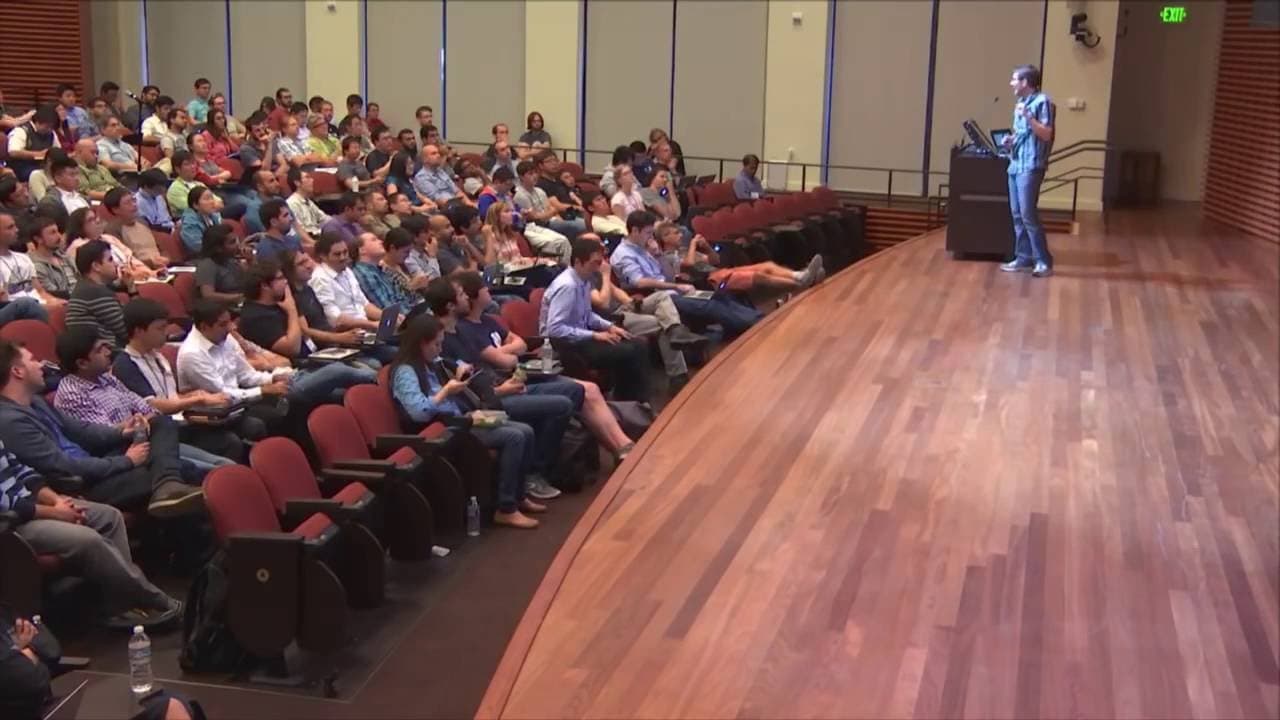
Deep Learning for Speech Recognition (Adam Coates, Baidu)
TL;DR
Deep learning enhances speech recognition by enabling accurate audio transcription, leading to applications like hands-free interfaces and faster voice texting. Recent systems can transcribe voice three times faster than traditional methods, significantly improving efficiency and accessibility.
Transcript
so I want to tell you guys about speech recognition and deep learning I think deep learning has been playing an increasingly large role in speech recognition and one of the things I think is most exciting about this field is that speech recognitions at a place right now where it's becoming good enough to enable really exciting applications that end... Read More
Key Insights
- 😯 Deep learning has significantly improved the accuracy of speech recognition, making it viable for a wide range of applications.
- 🥅 Transcribing audio into words is a basic goal of artificial intelligence, and deep learning has made significant progress in achieving this goal.
- 😯 Speech recognition systems powered by deep learning can be faster and more efficient, leading to improved user experience.
- 😯 Language models and other techniques can further enhance the accuracy and contextual understanding of deep learning-powered speech recognition systems.
- ⚖️ The availability of large-scale data and computing power is essential for scaling up deep learning-based speech recognition models.
Install to Summarize YouTube Videos and Get Transcripts
Explore YouTube Video Summarizer or Get YouTube Transcript Extractor
Questions & Answers
Q: What is the role of deep learning in speech recognition?
Deep learning has revolutionized speech recognition, allowing for more accurate transcription and enabling exciting applications such as hands-free interfaces and faster voice texting.
Q: How does deep learning improve speech recognition accuracy?
Deep learning algorithms have replaced traditional speech recognition components, such as acoustic models, improving accuracy by 10-20%.
Q: Why is speech recognition important?
Speech recognition allows for the transcription of audio into words, making content accessible and enabling applications like captioning videos and hands-free interfaces.
Q: What are some potential applications of deep learning-powered speech recognition?
Deep learning-powered speech recognition can be used to create hands-free interfaces in cars, improve mobile and home device efficiency, and enable faster voice texting.
Summary
In this video, the speaker discusses the use of deep learning in speech recognition and highlights some of the exciting applications enabled by this technology. The traditional speech recognition pipeline is explained, and the limitations and challenges associated with it are discussed. The speaker then introduces the concept of a complete speech engine powered by deep learning and explains the different components involved. The process of training this engine using connectionist temporal classification (CTC) is also explained. Finally, the speaker discusses additional techniques such as sorting by length and batch normalization that can improve the performance of deep learning models in speech recognition.
Questions & Answers
Q: What are some of the exciting applications enabled by deep learning in speech recognition?
Deep learning has made speech recognition good enough to enable a variety of exciting applications. These include captioning video content to make it accessible to all users, creating hands-free interfaces in cars for safer technology use, and improving the efficiency and enjoyment of mobile and home devices. Texting with voice recognition systems has also been shown to be three times faster than typing, showcasing the potential speed and convenience that deep learning brings to speech applications.
Q: Can you explain the traditional speech recognition pipeline?
The traditional speech recognition pipeline consists of several components. It starts with the raw audio, which is then converted into a feature representation called a spectrogram or MFCC. This representation is fed into an acoustic model, which learns the relationship between the features and the words being spoken. A language model is also used to capture knowledge about word spellings and combinations. Finally, a decoder combines the contributions from the acoustic and language models to find the most likely word transcription given the audio.
Q: How does deep learning impact the traditional speech recognition pipeline?
Deep learning has had a significant impact on the traditional speech recognition pipeline by replacing the acoustic model component with a deep learning algorithm. This has led to significant improvements in accuracy, with relative improvements of 10-20% compared to previous methods. By using deep learning for the acoustic model, researchers have been able to push the performance of speech recognition systems to new levels that were not possible with traditional methods alone.
Q: How does CTC (Connectionist Temporal Classification) help in training the speech engine?
CTC is a technique used to train a speech engine by mapping the audio input to a transcription. It deals with the challenge of variable-length input and output by defining a mapping function that removes duplicate characters and blank symbols from the output. The CTC loss function allows for the efficient computation of the log probability of a transcription given the audio. This loss function can be computed using off-the-shelf software, which also provides the gradient with respect to the output neurons of the neural network.
Q: How can the deep learning model be trained more effectively?
There are a few strategies that can help improve the training of deep learning models in speech recognition. One strategy is to use curriculum learning, where shorter utterances are trained first before progressing to longer ones. This helps avoid numerical issues and improves the optimization process. Another technique is batch normalization, which can be applied to recurrent and deep neural networks to improve their training efficiency. These strategies can help achieve better results with challenging datasets that contain noise or long utterances.
Q: Is there a simple way to decode the outputs of the neural network into transcriptions?
One simple decoding approach is called max decoding, where the most likely sequence of symbols is chosen from the output of the neural network. However, this approach is approximate and may not always yield the correct transcription. It can be used as a diagnostic method to check if the network is capturing any signal. There are more sophisticated decoding approaches available, such as beam search or attention models, which are not covered in this video.
Q: What datasets are commonly used for training speech recognition models in deep learning?
The TIMIT dataset is a popular choice for training speech recognition models. It consists of people reading The Wall Street Journal and is widely used by researchers. Another dataset, LibriSpeech, is a free alternative that contains audio from Creative Commons audiobooks. Both datasets are commonly used to train deep learning models for speech recognition.
Q: What are some additional techniques that can improve the performance of deep learning models in speech recognition?
Two additional techniques that can improve the performance of deep learning models in speech recognition are sorting by length and batch normalization. Sorting the utterances by length during training helps prevent numerical issues and makes optimization more efficient, especially in the early stages. Batch normalization, on the other hand, can be applied to recurrent and deep neural networks to improve training stability and convergence. These techniques can be particularly helpful when dealing with challenging datasets or very deep models.
Q: How can we put a speech engine powered by deep learning into production?
Once a speech engine powered by deep learning has been trained, it can be deployed in a production environment by using cloud servers. There are various ways to achieve this, such as creating an API that allows developers to send audio inputs and receive transcriptions in return. The scalability of the system can be improved by leveraging technologies like auto-scaling, load balancing, and distributed computing. Production deployment requires additional considerations beyond the scope of this video, but it is an important step towards making the system available to real users.
Q: What is the objective of the tutorial mentioned in the video?
The objective of the tutorial mentioned in the video is to provide an understanding of the high-level ideas behind speech recognition using deep learning. The tutorial aims to give participants enough knowledge to build a basic speech engine and to understand the potential for further development and scale. The goal is to empower participants to start working on speech recognition projects and provide them with the necessary resources to expand their knowledge in this field.
Q: What software packages are available for implementing CTC in deep learning frameworks?
There are several software packages available for implementing CTC in deep learning frameworks. Some examples include warp CTC from Baidu, which is specifically designed for GPU implementation. Stanford and other research groups also have CTC implementations, and frameworks like TensorFlow provide built-in support for CTC loss. These implementations allow for efficient computation of the CTC loss function and gradients, making it easier to train speech recognition models using CTC.
Summary & Key Takeaways
-
Deep learning has played a significant role in improving speech recognition, making it accurate enough for various applications.
-
Speech recognition systems powered by deep learning can accurately transcribe audio into words, enabling accessibility and convenience.
-
Voice recognition systems powered by deep learning are three times faster than traditional methods, making voice texting more efficient.
Read in Other Languages (beta)
Share This Summary 📚
Summarize YouTube Videos and Get Video Transcripts with 1-Click
Try YouTube Summary with ChatGPT & Claude or YouTube Transcript Generator
Explore More Summaries from Lex Fridman 📚


Summarize YouTube Videos and Get Video Transcripts with 1-Click
Try YouTube Summary with ChatGPT & Claude or YouTube Transcript Generator