What will the next 3 years look like for AI?
TL;DR
Compute growth continues in the next three years, driven by analog and specialized AI silicon that keeps Moore’s law on track. The conversation explores architectural variants, reinforcement learning, and the possibility of self improving systems, while highlighting industries likely to digitize first and the people shaping those bets.
Transcript
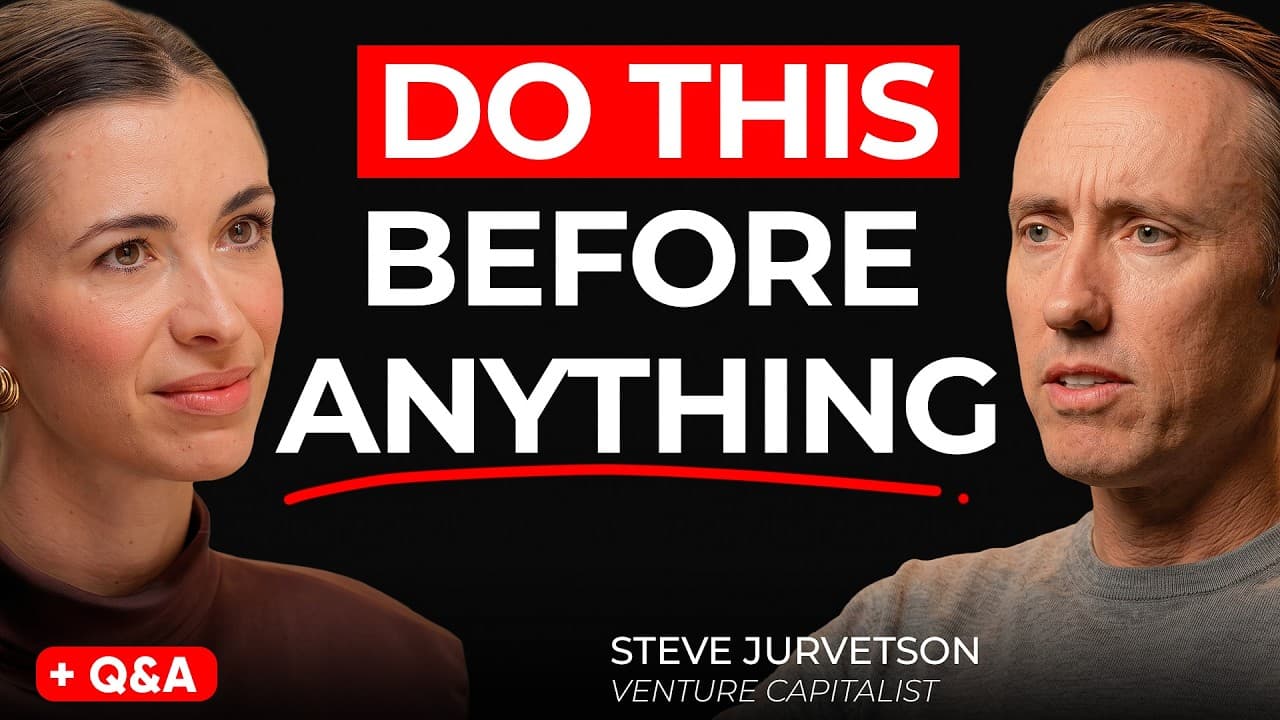
What will the next three years look like? >> I have this gut feeling that it'll be something architecturally variant. >> This is Steve Jurvetson, an early investor in SpaceX when almost nobody believed in private space. He backed Tesla before electric cars went mainstream. For over 30 years, he's been betting on the future, and history keeps provin... Read More
Key Insights
- Compute capacity and memory drive customer value, not transistor counts.
- The next three years will see continued exponential growth in compute, especially in analog and specialized AI silicon.
- Architectural variants may subsume current models, possibly enabling more efficient, agentic AI systems.
- Discussions explore reinforcement learning as a possible driver for long term AI progress, including self improved systems.
- The industries most likely to change first are energy, agriculture, construction, and healthcare due to low digitization.
- There is debate about whether true superintelligence could emerge soon and how it would manifest.
- Investors look for co founders and leadership traits when backing deeply technical ventures, especially with Elon Musk’s ecosystem in mind.
Install to Summarize YouTube Videos and Get Transcripts
Explore YouTube Video Summarizer or Get YouTube Transcript Extractor
Questions & Answers
Q: What is Steve Jurvetson’s view on the next three years in AI and tech?
Steve argues that compute capacity and memory will continue to improve and that this exponential growth will carry the AI juggernaut forward for the next three years. He highlights analog and custom AI silicon as key enablers, ensuring the trend remains robust even as traditional transistors evolve. He also notes that this acceleration will ripple through many industries and enable new business models.
Q: What industries does Steve think will be most affected in the near term?
Steve points to three giant industries poised to wake up due to AI and compute advances: energy, agriculture, and construction. He asserts these sectors are enormous and currently among the least digitized, making them ripe for disruption as information centric, compute driven approaches are introduced.
Q: What role does reinforcement learning play in the future of AI according to the interview?
The discussion suggests reinforcement learning could drive a breakthrough era alongside or within the next generation of neural architectures. Steve mentions a new generation of neural labs focused on reinforcement learning and contemplates whether a single continuous learning algorithm could bootstrap intelligence in a more autonomous, agent like fashion within the coming years.
Q: Is there a possibility of true superintelligence in the next year, according to the conversation?
There is debate about the near term emergence of superintelligence. Jack Clark is cited with a 30 percent chance of such a development next year, but the speakers acknowledge the uncertainty and emphasize that current progress still largely relies on human directed goals and verification loops rather than fully autonomous self directed systems.
Q: What questions are raised about how AI might change job roles and human purpose?
The dialogue raises questions about what remains for humans when machines can automate many tasks. It explores the idea of long term purpose and the evolving role of people in an AI driven economy, including how to adapt, re skill, and find meaningful work as AI capabilities mature and take on more responsibilities.
Q: What is the significance of Moore’s Law in the discussion?
The significance lies in the assertion that compute capacity growth continues to power AI progress. The conversation mentions Kurzweil and Moore’s Law as a framework to understand how decreasing costs and increasing performance enable ongoing innovation in AI, robotics, and related fields, affecting startups and disruption across industries.
Q: What is meant by an architecturally variant future in AI?
An architecturally variant future refers to AI systems evolving beyond current transformer based models toward new architectures or mixtures of models that could perform better or more efficiently. This concept includes the possibility of diffusion like approaches or multi agent inspired systems that redefine how AI sees and learns from the world.
Q: How do co founders and leadership play into the investment landscape discussed?
Leadership and prior collaboration history are highlighted as critical when evaluating investments in AI ventures. The emphasis is on finding co founders, working with trusted teams, and observing leaders in action to understand how they can execute complex, long term AI driven projects, especially in the Elon Musk ecosystem.
Summary & Key Takeaways
-
Steve argues compute is the core driver for three years of AI driven change, with analog and specialized silicon carrying Moore’s law forward.
-
Industries like energy, agriculture, and construction are identified as the least digitized and thus most reshaped by technology in the near term.
-
The discussion covers governance and human alignment questions around self improving AI and the potential for a new generation of architectures beyond traditional transformers.
Read in Other Languages (beta)
Share This Summary 📚
Summarize YouTube Videos and Get Video Transcripts with 1-Click
Try YouTube Summary with ChatGPT & Claude or YouTube Transcript Generator
Explore More Summaries from Silicon Valley Girl 📚



Summarize YouTube Videos and Get Video Transcripts with 1-Click
Try YouTube Summary with ChatGPT & Claude or YouTube Transcript Generator