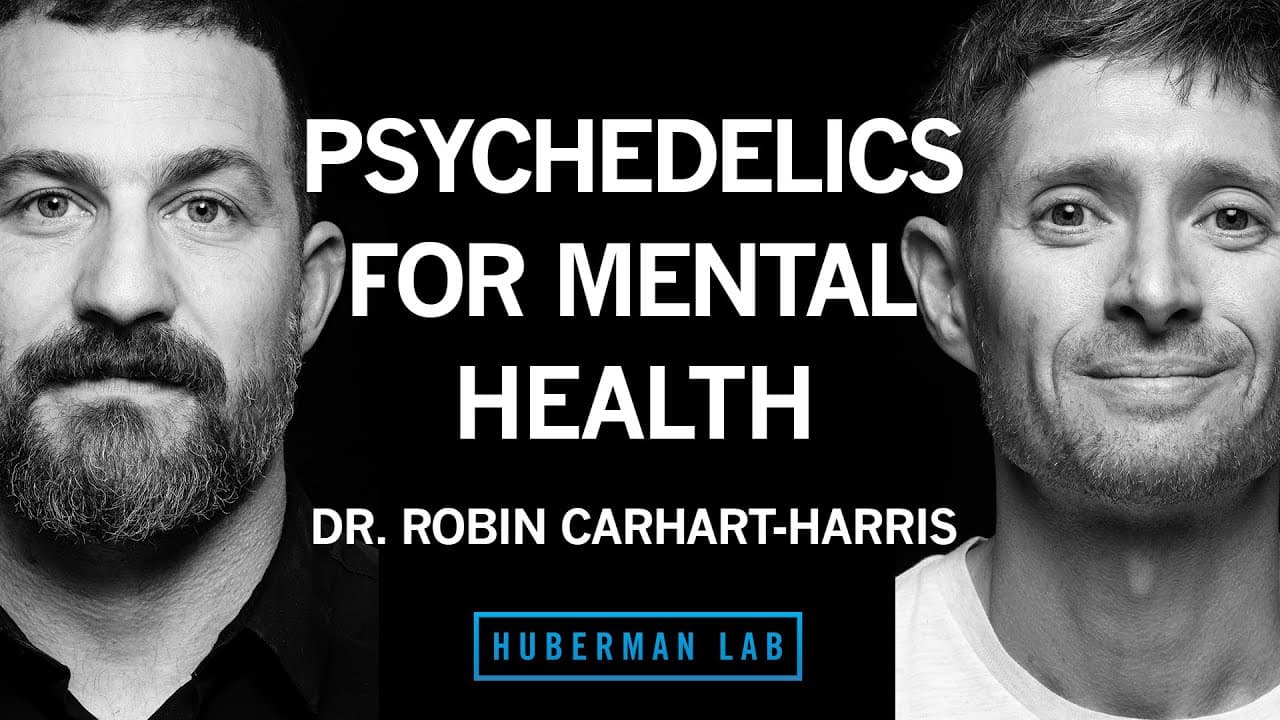
How Do Psychedelics Like Psilocybin Affect Mental Health?
TL;DR
Psychedelics such as psilocybin can significantly treat major depression by producing lasting changes in brain function. Clinical trials have shown that more than 67% of individuals experience relief from depression with appropriate dosages. The psychedelic experience, which often includes emotional release and new insights, plays a crucial role in these therapeutic outcomes.
Transcript
ANDREW HUBERMAN: Welcome to the Huberman Lab podcast, where we discuss science and science-based tools for everyday life. [MUSIC PLAYING] I'm Andrew Huberman, and I'm a professor of neurobiology and ophthalmology at Stanford School of Medicine. Today, my guest is Dr. Robin Carhart-Harris. Dr. Carhart-Harris is a distinguished professor of neurology... Read More
Key Insights
- 🫥 Psychedelics can reveal aspects of the mind that are not ordinarily visible, leading to new forms of learning and neural plasticity.
- ❓ The psychedelic experience, including hallucinations and emotional release, is considered an important component of psychedelic therapy.
- 🧠 Increased communication between brain regions and neuroplasticity changes may contribute to the therapeutic effects of psychedelics.
Install to Summarize YouTube Videos and Get Transcripts
Explore YouTube Video Summarizer or Get YouTube Transcript Extractor
Questions & Answers
Q: What is the significance of the term "psychedelic" and how did it originate?
The term "psychedelic" was coined by Humphry Osmond in the 1950s to refer to drugs that reveal aspects of the human mind or soul that are not ordinarily visible. It is derived from two ancient Greek words: "psyche," meaning mind or soul, and "deloun," meaning to make clear or reveal.
Q: How do psychedelics work in the brain?
Psychedelics, such as psilocybin, activate the serotonin 2A receptor in the brain, leading to increased communication between brain regions that are not usually connected. This can result in altered perception, hallucinations, and changes in mood and cognition.
Q: What is the role of the psychedelic experience in psychedelic therapy?
The psychedelic experience, which includes a range of hallucinations, emotions, and insights, is considered an important component of psychedelic therapy. The subjective experience is correlated with therapeutic outcomes, and some believe it plays a role in unlocking unconscious material and promoting emotional release.
Q: Can the therapeutic effects of psychedelics be achieved without the psychedelic experience?
While there is ongoing research into developing drugs that have therapeutic effects without producing hallucinations, the current evidence suggests that the subjective experience is closely tied to the therapeutic outcomes of psychedelic therapy. Attempts to separate the two may not be as effective in treating mental health conditions.
Key Insights:
- Psychedelics can reveal aspects of the mind that are not ordinarily visible, leading to new forms of learning and neural plasticity.
- The psychedelic experience, including hallucinations and emotional release, is considered an important component of psychedelic therapy.
- Increased communication between brain regions and neuroplasticity changes may contribute to the therapeutic effects of psychedelics.
- Attempting to separate the therapeutic effects from the psychedelic experience may not be as effective in treating mental health conditions.
Summary & Key Takeaways
-
Psychedelics, like psilocybin (found in magic mushrooms), can lead to new forms of learning and neural circuitry changes in the brain.
-
Clinical trials have shown that psilocybin can alleviate major depression in over 67% of individuals who take the drug.
-
Psychedelics are being studied for their potential to expand different aspects of the human mind, including creativity and intelligence.
Read in Other Languages (beta)
Share This Summary 📚
Summarize YouTube Videos and Get Video Transcripts with 1-Click
Try YouTube Summary with ChatGPT & Claude or YouTube Transcript Generator
Explore More Summaries from Andrew Huberman 📚
Summarize YouTube Videos and Get Video Transcripts with 1-Click
Try YouTube Summary with ChatGPT & Claude or YouTube Transcript Generator