Which Free AI Courses Can Help You Get Hired?
TL;DR
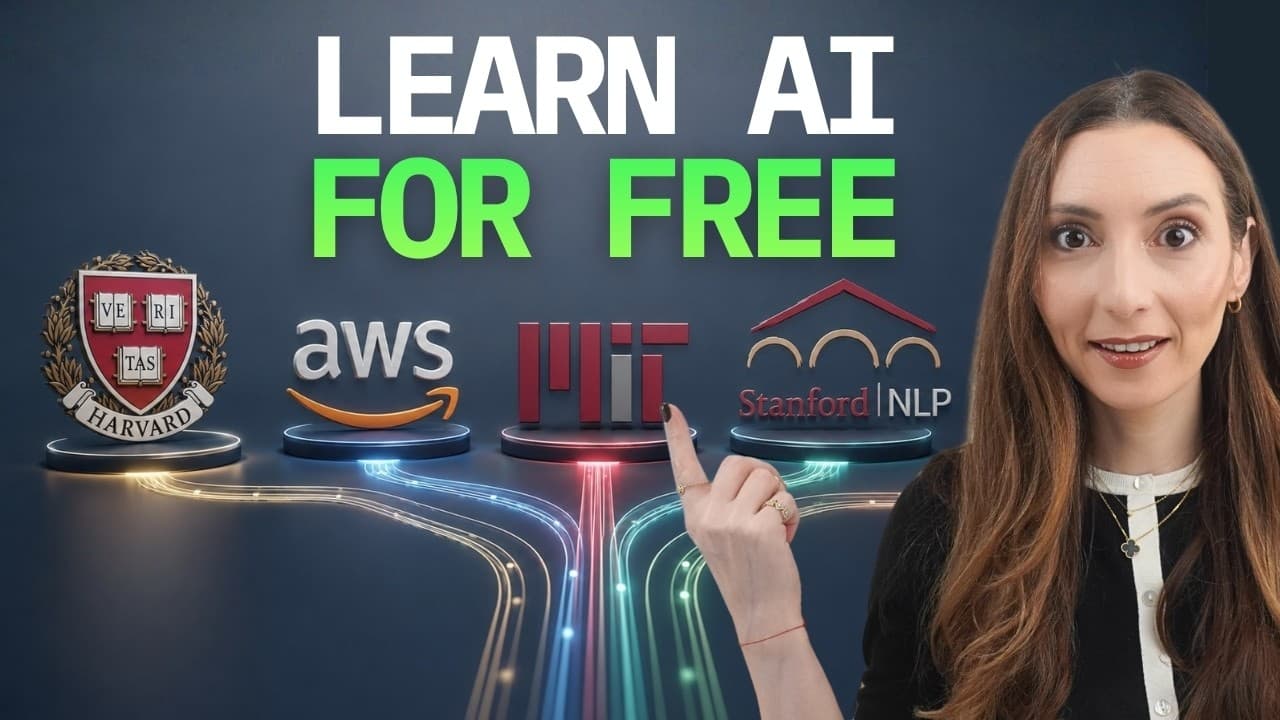
Start with Databricks Generative AI Fundamentals for a quick foundation, then study AWS Machine Learning Foundations for implementation skills or MIT OpenCourseWare Introduction to Deep Learning for greater technical depth. Certifications are most useful when paired with proof that you can automate workflows, improve decisions, create content, deploy systems, or produce other measurable business outcomes.
Transcript
The AI job market is exploding, but applying without skills is like bringing a spoon to a knife fight. And look, do you need certifications to be good? Not necessarily. But if you're trying to get hired, win clients, or pitch yourself as the AI person, a reputable certification is proof that you're not just messing around with Chad GBT at 2 a.m. So... Read More
Key Insights
- AI certifications are credible signals rather than substitutes for ability. Their career value increases when candidates can show how they use AI to solve problems, automate workflows, produce faster results, or deliver business outcomes during interviews, client calls, and other professional opportunities.
- Business outcomes are the central measure of valuable AI work. The transcript identifies repetitive-work automation, faster decision-making, lead and content generation, insight extraction, and accelerated coding as examples of capabilities that can make an employee, freelancer, founder, or consultant more useful.
- Databricks Generative AI Fundamentals is a beginner-friendly foundation course covering large language models, transformer basics, prompt engineering, ethical considerations, and real-world cases. Its association with an enterprise data and AI infrastructure company is presented as a stronger professional signal than an unidentified internet course.
- The Databricks course is designed to take approximately four to five hours. Its short format makes it possible to complete in a focused weekend session while gaining enough vocabulary and conceptual structure to discuss generative AI more professionally and recognize potential business applications.
- Generative AI skills can support concrete service offers. Examples in the transcript include internal assistants for procedures and customer support, workflows that summarize calls and update customer relationship systems, and content engines that produce posts using a company's established brand voice.
- AWS Machine Learning Foundations is an introduction to machine learning through the AWS ecosystem. It covers supervised and unsupervised learning, data processing and preprocessing, evaluation concepts, and the role of services such as SageMaker within practical machine learning workflows.
- AWS knowledge is valuable because it connects AI demonstrations to operational deployment. The course is positioned for junior machine learning or data roles, technical product work, analytics, entrepreneurship, and services involving dashboards, forecasting, customer churn prediction, lead scoring, or hosted automation pipelines.
- MIT OpenCourseWare Introduction to Deep Learning is a rigorous technical option rather than a quick credential. Its flexible workload is described as roughly 40 hours, with coverage of neural networks, convolutional neural networks for vision, recurrent neural networks, sequence modeling, and modern AI mechanics.
- More videos from this channel:
- More from this channel: AI Founders
Install to Summarize YouTube Videos and Get Transcripts
Explore YouTube Video Summarizer or Get YouTube Transcript Extractor
Questions & Answers
Q: How can free AI certifications help with getting hired?
Free AI certifications can give employers or clients a recognizable signal that a candidate has studied relevant concepts instead of merely claiming familiarity with prompting. Their strongest value comes when the credential supports practical evidence, such as an automated workflow, an AI assistant, a content system, or another project that demonstrates faster work and useful business outcomes.
Q: What does Databricks Generative AI Fundamentals cover?
Databricks Generative AI Fundamentals introduces large language models at a high level, transformer basics, prompt engineering fundamentals, ethical considerations, and real-world case studies. It is presented as a beginner-friendly option for people in marketing, operations, sales, content, or product who want a structured foundation for applying generative AI to practical work.
Q: How long does Databricks Generative AI Fundamentals take?
Databricks Generative AI Fundamentals is described as requiring approximately four to five hours. That makes it suitable for a focused weekend session rather than an extended academic program. The intended result is a basic professional vocabulary, a clearer understanding of generative AI, and an improved ability to identify useful large language model applications within businesses.
Q: How can generative AI fundamentals be monetized?
Generative AI fundamentals can support services tied to specific operational outcomes. The transcript suggests building internal assistants for standard operating procedures and customer support, creating workflows that summarize calls and extract action items, automatically updating customer relationship systems, or developing content engines that generate posts while following a client's established brand voice.
Q: What does AWS Machine Learning Foundations teach?
AWS Machine Learning Foundations covers supervised and unsupervised learning, data processing and preprocessing, evaluation concepts, and how AWS services such as SageMaker fit into machine learning workflows. It is intended to move learners beyond experimenting with standalone tools toward understanding how AI capabilities can be incorporated into real systems and existing business technology stacks.
Q: Who should take AWS Machine Learning Foundations?
AWS Machine Learning Foundations is positioned for people pursuing junior machine learning or data roles, technical product positions, analytics work, or entrepreneurship involving dependable AI deployment. It can also help business owners understand how AI might connect with their existing systems. The course is self-paced and is described as taking about 20 hours, depending on depth.
Q: What business services can AWS machine learning skills support?
AWS machine learning skills can support services such as AI-powered dashboards, business forecasting, customer churn prediction, lead-scoring models, and automation pipelines hosted on operational infrastructure. The central advantage described in the transcript is the ability to implement AI inside a business reliably, moving from an interesting demonstration toward a system connected to real organizational needs and budgets.
Q: What is covered in MIT's Introduction to Deep Learning?
MIT OpenCourseWare Introduction to Deep Learning examines neural networks, convolutional neural networks for computer vision, recurrent neural networks, sequence modeling, and the underlying mechanics of modern AI systems. It is described as a university-level, technically rigorous option for learners who want to understand how the tools work, pursue more technical roles, or build differentiated AI products.
Summary & Key Takeaways
-
AI capability is becoming relevant across technical and nontechnical jobs because businesses want people who can automate repetitive work, accelerate decisions, and produce useful outputs. A reputable certification can provide a credible signal, but its practical value comes from combining that credential with demonstrable skills, completed projects, and business-focused results.
-
Databricks Generative AI Fundamentals offers a beginner-friendly introduction to large language models, transformers, prompting, ethics, and business cases. The course reportedly takes four to five hours. It is positioned as an accessible starting point for professionals in marketing, operations, sales, content, or product who want to apply generative AI.
-
AWS Machine Learning Foundations connects machine learning concepts to deployable business systems, while MIT OpenCourseWare Introduction to Deep Learning provides greater theoretical depth. AWS covers learning methods, data preparation, evaluation, and services such as SageMaker. MIT examines neural networks, vision models, sequence modeling, and the mechanics underlying modern AI systems.
Read in Other Languages (beta)
Share This Summary 📚
Summarize YouTube Videos and Get Video Transcripts with 1-Click
Try YouTube Summary with ChatGPT & Claude or YouTube Transcript Generator
Explore More Summaries from AI Founders 📚





Summarize YouTube Videos and Get Video Transcripts with 1-Click
Try YouTube Summary with ChatGPT & Claude or YouTube Transcript Generator