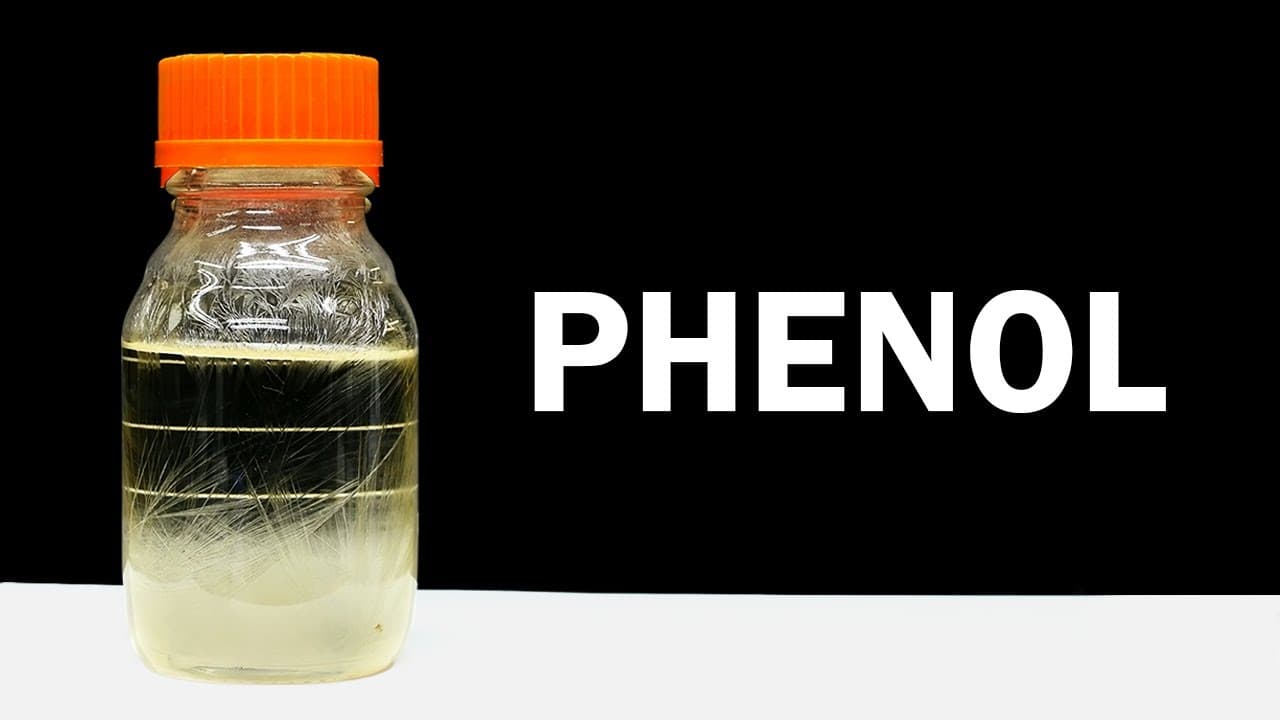
How to Clean Contaminated Phenol Using Distillation
TL;DR
Contaminated phenol can be effectively cleaned through distillation, which purifies it by removing oxidation products and polymers. Using vacuum distillation lowers the boiling point, preventing reactions with oxygen and yielding a clearer product. While some impurities may remain, the distillation process significantly improves the purity of the phenol.
Transcript
Phenol has a wide variety of uses and it's a precursor to many things like plastics or pharmaceuticals. Phenol is normally a white crystalline solid but it's susceptible to oxidation in air and old phenol tends to be a little bit discolored. When phenol is oxidized by oxygen in the air it tends to form para-benzoquinone which has a yellow... Read More
Key Insights
- 🥺 Phenol is susceptible to oxidation and polymerization, leading to discoloration and contamination.
- ❓ Distillation can effectively clean phenol and remove impurities, resulting in a purer product.
- 😥 Vacuum distillation is preferred for phenol purification as it lowers the boiling point and prevents reactions with oxygen.
- 🎚️ Phenol's contamination level can be reduced significantly through distillation, even if some impurities remain.
- 👨🔬 The mechanisms of phenol's reactions and purification are still not fully understood, requiring further research and discussion.
- 🈸 Distilled phenol can be used as a precursor for various applications, including the production of plastics and pharmaceuticals.
- 😒 The use of a fractionating column can further improve the separation and purity of phenol during distillation.
Install to Summarize YouTube Videos and Get Transcripts
Explore YouTube Video Summarizer or Get YouTube Transcript Extractor
Questions & Answers
Q: What causes phenol to become discolored and contaminated?
Phenol can turn yellow due to oxidation, forming para-benzoquinone. Polymerization reactions can also occur, resulting in the formation of a brown or black polymer.
Q: How is contaminated phenol cleaned?
Contaminated phenol can be cleaned through a distillation process. The impurities are separated and removed, resulting in a purer product.
Q: Why is vacuum distillation used for phenol purification?
Vacuum distillation lowers the boiling point of phenol and prevents reactions with oxygen, resulting in a cleaner and more stable product.
Q: Is it possible to distill phenol without a vacuum?
While distillation without a vacuum might be possible, the purity and quality of the resulting phenol are unknown as vacuum distillation is the commonly used method.
Summary & Key Takeaways
-
Phenol is a versatile compound used in plastics and pharmaceuticals but is prone to oxidation and polymerization reactions, leading to discoloration.
-
The contaminated phenol can be cleaned through a distillation process, which reduces impurities and yields a purer product.
-
Distillation can be done under vacuum to lower the boiling point of phenol and prevent reactions with oxygen, resulting in a cleaner and more stable product.
Read in Other Languages (beta)
Share This Summary 📚
Summarize YouTube Videos and Get Video Transcripts with 1-Click
Try YouTube Summary with ChatGPT & Claude or YouTube Transcript Generator
Explore More Summaries from NileRed 📚
Summarize YouTube Videos and Get Video Transcripts with 1-Click
Try YouTube Summary with ChatGPT & Claude or YouTube Transcript Generator