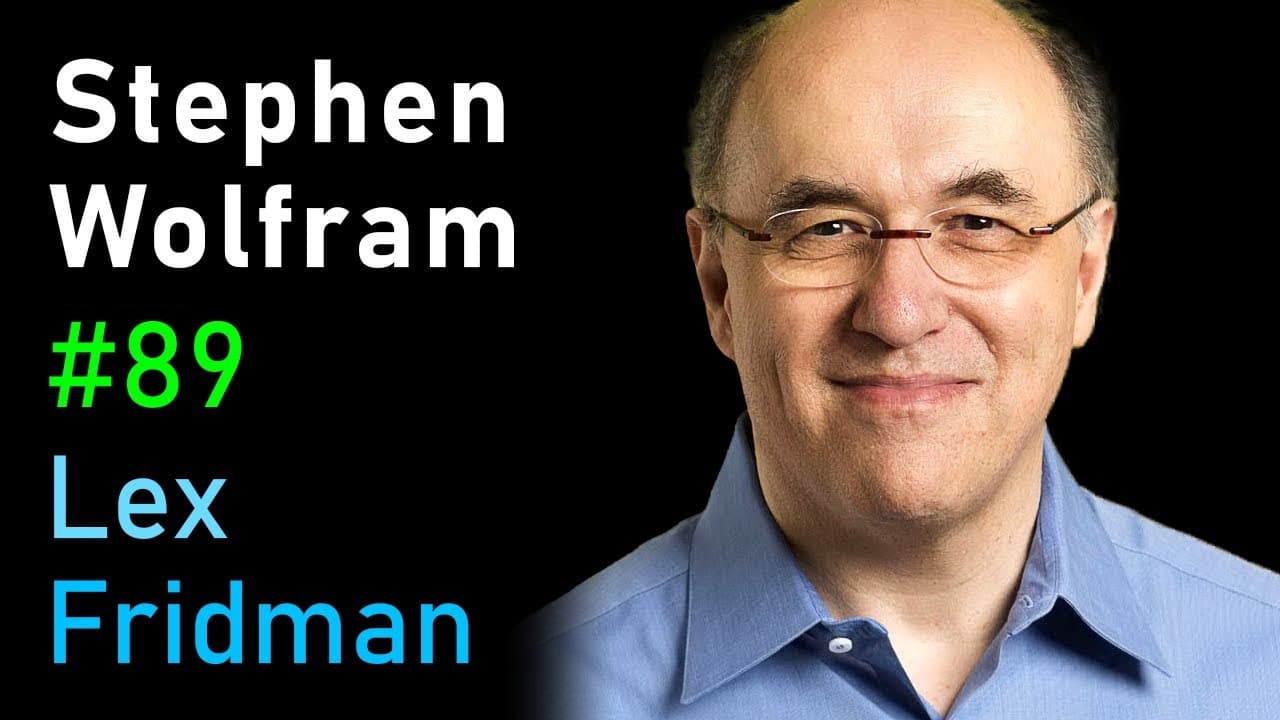
Stephen Wolfram: Cellular Automata, Computation, and Physics | Lex Fridman Podcast #89
TL;DR
Stephen Wolfram connects cellular automata, universal computation, artificial intelligence, and observer-dependent physics to ask how simple computational rules might produce a complex universe. He treats AI as humanity’s first example of alien intelligence and argues that visiting extraterrestrials would likely permit some form of communication. He also explains why computational irreducibility may limit complete prediction while still allowing incremental understanding. Read on for his answers about computation, aliens, ego, and fundamental physics.
Transcript
the following is a conversation with Stephen Wolfram a computer scientist mathematician and theoretical physicist who is the founder and CEO of Wolfram research a company behind Mathematica Wolfram Alpha Wolfram language and the new Wolfram physics project is the author of several books including a new kind of science which on a personal note was o... Read More
Key Insights
- 🤔 Ego can be both a hindrance and a superpower, fueling innovative thinking.
- 👽 Communication with aliens would require finding a common language, similar to how we communicate with artificial intelligence.
- ❓ Computation is a robust concept that transcends specific computational frameworks.
- 👮 Computational irreducibility presents a challenge in understanding complex systems and the laws of physics.
- 👮 Understanding fundamental laws of physics may require more realistic models of observers and computation.
- 🦾 The nature of quantum mechanics and the role of observers remains a complex area of study.
Install to Summarize YouTube Videos and Get Transcripts
Explore YouTube Video Summarizer or Get YouTube Transcript Extractor
Questions & Answers
Q: What does Stephen Wolfram discuss in Lex Fridman Podcast #89?
Stephen Wolfram discusses cellular automata, computation, artificial intelligence, communication with aliens, and the search for fundamental laws of physics. He also considers computational irreducibility, observers in physics, quantum mechanics, and the role of ego in bold intellectual work.
Q: Could humans communicate with aliens visiting Earth?
Wolfram thinks some form of communication would be possible. Calling them “visiting” already implies that they exist in a physical setup sufficiently similar to ours to appear as actual entities rather than only as radio signals, although defining communication and purpose remains philosophically difficult.
Q: Why does Wolfram compare artificial intelligence with alien intelligence?
Wolfram describes AI as humanity’s first example of alien intelligence and therefore its best current model for thinking about extraterrestrial communication. Inspecting a neural network and asking what it is thinking is difficult, but he says communication with it is not absolutely impossible.
Q: What does an alien “visit” imply in Wolfram’s argument?
A visit implies a physically embodied event: something can show up in the same general physical setting that humans inhabit. Wolfram says the ordinary word “visit” carries assumptions because human language is imprecise.
Q: Is computation independent of a particular computational framework?
Wolfram presents computation as a robust concept that transcends individual frameworks. The universal Turing machine can encompass computational approaches such as cellular automata and lambda calculus, separating the general idea of computation from any one system.
Q: What is computational irreducibility?
Computational irreducibility is presented as a challenge to fully understanding complex systems and the laws of physics. It suggests that even when underlying rules are simple, their consequences may not be completely accessible through a simpler shortcut.
Q: Can humans understand simple rules underlying the laws of physics?
Wolfram argues that humans can construct scientific models and abstract concepts as waypoints of understanding. These waypoints support incremental progress, even if computational irreducibility prevents complete understanding.
Q: How can ego affect innovative thinking?
The discussion presents ego as both a hindrance and a potential superpower. It can lead a person astray, but it can also fuel bold, innovative thinking that resists the cautious habits of academic institutions.
Summary
In this video conversation with Stephen Wolfram, a computer scientist, mathematician, and theoretical physicist, various topics are discussed, including the possibility of communicating with aliens, the nature of computation, the relationship between AI and extraterrestrial intelligence, the concept of intelligence, and the ethical implications of AI. Wolfram shares insights into the history and development of computation, highlighting the equivalence of different computational systems, such as Turing machines and cellular automata. He also introduces the principle of computational equivalence, which states that systems with simple rules can exhibit complex computational behavior. While the principle is considered true based on empirical evidence, proving it mathematically remains a challenge. Additionally, the conversation touches on the notion of intelligence and understanding, the connection between energy, mass, and computation, and the limitations of human understanding when it comes to predicting the behavior of the universe.
Questions & Answers
Q: Do you believe we would be able to find a common language if aliens visited Earth?
By the time we are able to say that aliens are visiting us, we would have already established the ability to communicate with them. The concept of alien visitation implies their existence in physical forms similar to our own, allowing for some form of communication. While communication with artificial intelligence (AI) can be challenging, it is not impossible to have a dialogue with them. Thus, we would likely be able to find a way to communicate with aliens.
Q: How would alien visitation look like if they were to visit Earth?
The term "visit" has certain implications, assuming a physical embodiment that travels in a spacecraft. If we imagine aliens visiting us, they would likely be physical entities made of atoms or other particles rather than mere radio signals or photons. The question then arises whether photons in elaborate patterns could be considered a civilization. Differentiating between intelligence in the weather and in our brains proves challenging. While our distinction may rely on the thread of history and civilization that connects human intelligence, it is uncertain how to categorize extraterrestrial intelligence, especially when considering the complex processes within pulsar magnetospheres or other natural phenomena.
Q: Is there a clear definition of intelligence and a distinction between computational processes in different contexts?
The line between intelligent and computational processes is not as clear as once thought. While traditionally, intelligence has been associated with the human brain and biological systems, it is increasingly evident that sophisticated computational processes occur in various domains, such as weather patterns. Distinguishing between the computation happening in our brains and natural phenomena like the weather becomes challenging. The connections and separations between different computational processes are still not well-defined, and the distinction between intelligent and computational processes may be more fluid than previously believed.
Q: What could be sent as a representation of our civilization to showcase our technological achievements?
It is challenging to determine what we should send as a representation of our civilization to other beings. Any random artifact we produce is relatively equivalent to others. Attempts to create a representation that conveys intelligence, such as the Voyager's golden record, may not fully capture the complexity and uniqueness of our civilization. Ultimately, the details of our civilization's history and stories make our achievements special, and no abstract attribute can fully define our civilization in a way that others could recognize and understand.
Q: How does Stephen Wolfram view the monolith in "2001: A Space Odyssey" in terms of communication with aliens?
The monolith in "2001: A Space Odyssey" is intriguing as a potential means of communication with aliens. Its perfect cuboid shape appears engineered, suggesting a technological signature. However, determining the meaning of perfection and its significance as a sign of intelligence is challenging. Identifying a communication method or intention that demonstrates engineering expertise is an interesting question. The monoliths serve as examples of potentially deliberate communication, although our interpretation of their purpose and message remains uncertain.
Q: Is there a connection between energy and mass, similar to the relationship between computation and energy/mass?
While there is a relationship between energy and mass, as evidenced by the laws of thermodynamics and physics, no connection has been established between energy/mass and computation. The exploration of fundamental physics, which Stephen Wolfram is currently focused on, may provide more insights into potential connections between energy/mass and computation. However, at this time, no known relationships exist.
Q: How does Stephen Wolfram define computation?
Computation can be operationally defined as the process of systematically following rules. It involves data, typically provided as input, and rules dictating how to manipulate that data. Computation is not constrained to a specific hardware or physical representation, as evidenced by various computational models like Turing machines and cellular automata. There is a search for a robust notion of computation that transcends specific computational frameworks and captures the essence of computation itself.
Q: Is there an equivalence between different computational systems, such as Turing machines and cellular automata?
Yes, there is an equivalence between different computational systems, including Turing machines and cellular automata. Initially, there were doubts about whether different computational frameworks represented different notions of computation. However, it was discovered that Turing machines, lambda calculus, and other models of computation are all equivalent. This equivalence suggests a robust notion of computation that is not confined to specific frameworks but transcends them.
Q: Does the principle of computational equivalence hold true for the physical world?
While the principle of computational equivalence is considered true based on empirical evidence, its applicability to the physical world, including the universe and the human brain, is an ongoing investigation. Cellular automata, with their simple rules, demonstrate that sophisticated computational behavior can emerge, indicating computational equivalence. However, more research and evidence are needed to fully establish the connection between computational equivalence and the physical world.
Q: How can we determine the complexity of behavior exhibited by computational systems governed by simple rules?
There are indicators to assess the complexity of behavior in computational systems. One indicator is the capability of universal computation, which suggests that a system can be programmed to perform any computation. In some cases, it has been proven that even extremely simple rule sets can exhibit universal computation. These examples provide evidence in support of the principle of computational equivalence and the emergence of complexity from simplicity. However, mathematically proving the complexity of behavior in computational systems remains challenging.
Summary & Key Takeaways
-
Wolfram believes that ego can be both a hindrance and a superpower, enabling bold and innovative thinking.
-
He suggests that communicating with aliens would require finding a common language, similar to how we communicate with artificial intelligence.
-
Wolfram explores the concept of computational irreducibility and the challenge of understanding the fundamental laws of physics.
Read in Other Languages (beta)
Share This Summary 📚
Summarize YouTube Videos and Get Video Transcripts with 1-Click
Try YouTube Summary with ChatGPT & Claude or YouTube Transcript Generator
Explore More Summaries from Lex Fridman Podcast 📚


Summarize YouTube Videos and Get Video Transcripts with 1-Click
Try YouTube Summary with ChatGPT & Claude or YouTube Transcript Generator