How to Enhance Learning with Neuroscience & AI
TL;DR
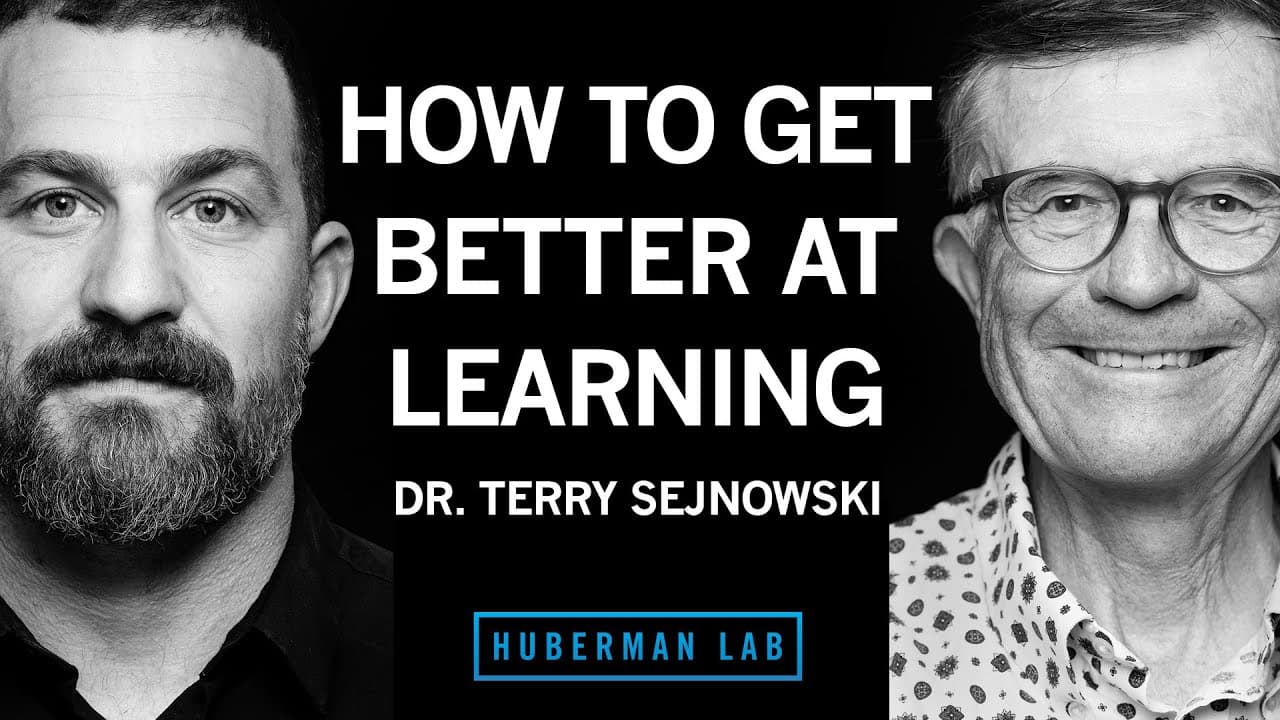
Understanding how the brain processes information can significantly improve learning. Dr. Terry Sejnowski explains the role of computational neuroscience and AI in enhancing our ability to learn. He discusses practical tools, like a free online course, that leverage these insights to improve learning efficiency. The conversation also explores how exercise and sleep contribute to brain function, offering a comprehensive view of how to optimize learning and memory.
Transcript
welcome to the huberman Lab podcast where we discuss science and science-based tools for everyday life I'm Andrew huberman and I'm a professor of neurobiology and Opthalmology at Stanford School of Medicine my guest today is Dr Terry snowski Dr Terry snowski is a professor at the sulk Institute for biological studies where he directs the computatio... Read More
Key Insights
- The brain uses algorithms to process information, which can be optimized for better learning.
- Procedural and cognitive learning systems complement each other and are necessary for mastering skills.
- Exercise enhances mitochondrial function, which is crucial for maintaining brain energy and cognitive performance.
- Sleep spindles play a key role in consolidating memories, and their number can be increased with certain behaviors.
- AI can assist in predicting future outcomes by analyzing vast amounts of data and generating new hypotheses.
- The basal ganglia play a crucial role in learning sequences of actions and are involved in both motor and cognitive tasks.
- Social interactions and cultural learning are heavily influenced by the prefrontal cortex, which develops late in adolescence.
- AI tools are transforming our understanding of brain function, offering new ways to address neurological diseases like Alzheimer's.
Install to Summarize YouTube Videos and Get Transcripts
Explore YouTube Video Summarizer or Get YouTube Transcript Extractor
Questions & Answers
Q: How can understanding brain algorithms improve learning?
Understanding brain algorithms allows us to optimize how we process and store information. By identifying the specific algorithms the brain uses, such as those involved in procedural and cognitive learning, we can develop strategies and tools to enhance our learning efficiency. This understanding helps in creating educational programs and AI tools that align with natural brain processes, making learning more effective.
Q: What role do exercise and sleep play in brain function?
Exercise enhances mitochondrial function, which is crucial for maintaining the brain's energy levels and cognitive performance. It supports overall brain health and resilience. Sleep, particularly through the occurrence of sleep spindles, plays a vital role in memory consolidation. Adequate sleep ensures that new information is effectively integrated into long-term memory, making it a critical component of the learning process.
Q: How can AI tools assist in learning and medical diagnostics?
AI tools can process vast amounts of data to identify patterns and generate hypotheses, assisting in learning by predicting future scenarios and providing new insights. In medical diagnostics, AI can analyze patient data to suggest potential diagnoses and treatments, offering a complementary tool to human expertise. This capability enhances decision-making and can lead to more personalized and effective healthcare solutions.
Q: What is the significance of the basal ganglia in learning?
The basal ganglia are crucial for learning sequences of actions, which are essential for mastering both motor and cognitive tasks. They help in forming habits and routines by integrating and automating learned behaviors. This brain region's involvement in both 'go' and 'no-go' processes is vital for decision-making and executing learned actions efficiently.
Q: How do procedural and cognitive learning systems work together?
Procedural learning involves acquiring skills through practice and repetition, leading to automaticity in performance. Cognitive learning involves understanding and applying knowledge. These systems complement each other; procedural learning solidifies skills, while cognitive learning provides the framework and understanding needed to adapt and apply skills to new situations, enhancing overall learning effectiveness.
Q: What is the impact of social interactions on brain development?
Social interactions heavily influence brain development, particularly in the prefrontal cortex, which is responsible for complex decision-making and social behavior. This brain region develops late in adolescence, highlighting the importance of social learning and cultural exposure in shaping our cognitive and social capabilities. Understanding these processes can inform educational strategies and interventions to support healthy brain development.
Q: How can AI predict future scenarios in neuroscience?
AI can analyze large datasets from neuroscience research to identify trends and make predictions about future outcomes. By simulating various scenarios, AI can suggest potential paths for research and treatment, offering a powerful tool for hypothesis generation and decision-making in neuroscience. This capability can accelerate discoveries and improve our understanding of brain function and disease.
Q: What are sleep spindles, and why are they important?
Sleep spindles are bursts of brain activity that occur during non-REM sleep and are crucial for memory consolidation. They help integrate new information into existing memory networks without disrupting them. Increasing the number of sleep spindles can enhance memory retention and learning, highlighting the importance of adequate sleep for cognitive health and performance.
Summary & Key Takeaways
-
Dr. Terry Sejnowski discusses how computational neuroscience and AI can improve learning, emphasizing the importance of understanding brain algorithms. He introduces a free online course that teaches effective learning strategies by combining procedural and cognitive learning.
-
The conversation highlights the role of exercise and sleep in maintaining brain health. Exercise boosts mitochondrial function, which is vital for energy, while sleep spindles help consolidate memories, both crucial for effective learning.
-
AI's ability to analyze large datasets offers new insights into brain function and potential treatments for neurological diseases. Dr. Sejnowski explains how AI can predict future scenarios and assist in medical diagnostics, enhancing our approach to health and learning.
Read in Other Languages (beta)
Share This Summary 📚
Summarize YouTube Videos and Get Video Transcripts with 1-Click
Try YouTube Summary with ChatGPT & Claude or YouTube Transcript Generator
Explore More Summaries from Andrew Huberman 📚

Summarize YouTube Videos and Get Video Transcripts with 1-Click
Try YouTube Summary with ChatGPT & Claude or YouTube Transcript Generator