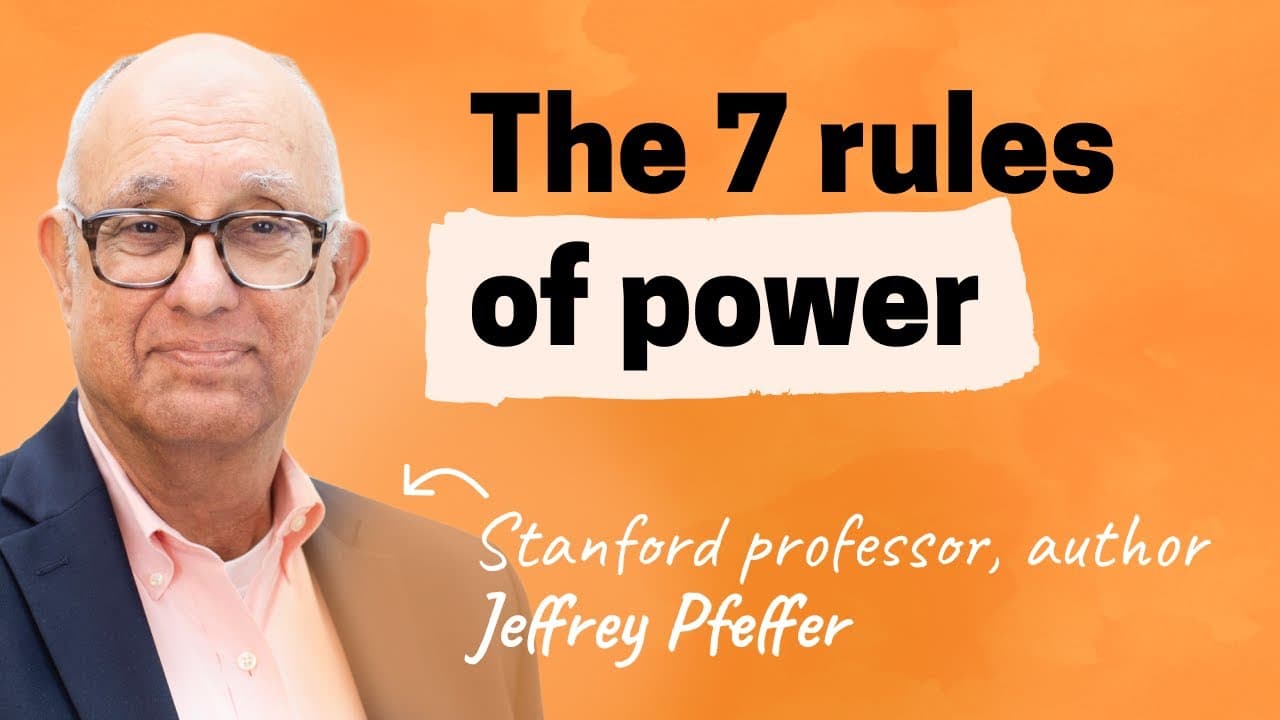
Jeffrey Pfeffer on Growing Power in Life and Career
TL;DR
Power skills correlate with higher salary and more promotions, and being able to navigate power dynamics leads to less stress and greater career happiness. Pfeffer outlines seven rules of power and explains how to build a powerful personal brand and network relentlessly. The discussion also covers why power is not inherently bad and how to apply it responsibly.
Transcript
We're going to be talking about how to grow your power. The reason why you should pay attention to this is because it leads to a lot of good things, salary, getting promoted, being happy in your career, being less stressed. You're not describing how the world should work. This is just how it is. Not only is, but how it was and how it will be. T... Read More
Key Insights
- Power skills are associated with positive career outcomes such as salary and promotion, according to Pfeffer and his research.
- The seven rules of power are practical skills that can be learned and applied in life and work to build influence.
- Building a powerful brand and networking relentlessly are central to gaining and leveraging power.
- Power can be used for good when guided by ethical considerations and clear objectives.
- People from disadvantaged backgrounds can benefit from power skills to counteract systemic barriers.
- Judgment should be suspended in professional interactions when someone is on your critical path to get things done.
- Power is a tool like a knife or hammer, useful in the right hands and context, not inherently good or bad.
- The class aims to be open to learning; discomfort is acknowledged as part of the process but not a barrier to skill development.
Install to Summarize YouTube Videos and Get Transcripts
Explore YouTube Video Summarizer or Get YouTube Transcript Extractor
Questions & Answers
Q: A real search query question about the video 1
What are the seven rules of power and how can they be applied in everyday work to advance a career? The seven rules are presented as actionable skills that individuals can master to increase influence, negotiate better outcomes, and secure opportunities. Applying them requires self awareness, strategic behavior, and ethical consideration to balance ambition with others’ needs.
Q: A real search query question about the video 2
Why does Pfeffer argue that power is not inherently dirty and how can power be used for good in a corporate environment? He compares power to a tool that can be used for curing cancer or harming others, implying that intent and application determine whether power is beneficial or harmful. Responsible use relies on goals that improve outcomes for stakeholders.
Q: A real search query question about the video 3
How does Pfeffer suggest should people react to power when they feel uncomfortable with it? He notes that discomfort often stems from mismatches between idealized norms and real world dynamics, and recommends focusing on learning and applying power skills rather than rejecting power altogether, while remaining mindful of ethical implications.
Q: A real search query question about the video 4
What is the role of personal branding in developing power according to Pfeffer, and how should it be done without cringe? Personal branding is about presenting a credible, capable image that aligns with one’s actions and outcomes, built through consistent behavior, competent networking, and delivering value rather than flashy or inauthentic self promotion.
Q: A real search query question about the video 5
How can networking contribute to increasing influence in an organization? Networking provides access to information, opportunities, and allies who can support promotion and key initiatives. The idea is to network relentlessly, building genuine relationships that are grounded in reciprocity and trust rather than transactional contacts.
Q: A real search query question about the video 6
What does Pfeffer say about fairness and judgment in power dynamics? He argues that judging others can obstruct collaboration, and the crucial skill is to work with people on your critical path regardless of personal opinions, maintaining professional respect to achieve shared goals.
Q: A real search query question about the video 7
Why is power training valuable for underrepresented groups and how can it help address barriers in the workplace? The discussion highlights that political skill can mitigate disadvantages by enabling individuals to navigate organizational structures, build credibility, and secure opportunities that might otherwise be inaccessible, contributing to more equitable outcomes.
Q: A real search query question about the video 8
What practical steps can listeners take today to start building their own power, according to Pfeffer and the host? Steps include identifying key people on your path, practicing strategic visibility, refining your personal brand, seeking mentorship, and applying power skills in real projects to demonstrate impact while maintaining ethical integrity.
Summary & Key Takeaways
-
Power concepts are taught as practical skills you can master to advance in your career and improve job satisfaction, with emphasis on how power translates into tangible outcomes like salary and promotions.
-
The Paths to Power course, taught by Pfeffer, focuses on seven rules of power and teaches techniques for building influence, brand, and networks while addressing common discomfort around power.
-
The conversation also covers the ethical use of power and the importance of adapting to power dynamics rather than adhering to idealistic norms.
Read in Other Languages (beta)
Share This Summary 📚
Summarize YouTube Videos and Get Video Transcripts with 1-Click
Try YouTube Summary with ChatGPT & Claude or YouTube Transcript Generator
Explore More Summaries from Lenny's Podcast 📚


Summarize YouTube Videos and Get Video Transcripts with 1-Click
Try YouTube Summary with ChatGPT & Claude or YouTube Transcript Generator