Lambda Calculus - Computerphile
TL;DR
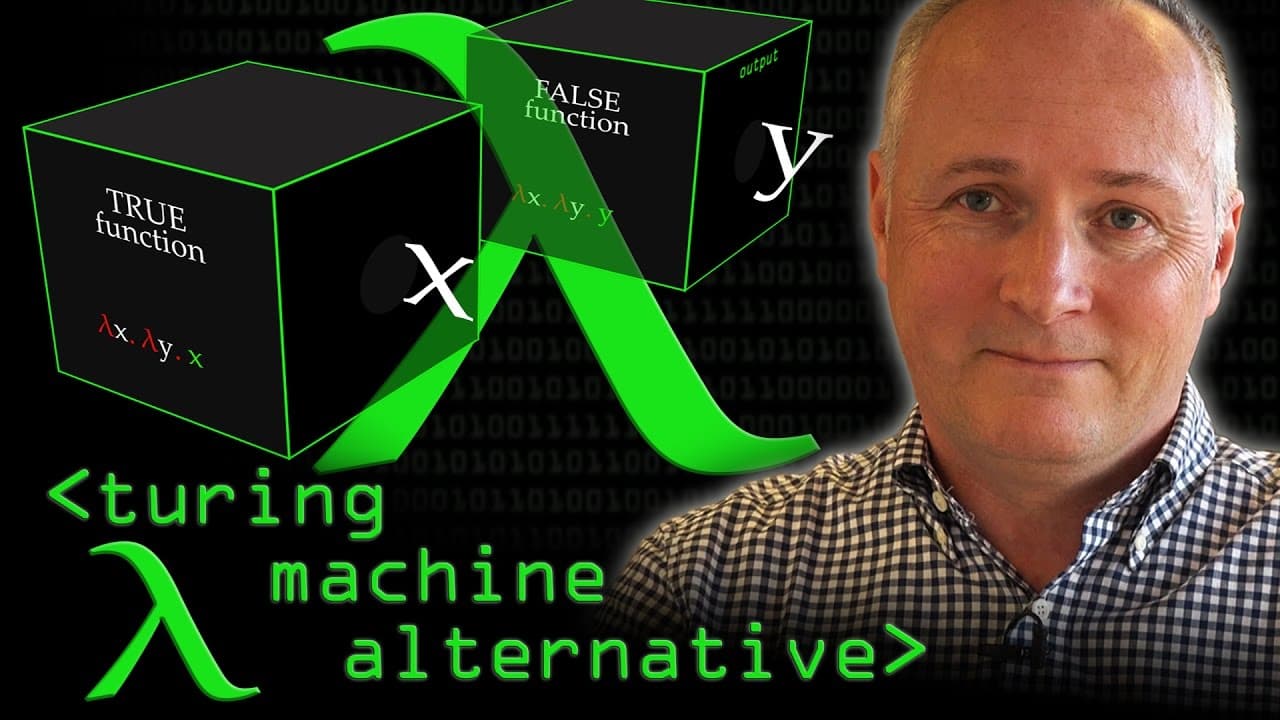
The Lambda Calculus, invented by mathematician Alonso Church, is a functional notation for defining and applying functions. It can encode any computation, serves as the basis for functional programming languages, and is present in major programming languages today.
Transcript
today we're going to talk about one of my favorite topics in computer science which is the lambda calculus and in particular we're going to talk about three things we're going to think what actually is it why is it useful and where did it actually come from so we're going to start with the last question here where did it actually come from this is ... Read More
Key Insights
- ❓ The Lambda Calculus was invented by Alonso Church and captures the concept of functions from a computational perspective.
- ✊ Despite the differences between the Lambda Calculus and Turing Machines, both systems are equivalent in terms of computational power.
- 🛟 The Lambda Calculus can encode any computation and serves as the basis for functional programming languages like Haskell.
- ❓ Major programming languages now incorporate the Lambda Calculus as a fundamental component.
- 😑 The Y combinator is a Lambda Calculus expression that enables recursion within this system.
- 🤳 The Lambda Calculus and the structure of human DNA share similarities, both involving the idea of self-replication.
Install to Summarize YouTube Videos and Get Transcripts
Explore YouTube Video Summarizer or Get YouTube Transcript Extractor
Questions & Answers
Q: Who invented the Lambda Calculus and why?
The Lambda Calculus was invented by mathematician Alonso Church. He was interested in understanding the computational perspective of functions and developed the lambda notation to capture this concept.
Q: What is the difference between the Lambda Calculus and Turing Machines?
The Lambda Calculus focuses on functions as black boxes without internal state, while Turing Machines have internal state. Despite these differences, the Church-Turing hypothesis states that both systems are equivalent in terms of computational power.
Q: How is the Lambda Calculus used in computer science today?
The Lambda Calculus can encode any computation and serves as the foundation for functional programming languages like Haskell. Additionally, most major programming languages now incorporate the Lambda Calculus as a fundamental component.
Q: Can recursive functions be defined in the Lambda Calculus?
Yes, the Y combinator, a famous Lambda Calculus expression invented by Haskell Curry, allows for recursion within the Lambda Calculus. It is the key to encoding recursion in this system.
Summary & Key Takeaways
-
The Lambda Calculus was invented by mathematician Alonso Church as a way to capture the notion of a function from a computational perspective.
-
Church's Lambda Calculus and Alan Turing's Turing Machines, despite having different notions of computation, are equivalent, known as the Church-Turing hypothesis.
-
The Lambda Calculus consists of variables, lambda notation for building functions, and function application. It can encode any computation, is the basis for functional programming languages, and is now present in major programming languages.
Read in Other Languages (beta)
Share This Summary 📚
Summarize YouTube Videos and Get Video Transcripts with 1-Click
Try YouTube Summary with ChatGPT & Claude or YouTube Transcript Generator
Explore More Summaries from Computerphile 📚
Summarize YouTube Videos and Get Video Transcripts with 1-Click
Try YouTube Summary with ChatGPT & Claude or YouTube Transcript Generator