How to Build Claude Code Memory With Obsidian
TL;DR
Build persistent Claude Code memory with three components: a raw-sources folder, a Markdown wiki maintained by Claude, and a rules file defining conventions and workflows. Focus each vault on one domain, ingest useful sources, query the compiled wiki instead of repeatedly retrieving raw chunks, and periodically lint the collection for contradictions, orphan pages, and stale claims.
Transcript
Imagine if Claude Code remembered everything and got smarter every time you spoke to it. In this video, I'm going to show you Andro Kopathy's Obsidian rag system that gives Claude a self-updating memory so the Claude code never forgets gets smarter in every conversation actually knows who you are and how to fix its massive limitation that 99% of pe... Read More
Key Insights
- The central limitation addressed by the system is context loss, because Claude can forget useful information from earlier conversations and may produce confidently incorrect answers during long interactions.
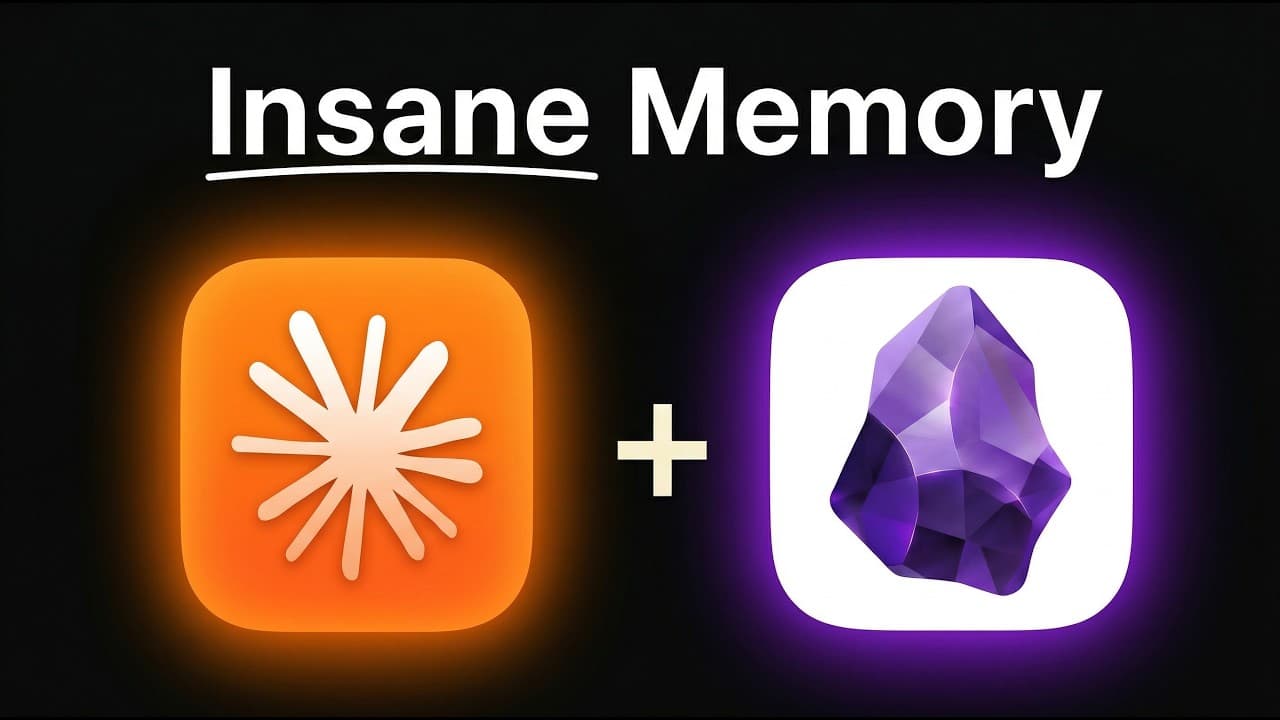
- The Obsidian memory system is a persistent personal wiki made from Markdown files that Claude can read, write, organize, and update while Obsidian supplies a visual layer for browsing the material.
- The system contains three core layers: a folder holding raw sources, a folder containing the wiki Claude maintains, and a schema file that defines the rules, conventions, and workflows for maintenance.
- Traditional retrieval starts again with a query, finds source chunks, assembles an answer, and then forgets that work, while the LLM wiki preserves compiled knowledge for future queries.
- A new source can update multiple related wiki pages in a single pass, allowing the knowledge base to compound as additional articles, PDFs, transcripts, web clips, and other materials are ingested.
- Contradiction detection is part of the ingestion process, because Claude can identify when incoming information conflicts with existing wiki content and flag those discrepancies for attention.
- Linting is periodic knowledge-base maintenance that searches for contradictions, orphan pages, and stale claims, covering organizational work that people may otherwise forget to perform.
- A focused domain is essential to the recommended setup, because the presenter advises creating one system for one book, project, research question, business topic, or similar bounded purpose.
Install to Summarize YouTube Videos and Get Transcripts
Explore YouTube Video Summarizer or Get YouTube Transcript Extractor
Questions & Answers
Q: How do you build persistent Claude Code memory with Obsidian?
Create a dedicated folder for one domain, then organize it around three components: raw sources, a wiki of Markdown files maintained by Claude, and a schema file containing conventions and workflows. Feed Claude articles, PDFs, transcripts, web clips, or other materials. Claude can compile them into wiki pages, update related pages, and use the resulting knowledge during later queries.
Q: What problem does an Obsidian memory system solve for Claude Code?
The system addresses context loss. Claude's normal conversational context can fail to preserve important information across interactions, and the transcript says the model can sometimes hallucinate or respond confidently while being incorrect. A persistent wiki supplements that context by storing organized knowledge in editable Markdown files that Claude can read again during future conversations and tasks.
Q: What files and folders are required for a Claude Code wiki?
The described design uses three main layers. A raw folder contains sources supplied by the user, a wiki folder contains summaries and structured pages written by Claude, and a schema file defines the rules of the system. The transcript also highlights index.md and log.md as bookkeeping files that help organize operations and support the wiki as it grows.
Q: How is an LLM wiki different from traditional RAG?
Traditional retrieval is described as a repeated sequence of query, chunks, and answer. Claude finds relevant chunks, stitches together a response, and then forgets the work, so a later question starts again. The LLM wiki instead compiles sources into persistent Markdown pages. Future queries read that maintained knowledge, allowing the collection to build value as more sources are added.
Q: How does new information update an Obsidian knowledge base?
When a new source enters the raw folder, Claude reads it, identifies the existing wiki pages to which it relates, and updates those pages in one pass. The transcript gives an example in which one source may update 10 to 15 wiki pages. Claude can also flag contradictions between the incoming material and information already stored in the wiki.
Q: What does linting mean in an Obsidian LLM wiki?
Linting is a recurring maintenance process for the compiled knowledge base. Every couple of weeks, Claude can examine the wiki for contradictions, orphan pages, and stale claims. This operation complements ingestion and querying by addressing organizational and accuracy problems that people may naturally overlook while continuously adding new sources and expanding the collection.
Q: Why should each Obsidian memory vault focus on one domain?
The presenter recommends choosing one bounded domain rather than putting everything into a single system. Suitable domains include one book, one project, one research question, a LinkedIn growth topic, a team or business wiki, or a personal-life wiki. This focused scope gives Claude a clearer body of related material to organize, connect, maintain, and query.
Q: How can Obsidian store downloaded images with source files?
Open Obsidian settings, go to Files and Links, and set the attachment folder path to a fixed directory such as raw assets. Then open the hotkey settings and find the command for downloading attachments for the current file. This configuration keeps images saved locally when information is captured from a page, making those assets available inside the vault.
Summary & Key Takeaways
-
The proposed memory system uses Claude Code to incrementally compile raw materials into a structured collection of Markdown files. Obsidian provides a visual interface for browsing those files and their relationships. The result functions like a personal Wikipedia that preserves useful information outside Claude's temporary conversational context and can be edited over time.
-
The workflow has three principal layers: raw sources supplied by the user, wiki pages written and maintained by Claude, and a schema or rulebook defining conventions and workflows. An index and log support bookkeeping, while locally stored attachments can keep images and other referenced assets available inside the selected Obsidian folder.
-
The system supports three recurring operations: ingesting new materials, querying the compiled knowledge, and linting the wiki. Linting checks for contradictions, orphan pages, and stale claims that people might otherwise overlook. The presenter recommends limiting each implementation to one domain, such as one book, project, research question, or business topic.
Read in Other Languages (beta)
Share This Summary 📚
Summarize YouTube Videos and Get Video Transcripts with 1-Click
Try YouTube Summary with ChatGPT & Claude or YouTube Transcript Generator
Explore More Summaries from Jack Roberts 📚



Summarize YouTube Videos and Get Video Transcripts with 1-Click
Try YouTube Summary with ChatGPT & Claude or YouTube Transcript Generator