Why AI Inference Chips Could Challenge Nvidia
TL;DR
AI chip spending is shifting from training toward inference, which already represents roughly two-thirds of AI computing in the source's 2026 account. Nvidia remains protected by CUDA's deeply established software ecosystem, while AMD challenges its general-purpose hardware and companies such as Groq, Cerebras, and Tesla pursue specialized architectures or applications instead of directly recreating Nvidia's strategy.
Transcript
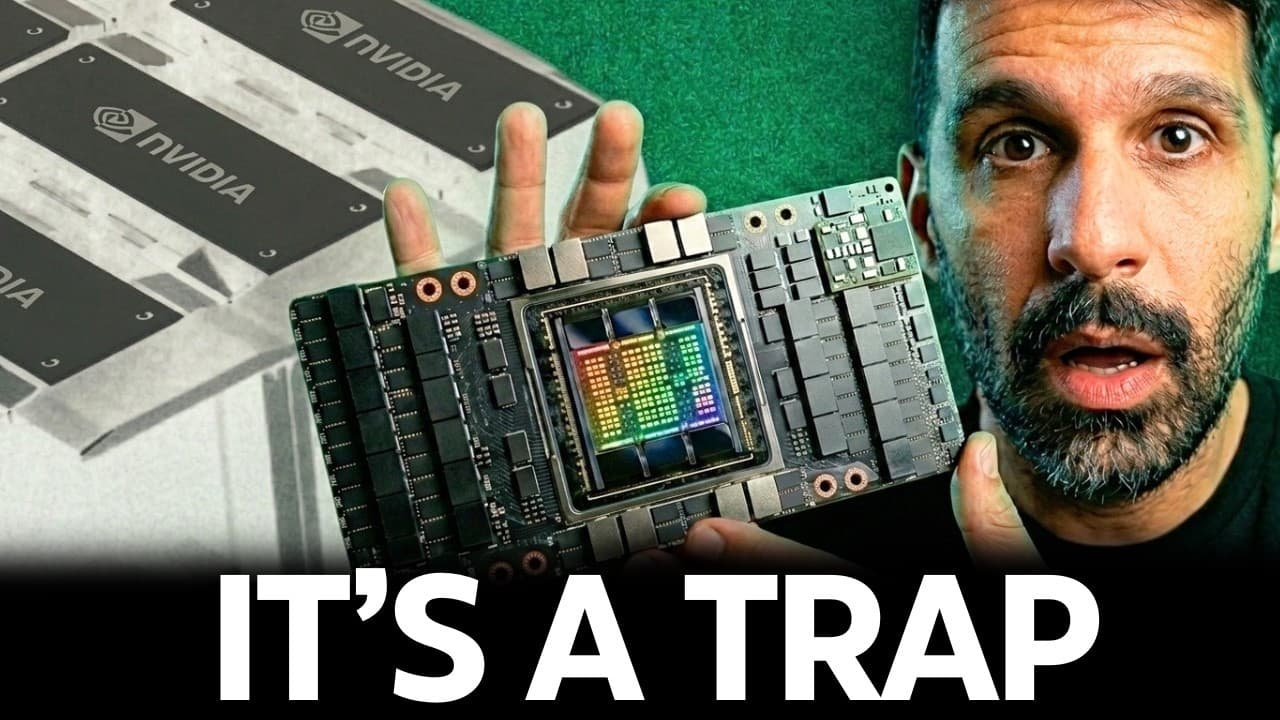
I've spent a stupid amount of time lately trying to learn and actually understand the chip war that's happening underneath the entire AI boom, and what I found really surprised me because the story you've been told that there's this big race and everybody's gunning for Nvidia is basically wrong. Let me start by giving you the lay of the land. Nvidi... Read More
Key Insights
- Training is the costly process of building an AI model from large collections of data, requiring months of computation and tens of thousands of chips. Inference is every subsequent execution of that trained model, including each generated answer, image, chatbot reply, or line of code.
- Inference is roughly two-thirds of global AI computing in the source's 2026 account, and its share is still increasing. Models may be trained once, but they can serve billions of requests, making repeated model execution a growing focus for AI infrastructure spending.
- CUDA is Nvidia's most important competitive defense because it connects programmers to Nvidia hardware. Developed since 2006, it benefits from extensive tools, accumulated engineering techniques, university education, and widespread familiarity that a technically strong competing chip cannot instantly reproduce.
- Nvidia's data-center business generated about $75 billion in the quarter ending April 2026, according to the source, with revenue rising around 92% from the previous year and gross margin near 75%. Blackwell was shipping in volume, while Rubin was expected in the second half of 2026.
- AMD is the primary company attempting to challenge Nvidia with similar general-purpose accelerators. Its leading chip reportedly came within a few percent of Nvidia's best in a 2026 inference benchmark, but AMD's ROCm software stack remains the central obstacle despite substantial improvements.
- Groq is designed specifically for fast inference rather than directly competing for Nvidia's training position. Its language processing unit uses on-chip SRAM to reduce delays caused by retrieving model data from slower memory, producing a reported time to first token of about 18 milliseconds.
- Groq's speed involves a significant memory constraint because the source contrasts its 230 MB of SRAM with an H100's 80 GB. Keeping data close to computation can sharply reduce latency, but limited on-chip capacity complicates the handling of very large models.
- Specialization is the central competitive strategy outside Nvidia's strongest market. Cerebras kept an entire wafer for a processor described as containing 4 trillion transistors, while Tesla's AI5, taped out in April 2026, targets FSD, Optimus, and orbital inference without being sold as a commercial chip.
Install to Summarize YouTube Videos and Get Transcripts
Explore YouTube Video Summarizer or Get YouTube Transcript Extractor
Questions & Answers
Q: What is the difference between AI training and inference?
AI training is the process of building a model by feeding it large amounts of data until it learns useful patterns. The source describes training as a months-long job involving tens of thousands of chips and enormous electricity consumption. Inference begins after training and occurs whenever the finished model answers a question, generates an image, writes code, or produces another output for a user.
Q: Why is inference becoming more important in the AI chip market?
Inference is becoming more important because training creates a model comparatively infrequently, while every use of that model requires another inference computation. The source says inference already accounts for roughly two-thirds of all AI computing in 2026 and continues to increase. Billions of recurring requests can therefore shift infrastructure spending from building models toward operating them efficiently, quickly, and continuously.
Q: Why is Nvidia difficult for other AI chip companies to challenge?
Nvidia is difficult to challenge because competitors must contend with CUDA as well as its hardware. CUDA has been developed since 2006 and has become a standard working environment for AI engineers, supported by tools, accumulated techniques, university instruction, and developer experience. A rival can build a faster or cheaper processor yet still struggle if customers must change software and retrain engineers to use it.
Q: How does AMD compete with Nvidia in AI accelerators?
AMD competes by offering the same broad category of general-purpose AI accelerator, aiming to improve price and performance rather than avoiding Nvidia's market. The source says AMD's leading chip came within a few percent of Nvidia's best in a major 2026 inference benchmark and that its next generation provides more high-speed memory than Nvidia's current flagship. Its main difficulty is the maturity and adoption of ROCm compared with CUDA.
Q: What is ROCm, and why does it matter for AMD?
ROCm is AMD's software stack for enabling developers to use its accelerators, serving the role that CUDA plays for Nvidia hardware. The source describes earlier versions as buggy and painful, while noting that the platform has improved dramatically. It matters because competitive hardware alone does not make migration easy. Software tools, established workflows, engineering knowledge, and developer familiarity determine whether customers can deploy accelerators effectively.
Q: How does Groq achieve fast AI inference?
Groq's language processing unit places model memory directly on the chip using very fast SRAM, reducing the need to repeatedly fetch information from slower memory. The source compares this design to keeping a cookbook and ingredients within reach instead of walking to a pantry. It reports about 18 milliseconds to the first token, compared with approximately 200 to 400 milliseconds on a normal cloud GPU setup.
Q: What limitation comes with Groq's on-chip SRAM design?
Groq's on-chip SRAM provides rapid data access but has far less capacity than the memory associated with a conventional GPU in the source's comparison. The description contrasts 230 MB of SRAM with an H100's 80 GB. That tradeoff helps explain why Groq can reduce response latency while facing constraints when storing or running very large models that require substantially more memory.
Q: How are Cerebras and Tesla approaching AI chips differently from Nvidia?
Cerebras and Tesla pursue specialized approaches instead of simply copying Nvidia's general-purpose accelerator business. The source says Cerebras retained a whole wafer to create a processor containing 4 trillion transistors, about 57 times a GPU by its comparison. Tesla's AI5 taped out in April 2026 for FSD, Optimus, and orbital inference, and Tesla does not sell the chip to outside customers.
Summary & Key Takeaways
-
AI chips perform two distinct jobs: training builds a model through an expensive, months-long process, while inference runs the finished model whenever someone requests text, code, or an image. Because models are trained comparatively infrequently but used continuously, inference is becoming the larger share of total AI computing and investment.
-
Nvidia dominates AI training through more than hardware performance. CUDA, its software layer developed since 2006, has accumulated tools, engineering knowledge, university instruction, and widespread developer familiarity. A challenger therefore must offer competitive silicon while overcoming an established programming environment that influences how much practical value customers can extract from the hardware.
-
Competitors are pursuing different strategies rather than uniformly attacking Nvidia. AMD offers comparable general-purpose accelerators but must improve ROCm adoption. Groq prioritizes very low inference latency through on-chip SRAM, Cerebras uses an unusually large wafer-scale design, and Tesla's AI5 targets the company's own FSD, Optimus, and orbital-inference applications rather than external chip sales.
Read in Other Languages (beta)
Share This Summary 📚
Summarize YouTube Videos and Get Video Transcripts with 1-Click
Try YouTube Summary with ChatGPT & Claude or YouTube Transcript Generator
Explore More Summaries from Farzad 📚






Summarize YouTube Videos and Get Video Transcripts with 1-Click
Try YouTube Summary with ChatGPT & Claude or YouTube Transcript Generator