How to Write Clear and Useful Mini-Essays
TL;DR
Keep each mini-essay focused on one idea, limit it to roughly 100–500 words, record its sources, and organize it for easy retrieval. A simple introduction, body, and conclusion provides a reliable starting structure, while links between separate essays preserve useful connections without overcrowding individual notes.
Transcript
mini essays are one of the best tools for learning they're an outlook for you to read and reflect on the ideas but also a way for you to practice your writing every single day it's like the Swiss army knife of your personal education and this is something I talked about in depth in a previous video so I don't want to bore you with the same old deta... Read More
Key Insights
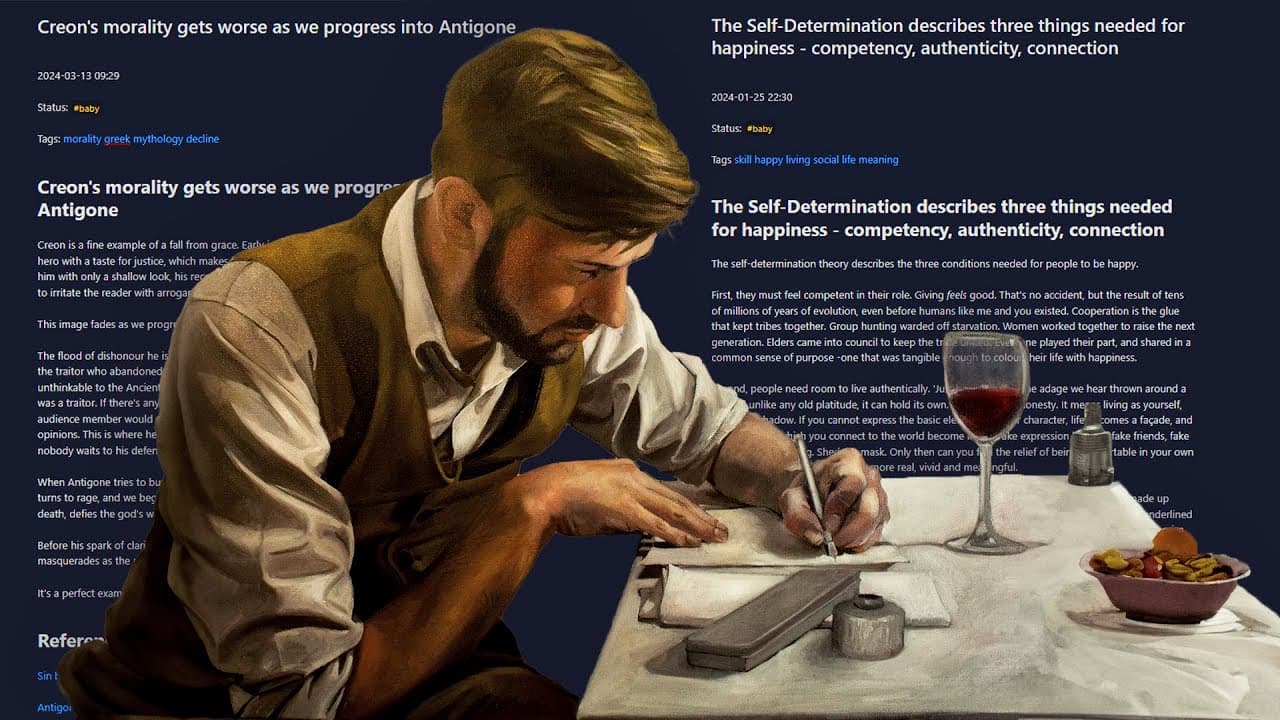
- A mini-essay is a detailed note that helps its writer reflect on ideas while practicing writing regularly. It occupies a middle ground between rough notes and full writing projects, providing enough depth for understanding without requiring the time and effort of a conventional essay.
- The purpose of a mini-essay should determine its style and structure. A writer seeking clear, informative, and entertaining prose may work differently from someone pursuing another goal, so the format should remain flexible rather than becoming a single prescribed method.
- Each mini-essay should focus on one idea only. A narrow focus prevents the writer from becoming lost in several competing thoughts and keeps the note distinct, straightforward, and easier to reuse in a larger essay, article, newsletter, or video script.
- The recommended length for a mini-essay is approximately 100–500 words. This range is usually short enough to complete in 10 or 20 minutes, yet long enough to develop an idea, improve understanding, and provide meaningful writing practice.
- A screen-sized limit can train clearer and more concise writing. Trying to keep the entire mini-essay visible without scrolling creates a practical restriction that discourages unnecessary wording and helps the writer preserve the short format.
- An organization system makes mini-essays easier to retrieve and reuse. Tags, folders, indexes, references, and links can help notes from months earlier resurface during the creation of scripts, articles, newsletters, or other longer pieces.
- Source references should be recorded when the mini-essay is written. Spending a small amount of time identifying where an idea came from can prevent a later search through books, papers, articles, or the internet when the writer wants to verify or explore it.
- Links between related mini-essays can create a chain of reasoning without overcrowding individual notes. Separate notes preserve one-idea focus, while hyperlinks reveal how thoughts developed and may eventually support new questions, a book, or another extended piece of writing.
Install to Summarize YouTube Videos and Get Transcripts
Explore YouTube Video Summarizer or Get YouTube Transcript Extractor
Questions & Answers
Q: How do you start writing a mini-essay?
Start with one clearly defined idea rather than several related topics. If you are unsure how to organize it, use the basic three-part structure of introduction, body, and conclusion. This structure provides direction without preventing adaptation. The goal is to get the first sentence down, explain the selected idea clearly, and finish with a concise conclusion.
Q: What is the best structure for a mini-essay?
A reliable default structure is an introduction, body, and conclusion. The introduction brings the reader into the idea, the body develops it clearly and logically, and the conclusion wraps it up with a strong final point. This format is simple, but it still tests writing ability and teaches principles that apply to many other forms of writing.
Q: How long should a mini-essay be?
A practical target is approximately 100–500 words. That range is short enough for the essay to remain fresh and realistic as a regular habit, while providing enough room to develop an idea and practice writing. The speaker estimates that a mini-essay of this kind can often be completed in about 10 or 20 minutes.
Q: Why should a mini-essay cover only one idea?
Focusing on one idea narrows the writer's attention and prevents the note from becoming a confusing mixture of thoughts. Mini-essays are detailed notes rather than final projects designed to address many angles. Related ideas can receive their own essays, then be connected with links and developed more fully in articles, scripts, books, or longer essays.
Q: How can you keep a mini-essay concise?
Set a clear length restriction and treat 100–500 words as a useful working range. Another prompt is to make the essay short enough that the entire text fits on a computer screen without scrolling. This physical boundary encourages clarity, limits unnecessary wording, and reduces the urge to turn every note into a lengthy writing project.
Q: How should mini-essays be organized?
Use whichever combination of tags, folders, indexes, references, and links makes retrieval easy. The system exists to serve the writer, especially when an older note becomes relevant to a script, article, or newsletter. The speaker uses tags, indexes, and links in Obsidian, but emphasizes choosing an organization method suited to the individual writer.
Q: Why should sources be recorded in mini-essays?
Recording the source preserves the origin of an idea and makes later investigation easier. Without a reference, the writer may have to search books, papers, articles, or the internet to reconstruct where the information came from. Adding the reference in the present takes little effort and can save substantial time when the note is revisited.
Q: How do linked mini-essays improve learning and writing?
Links allow related ideas to form a chain of reasoning while each mini-essay remains focused on one subject. They also show how the writer's thinking developed over time and can prompt new questions. Eventually, connected notes may provide material for a larger essay, article, video script, newsletter entry, or even a book.
Summary & Key Takeaways
-
Mini-essays combine the speed of note-taking with enough depth to examine an idea and practice writing. They should remain flexible because writers have different goals, interests, and preferred styles. The suggested principles are general guidance, intended to make daily writing useful, manageable, enjoyable, and sustainable over the long term.
-
Each mini-essay should examine one idea and usually remain between 100 and 500 words, taking about 10 or 20 minutes to write. This balance provides room to develop understanding without turning every reading note into a demanding project. Keeping the complete text visible without scrolling can encourage clarity and concision.
-
A useful system combines tags, folders, indexes, links, and source references so old essays can support later articles, newsletters, or scripts. Similar essays can be linked without merging their ideas into one crowded note. When direction is unclear, the basic introduction, body, and conclusion structure offers a dependable starting point.
Read in Other Languages (beta)
Share This Summary 📚
Summarize YouTube Videos and Get Video Transcripts with 1-Click
Try YouTube Summary with ChatGPT & Claude or YouTube Transcript Generator
Explore More Summaries from Odysseas 📚



Summarize YouTube Videos and Get Video Transcripts with 1-Click
Try YouTube Summary with ChatGPT & Claude or YouTube Transcript Generator