Why AI Cannot Become Conscious Through Computing
TL;DR
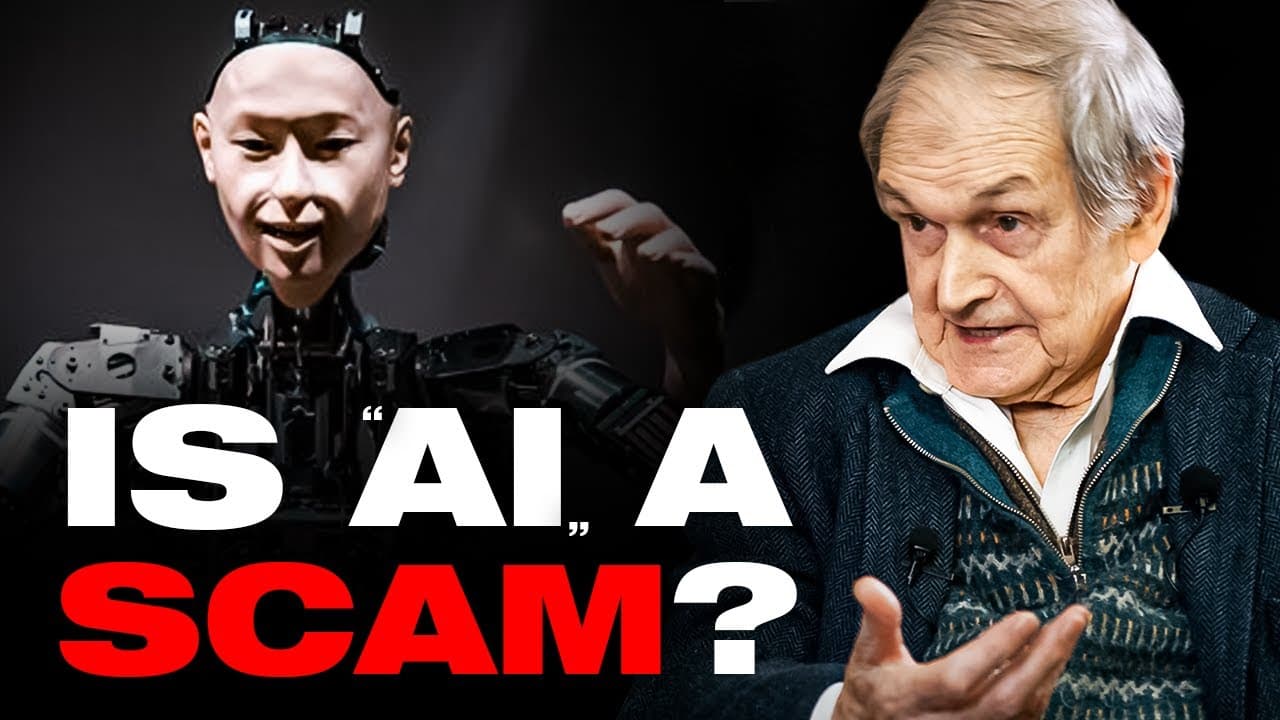
Current AI cannot become conscious through computation alone because it follows computable rules without understanding why those rules are true. Penrose argues that Gödel’s theorem shows how conscious mathematical understanding can transcend a fixed rule system, while AI remains powerful at computation, data analysis, and comparison without knowing what it is doing.
Transcript
Well, you have to be careful. First of all, the name is wrong. It's not artificial intelligence. It's not intelligence. Intelligence would involve consciousness, and I've always been a strong, I. Promoter of the idea that these devices are not conscious and they will not be, be conscious as unless they bring in some other ideas. The compute, they'r... Read More
Key Insights
- Penrose’s central claim is that intelligence involves consciousness, while current AI systems are computational devices that do not know what they are doing. He therefore considers the name artificial intelligence misleading when it implies genuine understanding rather than powerful information processing.
- Computability is a universal notion captured by Turing’s definition and other equivalent definitions mentioned in the discussion. Penrose treats anything implementable as computational rules on a computer as belonging to this shared domain, regardless of the particular language used to express those rules.
- Gödel’s theorem is presented as constructing a statement that says it cannot be proved by a specified system of proof rules. When the rules are trusted to yield only truths, the statement can be understood as true while remaining unprovable within that system.
- Mathematical understanding is more than receiving or applying rules because it includes knowing why the rules preserve truth. Penrose argues that this awareness lets a person recognize truths beyond what a particular formal rule system can establish by its own procedures.
- Creating new rules does not solve the problem unless the system knows why those rules are true. Penrose distinguishes mechanically generating or adopting rules from consciously understanding their validity, which he regards as the essential step in transcending a formal system.
- Consciousness enables rule transcendence in Penrose’s account because a conscious thinker can understand the meaning and truth-preserving character of rules. That understanding supports conclusions that are not obtainable merely by continuing to execute the original rules.
- Current AI is powerful because computers can process enormous amounts of data, identify what the data indicates, and compare a case with previous patterns. Penrose accepts these practical capabilities while denying that successful computation proves conscious comprehension.
- The Turing test approaches consciousness through conversation, but Penrose remains unconvinced that conversational performance establishes genuine awareness. An AI system may speak from accumulated experiences or data while still lacking knowledge of what it is doing or why its outputs are meaningful.
Install to Summarize YouTube Videos and Get Transcripts
Explore YouTube Video Summarizer or Get YouTube Transcript Extractor
Questions & Answers
Q: Why does Roger Penrose say AI is not intelligent?
Penrose says genuine intelligence involves consciousness and understanding, while current AI consists entirely of computable processes. Although an AI system can produce convincing language, analyze data, and perform calculations beyond human ability, he argues that it does not know what it is doing. Its useful outputs therefore demonstrate computational power, not the conscious understanding that he associates with intelligence.
Q: How does Gödel’s theorem relate to AI consciousness?
Gödel’s theorem provides Penrose with an example of understanding that goes beyond a fixed computational rule system. A specially constructed statement says it cannot be proved by the chosen rules. If those rules are understood to produce only truths, a person can recognize the statement as true even though it is not provable by those rules. Penrose connects this transcendence to consciousness.
Q: What does it mean to transcend a system of rules?
To transcend a rule system means recognizing a truth that the system itself cannot prove. Penrose says this is possible when someone understands why the rules produce only true conclusions. That understanding permits reasoning about the entire system rather than merely following its procedures. He treats such awareness as conscious understanding and distinguishes it from automatic execution of computational instructions.
Q: Why can AI not simply create new rules for itself?
Penrose argues that generating new rules is not enough because the system must know why those rules are true. A machine may modify, expand, or replace its procedures, but this remains computation unless it understands the truth-preserving basis of the new rules. His objection concerns conscious justification, not whether software can produce additional procedures or change how it processes information.
Q: What is the difference between computing and understanding?
Computing means following formal procedures that can be implemented by a computer, while understanding means knowing why those procedures and their conclusions are true. Penrose emphasizes that a person may be told that a rule is valid or learn it at school without truly understanding it. Conscious awareness of why it is valid is the feature he believes computation lacks.
Q: What useful role does Penrose accept for AI?
Penrose accepts that AI has an important role based on the extraordinary power of modern computation. Computers can process massive datasets, determine what patterns the data supports, compare new cases with previous examples, and carry out computations beyond human capabilities. His criticism does not deny these practical functions. It denies that performing them amounts to understanding or consciousness.
Q: Does passing the Turing test prove that an AI is conscious?
Penrose discusses the Turing test as an attempt to judge consciousness by having a conversation with an entity. However, he does not accept conversational ability as sufficient evidence of understanding. An AI can speak from accumulated experiences or data and still fail to know what it is doing. Fluent responses therefore do not resolve his objection that computation lacks conscious awareness.
Q: Why does Penrose think greater computing power is insufficient?
Greater computing power lets machines calculate faster, process more data, and perform tasks far beyond human computational capacity. Penrose argues that these gains remain inside the domain of computability. They can make AI appear intelligent and cause people to lose sight of what the system is actually doing, but increased scale does not create understanding of why rules or conclusions are true.
Summary & Key Takeaways
-
Penrose rejects the term artificial intelligence because he associates genuine intelligence with consciousness. Current machines operate entirely through computable processes, so their impressive performance does not demonstrate understanding. Their growing computational power can obscure the distinction between producing useful results and consciously knowing what those results or procedures mean.
-
Gödel’s theorem constructs a statement asserting that it cannot be proved by a chosen set of computational proof rules. If those rules are understood to produce only truths, the statement can be recognized as true even though the rules cannot prove it. Penrose presents this recognition as an example of transcending formal rules.
-
AI can analyze massive datasets, compare new cases with patterns in previous data, and perform computations beyond human capacity. Penrose accepts that these abilities give AI an important role. His objection is narrower: computation, however powerful, does not supply conscious understanding, so present computational methods are missing something required for consciousness.
Read in Other Languages (beta)
Share This Summary 📚
Summarize YouTube Videos and Get Video Transcripts with 1-Click
Try YouTube Summary with ChatGPT & Claude or YouTube Transcript Generator
Explore More Summaries from This Is The World 📚

![Sarah Paine: the Risk of Nuclear War, WW3 and NATO [INTERVIEW] thumbnail](/_next/image?url=https%3A%2F%2Fi.ytimg.com%2Fvi%2FyErY3J2hgKs%2Fhqdefault.jpg&w=750&q=75)
Summarize YouTube Videos and Get Video Transcripts with 1-Click
Try YouTube Summary with ChatGPT & Claude or YouTube Transcript Generator