How to Build an AI-Native Creative Agency
TL;DR
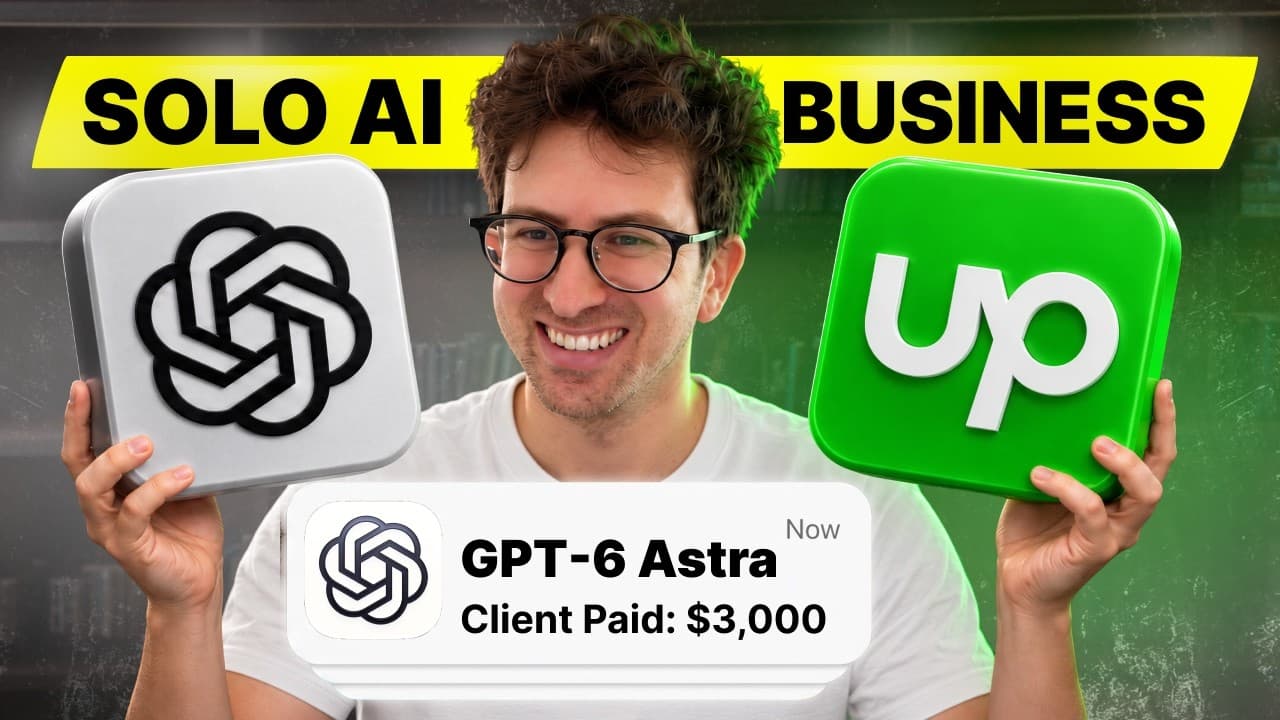
AI-native service firms are revolutionizing the business landscape by leveraging advanced creative models, orchestrators like Astra, and APIs such as Higgsfield. These firms can achieve significantly higher profit margins compared to traditional human agencies. By automating repetitive tasks and maintaining a learning loop, they offer scalable solutions with reduced operational costs, making them an attractive option for entrepreneurs seeking efficiency and innovation.
Transcript
The number of one-person businesses built with GPT, Astra, and creative models are about to explode. That little combo of Astra and creative models is barely talked about, so today I'm going to show you a glimpse of that future and give away everything you need to build one of these businesses before everyone else does. These businesses a... Read More
Key Insights
- AI-native service firms leverage models like Astra and Higgsfield for high efficiency.
- These firms can achieve 60%+ net margins, surpassing traditional agencies' 10-15%.
- Astra orchestrates tasks, manages workflows, and ensures quality in AI-native firms.
- Higgsfield API consolidates over 50 creative models, simplifying the production process.
- AI-native firms utilize platforms like Upwork and Fiverr to tap into existing demand.
- The learning loop in AI-native firms improves quality and margins over time.
- Studio Operator is a tool that automates creative service workflows using AI models.
- AI-native firms can offer scalable, high-margin solutions with minimal human oversight.
Install to Summarize YouTube Videos and Get Transcripts
Explore YouTube Video Summarizer or Get YouTube Transcript Extractor
Questions & Answers
Q: How do AI-native service firms achieve higher margins than traditional agencies?
AI-native service firms achieve higher margins by automating repetitive tasks and utilizing advanced AI models to handle creative work. This reduces the need for large human teams and allows for significant cost savings. By tapping into existing demand on platforms like Upwork and Fiverr, these firms can operate with gross margins of 70-95%, compared to the 10-15% net margins typical of traditional human agencies. The AI-driven workflow also ensures consistent quality and efficiency.
Q: What role does Astra play in AI-native service firms?
Astra acts as an orchestrator in AI-native service firms, managing workflows and ensuring quality control. It reads client briefs, plans tasks, selects suitable AI models, tracks budgets, and repairs any failures. Astra's ability to automate and streamline these processes allows the firm to operate efficiently with minimal human oversight, increasing productivity and profitability. Its integration with the Higgsfield API further enhances its capabilities by providing access to a wide range of creative models.
Q: How does the Higgsfield API benefit AI-native service firms?
The Higgsfield API benefits AI-native service firms by providing a single access point to over 50 creative models, simplifying the production process. It handles queuing, GPU scaling, and pricing, allowing firms to efficiently manage creative tasks without needing multiple provider integrations. This consolidation reduces complexity, enhances workflow efficiency, and ensures that firms can deliver high-quality outputs while maintaining control over costs and margins.
Q: What are the key differences between a human agency and an AI-native firm?
A human agency relies on word-of-mouth and organic social channels for growth, with net margins of 10-15% due to hiring and marketing costs. In contrast, an AI-native firm adds marketplaces like Upwork and Fiverr as sales channels, achieving gross margins of 70-95% by automating creative tasks with AI models. AI-native firms operate semi-autonomously, with AI handling the work and humans approving it, resulting in higher efficiency and profitability.
Q: How does Studio Operator automate creative workflows?
Studio Operator automates creative workflows by using six prompts to build and manage different layers of an AI-native firm. It routes tasks to appropriate AI models for people, products, text, repairs, and more, ensuring efficient and high-quality outputs. The system tracks job status, manages client preferences, and includes autonomy settings to control costs and revisions. This automation allows for streamlined operations and increased profit margins.
Q: What are some startup ideas for AI-native service firms?
Three startup ideas for AI-native service firms include: 1) An always-on ad studio that provides weekly creative packs for e-commerce brands, leveraging existing ad libraries for prospects. 2) A franchise localization service that transforms national campaigns into local versions for brands with multiple locations, starting with a pilot program. 3) An industrial catalog service that converts spec sheets and CAD files into sales and training assets, targeting manufacturers with outdated marketing materials.
Q: What factors should be considered when choosing an AI-native service firm to build?
When choosing an AI-native service firm to build, consider factors such as existing demand for the service, the clarity of the unit of work (e.g., one SKU pack), the potential for repetition and subscription-based revenue, and the ability to define concrete correctness criteria. These factors ensure that the firm addresses a real market need, offers scalable and repeatable services, and can maintain high quality and margins through checkable processes.
Q: How do AI-native firms maintain a learning loop to improve quality and margins?
AI-native firms maintain a learning loop by capturing lessons from each job and integrating them into their workflows. This includes tracking missing inputs, mistakes, and margin losses, and using these insights to refine intake, routing, QA, and approval processes. Over time, the firm becomes more efficient and effective, consistently improving quality and margins. The loop ensures that the firm's operational knowledge grows, unlike human agencies where lessons can leave with departing staff.
Summary & Key Takeaways
-
Creative models, Astra, and one production API matured together, enabling one-person creative firms. Platforms like Upwork and Fiverr highlight recurring demand, providing a foundation for these firms. AI-native firms can achieve 60%+ net margins, compared to 10-15% for human agencies.
-
Studio Operator, built with six prompts, automates creative workflows, matching jobs to models for tasks like people, products, text, and more. The strongest business ideas combine a creative surface with a repetitive, checkable operational core.
-
Three startup ideas include an always-on ad studio, a franchise localization service, and an industrial catalog service. Each leverages AI models to transform traditional processes, offering high-margin, scalable solutions.
Read in Other Languages (beta)
Share This Summary 📚
Summarize YouTube Videos and Get Video Transcripts with 1-Click
Try YouTube Summary with ChatGPT & Claude or YouTube Transcript Generator
Explore More Summaries from Greg Isenberg 📚




Summarize YouTube Videos and Get Video Transcripts with 1-Click
Try YouTube Summary with ChatGPT & Claude or YouTube Transcript Generator