How to Improve English Listening Skills with Slang
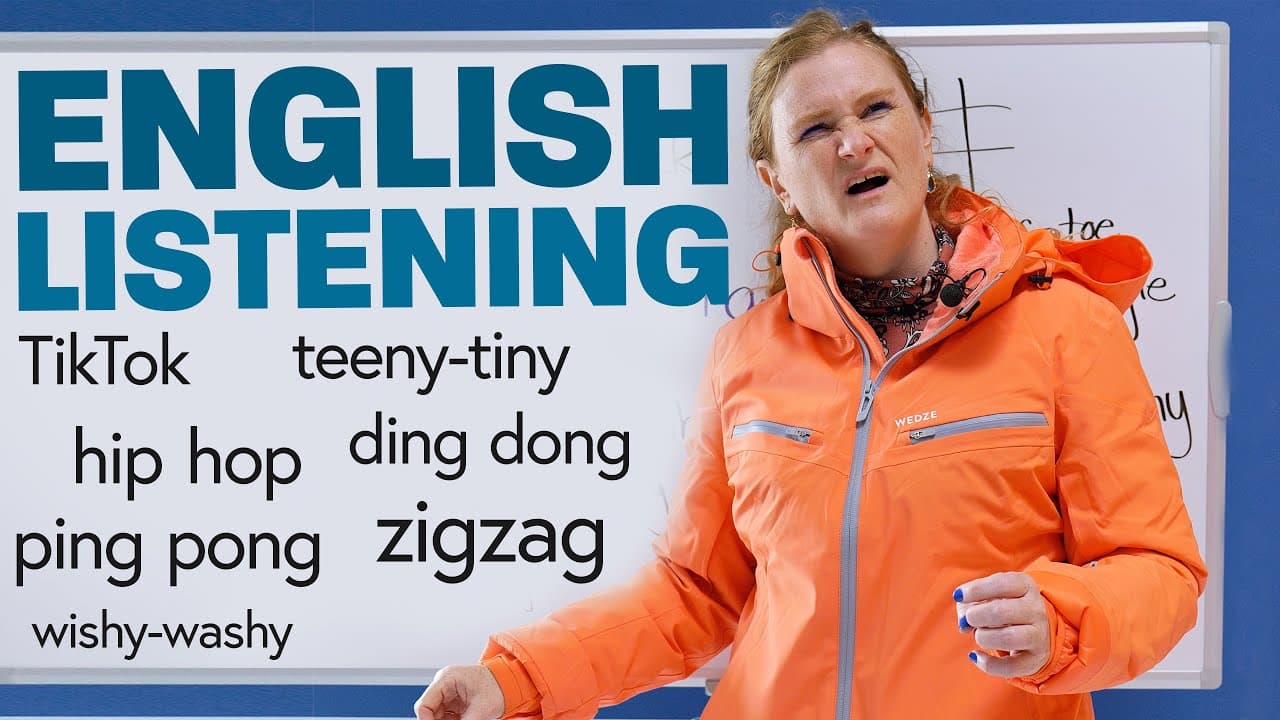
TL;DR
To improve your English listening skills, practice with stories that incorporate slang and follow the 'I-A-O' pattern, which dictates the order of certain sounds in phrases. Understanding this pattern can help you sound more natural and navigate irregular verb forms, making it easier to communicate effectively in casual conversations.
Transcript
Hey guys, it's Ronnie. Today we're going to practice some listening. I'm going to tell you a story. I'm going to speak slow enough so that you can understand my wonderful story. And make this kind of like a listening test for you to, you know, kind of practice your English listening, because people speak really quickly and it's hard to understand w... Read More
Key Insights
- 😯 Practicing listening skills is essential for understanding English slang and natural speech patterns.
- 👂 The "I-A-O" pattern helps English learners sound more natural and avoid common mistakes.
- 😃 The naming of the app TikTok is related to the sound a clock makes, and it demonstrates the use of the "I-A-O" pattern.
- 💁 Understanding irregular verb forms can become easier by following the "I-A-O" pattern.
- 💋 The pattern applies to various English words and can be observed in phrases like "hippity-hoppity" and "tick-tack-toe".
- 🔇 English slang and pronunciation can pose challenges even for native speakers.
- 🔑 Wishy-washy, dingle-dangle, and teeny-weeny are examples of slang words that adhere to the "I-A-O" pattern.
Install to Summarize YouTube Videos and Get Transcripts
Explore YouTube Video Summarizer or Get YouTube Transcript Extractor
Questions & Answers
Q: How can practicing listening skills help improve English comprehension?
Practicing listening skills is crucial because it exposes learners to natural speech patterns and helps them understand slang, fast speech, and word combinations that may be challenging to comprehend initially.
Q: What is the "I-A-O" pattern in English?
The "I-A-O" pattern refers to a rule in English where words with an "i" sound (like tick, zig, or ding) are always followed by a word with an "a" sound (like tack, zag, or dong), or an "o" sound (like tock, zig, or ding).
Q: Why is understanding the "I-A-O" pattern important?
Understanding the "I-A-O" pattern helps learners sound more natural when speaking English and avoid common mistakes. It also aids content creators in maintaining the rhythm and flow of English language creations.
Q: How can the "I-A-O" pattern help with irregular verbs?
The "I-A-O" pattern can be useful for remembering irregular verb forms. For example, the pattern can guide learners to correctly form the simple past and past participle of irregular verbs such as "begin" (began, begun) and "drink" (drank, drunk).
Summary & Key Takeaways
-
The video focuses on practicing listening skills and understanding English slang by narrating a story with slang words and slang pronunciation.
-
It explains the rule of the "I-A-O" pattern in English, which dictates the order of certain words and the pronunciation of certain sounds.
-
The video also discusses the origin of the name "TikTok" and its connection to the sound of a clock.
Read in Other Languages (beta)
Share This Summary 📚
Summarize YouTube Videos and Get Video Transcripts with 1-Click
Try YouTube Summary with ChatGPT & Claude or YouTube Transcript Generator
Explore More Summaries from English with Ronnie · EnglishLessons4U with engVid 📚






Summarize YouTube Videos and Get Video Transcripts with 1-Click
Try YouTube Summary with ChatGPT & Claude or YouTube Transcript Generator