How to Make Margarine from Olive Oil at Home
TL;DR
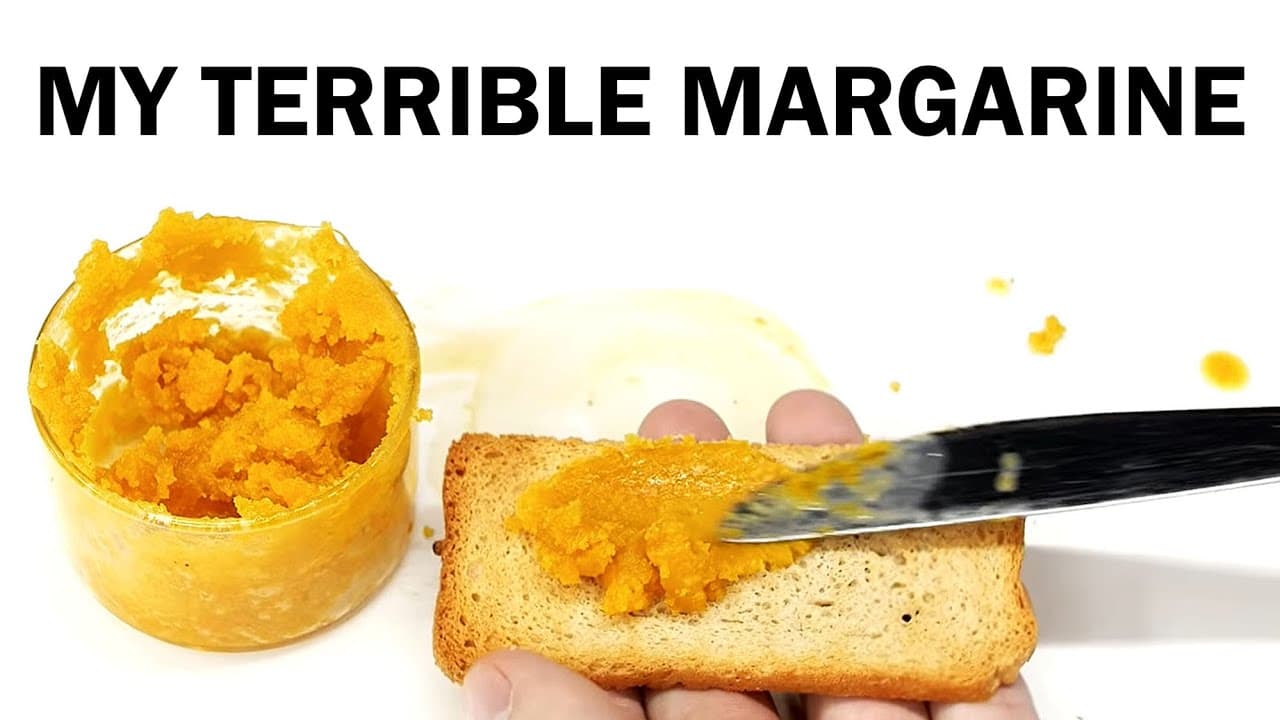
To make margarine from olive oil at home, hydrogenate the oil using a palladium catalyst by generating hydrogen gas, then blend the hydrogenated oil with water and emulsifiers. The process may yield a firmer product if fully hydrogenated, but can lead to an unappetizing texture and flavor if done without proper equipment.
Transcript
margarine is an imitation butters bread that was invented in France in 1869 it was developed as a cheap substitute for butter and was made by churning beef tallow with skim milk the beef tallow which is a hard form of animal fat was a byproduct of meat production so it was both cheap and abundant when the hard fat was thoroughly mixed with the milk... Read More
Key Insights
- 🍼 Margarine was initially created using beef tallow and skim milk, but the formula changed in 1902 when vegetable oils were discovered to be hydrogenated.
- 🛢️ Hydrogenation removes double bonds in unsaturated fatty acids, making them straight and solidifying the oil, resulting in margarine.
- 😒 The hydrogenation process requires the use of a palladium catalyst and proper separation techniques to isolate the margarine.
- 👨 Completely hydrogenated fats are harder and less spreadable, while partially hydrogenated fats maintain a softer consistency.
- 👨 Trans fats, found in partially hydrogenated oils, have been linked to negative health effects.
- 👪 The process of hydrogenating vegetable oil at home is challenging without proper equipment and can result in an unappetizing final product.
- 🖤 Homemade margarine typically lacks the flavors associated with store-bought margarine.
Install to Summarize YouTube Videos and Get Transcripts
Explore YouTube Video Summarizer or Get YouTube Transcript Extractor
Questions & Answers
Q: What is margarine and how was it developed?
Margarine is an imitation butter made by churning beef tallow with skim milk, invented in France in 1869 as a cheap substitute for butter.
Q: How does hydrogenation transform vegetable oil into margarine?
Hydrogenation removes double bonds in unsaturated fatty acids and straightens them out, resulting in a solid fat that can be mixed with water to create margarine.
Q: Why is partially hydrogenated vegetable oil used in margarine production?
Partial hydrogenation produces partially hydrogenated vegetable oils, which are used to maintain the soft spreadable consistency of margarine without making it too hard.
Q: What are the health benefits and risks associated with hydrogenated fats?
Completely hydrogenated fats eliminate trans fats, which are associated with negative health outcomes. However, the consumption of saturated fats in excess should be moderated.
Summary & Key Takeaways
-
Margarine was invented in France in 1869 as a cheap substitute for butter, made through churning beef tallow with skim milk.
-
In 1902, the formula and process of margarine changed when vegetable oils were discovered to be hydrogenated into hard fats.
-
The video demonstrates the process of generating hydrogen gas, hydrogenating olive oil using a palladium catalyst, and purifying the resulting saturated fat to make margarine.
Read in Other Languages (beta)
Share This Summary 📚
Summarize YouTube Videos and Get Video Transcripts with 1-Click
Try YouTube Summary with ChatGPT & Claude or YouTube Transcript Generator
Explore More Summaries from NileRed 📚
Summarize YouTube Videos and Get Video Transcripts with 1-Click
Try YouTube Summary with ChatGPT & Claude or YouTube Transcript Generator