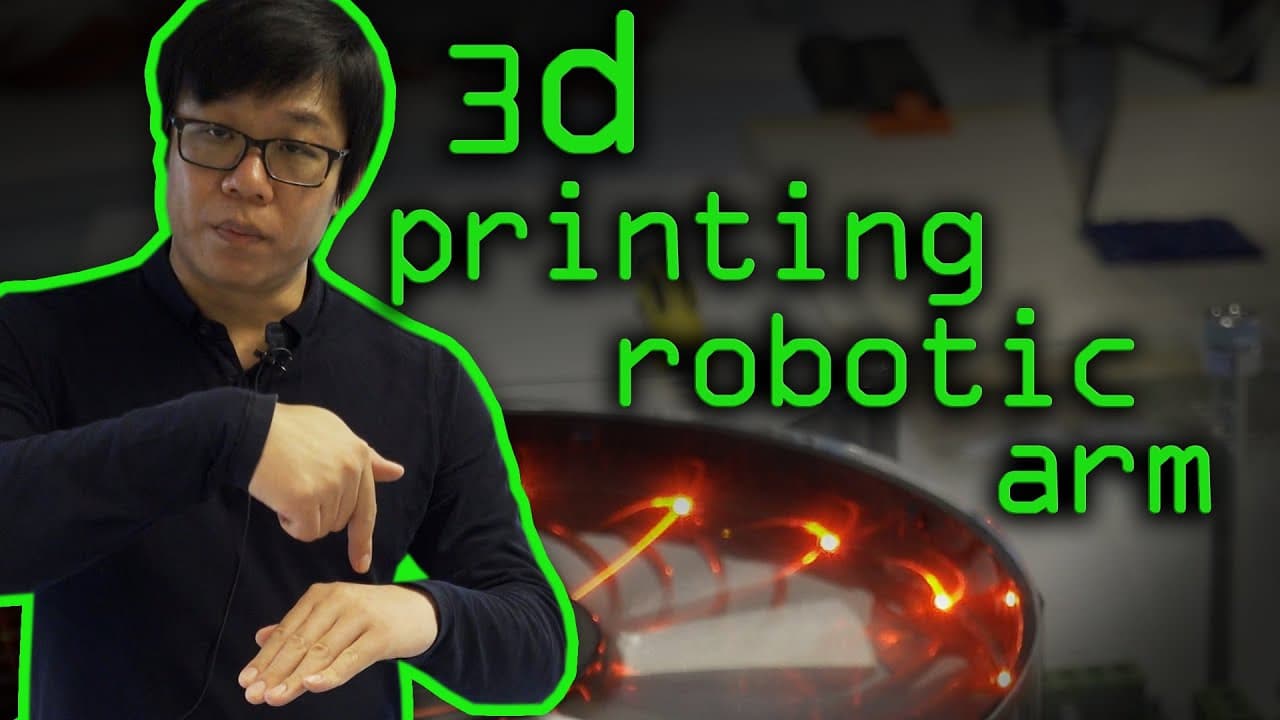
Is a Robotic Arm the Future of 3D Printing?
TL;DR
A robotic arm with six axes enhances 3D printing capabilities by allowing for greater flexibility and stronger, fiber-reinforced structures. By utilising an Arduino for control, the system can adjust temperature, height, and filament types, enabling precise layering even on complex geometries. This technology represents a significant advancement over traditional 3D printing methods.
Transcript
i'm doing 3d printing by this robotic arm it's driven by six axis compared with the conventional 3d printer it can have more flexibility you can print like this like this straight like this this movement because for the fiber reinforced 3d printed object the fiber geometry the fiber part is quite important but for conventional sweet printer it only... Read More
Key Insights
- 💪 A robotic arm with six axes enables more flexibility and stronger prints in fiber-reinforced 3D printing.
- 🎮 The Arduino controller plays a crucial role in regulating temperature, printing height, and motor speed in this setup.
- 👻 The ability to switch between resolution heights and different filaments allows for customized and reinforced printing.
- 💪 Following curved geometries during printing ensures stronger connections between layers.
- 😒 The use of carbon fiber reinforcement can significantly enhance the mechanical properties of printed parts.
- 🦾 The robotic arm's capacity to print varied orientations and curved surfaces improves geometric accuracy.
- 😥 The division of curves into points for the robotic arm to follow results in precise and controlled printing.
Install to Summarize YouTube Videos and Get Transcripts
Explore YouTube Video Summarizer or Get YouTube Transcript Extractor
Questions & Answers
Q: How does the robotic arm with six axes improve fiber-reinforced 3D printing?
The six axes of the robotic arm allow for varied movements and orientations, enabling stronger and more accurate prints with fiber reinforcement. It can print layers in different orientations, gradually changing from a flat to a curved surface for improved strength and geometry.
Q: What functions does the Arduino controller perform in this 3D printing setup?
The Arduino controller receives signals from the robotic controller, regulates temperature and printing height through heaters and sensors, and controls the motor speed for extrusion. It acts as an interface between the robotic arm and the defector, ensuring precise control over the printing process.
Q: Why is the ability to switch between different resolution heights and filaments important?
Switching between resolution heights allows for more precise printing of specific materials, such as carbon fiber. Different parts of a print can be reinforced with stronger materials, enhancing overall durability. This flexibility improves the quality and customization of the printed objects.
Q: How does the robotic arm follow curves during printing?
The robotic arm follows a pre-defined logic and set points to print along curves. The arm's movement ensures that the nozzle remains vertical with the printed surface, resulting in stronger connections between layers. This feature sets it apart from conventional 3D printers.
Summary & Key Takeaways
-
The robotic arm with six axes provides greater flexibility for printing fiber-reinforced 3D objects, resulting in stronger and more accurate geometries.
-
The controller device used is an Arduino, which receives signals from the robotic controller and controls temperature, printing height, and motor speed.
-
The ability to switch between different resolution heights and filaments during printing allows for customized, reinforced parts as needed.
Read in Other Languages (beta)
Share This Summary 📚
Summarize YouTube Videos and Get Video Transcripts with 1-Click
Try YouTube Summary with ChatGPT & Claude or YouTube Transcript Generator
Explore More Summaries from Computerphile 📚





Summarize YouTube Videos and Get Video Transcripts with 1-Click
Try YouTube Summary with ChatGPT & Claude or YouTube Transcript Generator