How to run a free restaurant that pays customers to eat
TL;DR
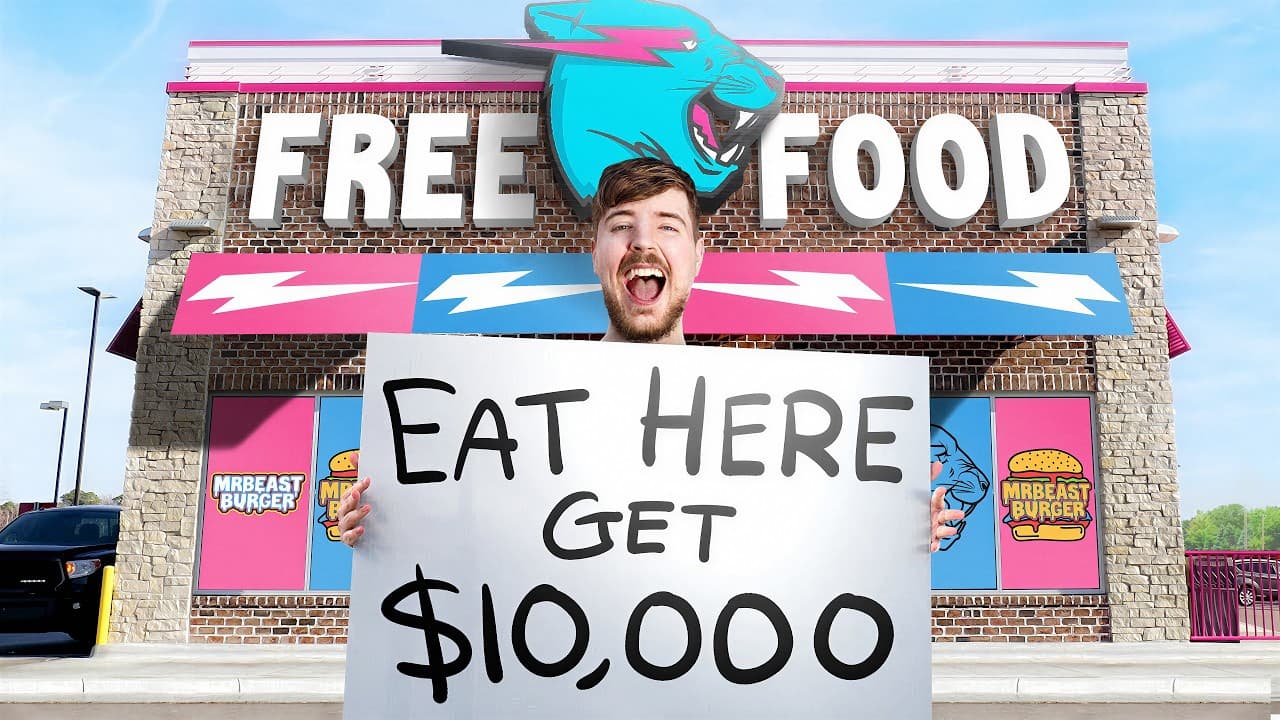
The video shows MrBeast opening a free restaurant and paying customers to eat, sparking massive demand and chaotic lines. They improvise with extra staff and incentives, eventually distribute money, cars, and devices to keep pace with crowd size, but decide to close early to avoid blocking traffic. The core lesson is that generosity can attract attention but requires fast organization and safety considerations.
Transcript
- I opened up the world's first free restaurant. And if that wasn't enough, I also paid people to eat at my restaurant. We haven't even opened yet and the police just told us they had to shut down a mile of traffic and there's a thousand cars in line. Put it on up. Yeah.
- Yeah. I've never ran a restaurant before. Money for you, money for you, mone... Read More
Key Insights
- The venture hinges on a high level of generosity to attract attention and participants.
- The operation quickly reveals that fast food preparation under chaos is far harder than expected.
- The team improvises by adding helpers, multiple service windows, and spontaneous prize giveaways to sustain momentum.
- Financial incentives like cash and gifts are used strategically to manage queues and keep customers engaged.
- Unforeseen events, such as cars in line and a vehicle giveaway, escalate the scope and risk of the operation.
- Coordination with local authorities leads to a decision to close early for safety and traffic considerations.
- Communicating the scale of demand helps justify rapid expansion and the need for more staff and space.
- The experience demonstrates how large-scale promotional stunts require contingency plans and clear safety protocols.
Install to Summarize YouTube Videos and Get Transcripts
Explore YouTube Video Summarizer or Get YouTube Transcript Extractor
Questions & Answers
Q: What is the basic idea behind the video’s restaurant stunt
The video centers on opening the world’s first free restaurant and paying people to eat there. The aim is to create a massive, attention grabbing event that can generate interest and engagement. The narrative follows the challenges of cooking at a large scale, managing lines, and sustaining generosity while improvising with extra help, cash gifts, and prize giveaways to keep customers excited and fed.
Q: What happens when demand exceeds supply at the restaurant
Demand quickly outstrips the restaurant’s capacity, causing long lines and traffic disruption. To cope, the team brings in extra cooks and employees, creates a second service window, and starts giving away money and prizes to diffuse tension and keep customers engaged while they work to prepare more food. The situation illustrates the difficulty of scaling a charity style event in real time.
Q: How do they handle the logistics of giving away money and prizes
Money is handed out in response to customer needs and as incentives to keep the line moving. They also introduce prizes like AirPods and iPads, and even a car can be awarded to acknowledge customers and generate headlines. The team uses a mix of cash allocations and donated or bought prizes to create a sense of value and urgency while feeding people.
Q: What safety or legal concerns are encountered during the stunt
The operation risks blocking traffic and drawing a police response. Local authorities are consulted, and the team ultimately decides to close the restaurant early to reduce traffic disruption and address safety concerns. The experience highlights the importance of coordinating with authorities and planning for crowd control in large scale promotional events.
Q: How does the team adapt to unexpected events during the day
They respond to a side swiping incident, a car with limited fuel, and a growing crowd by reallocating resources, adding new staff, and improvising with additional service windows. These adaptations demonstrate the need for flexibility and quick decision making when handling unpredictable factors in a real time event.
Q: What role do staff and volunteers play in the operation
Staff and volunteers become essential as the line grows, with people assigned to different tasks such as cooking, serving, and crowd management. They help scale operations by coordinating across windows and ensuring that food and money are distributed quickly. Their teamwork is critical to sustaining momentum during peak demand.
Q: What does the video suggest about promotional generosity as a strategy
The video shows that generosity can attract massive attention and participation, creating a powerful narrative that resonates with viewers. However, it also demonstrates that such stunts require careful planning, rapid scalability, and risk management. Without these elements, the generosity can lead to chaos rather than a smooth, positive outcome.
Q: What is the takeaway regarding closing the event and reflecting on impact
The takeaway is that responsible closure and safety considerations are essential after a highly visible promotional stunt. Coordinating with authorities, ensuring no long term disruption, and communicating the results helps preserve goodwill. The experience underscores the balance between generosity and responsible operations in large scale marketing.
Summary & Key Takeaways
-
The team launches a free restaurant concept and immediately faces overwhelming demand and lengthy lines.
-
They distribute money and prizes to customers to manage demand and maintain excitement while expanding operations.
-
After legal and safety concerns rise, they close early with a plan to responsibly return to normal operations while preserving goodwill.
Read in Other Languages (beta)
Share This Summary 📚
Summarize YouTube Videos and Get Video Transcripts with 1-Click
Try YouTube Summary with ChatGPT & Claude or YouTube Transcript Generator
Explore More Summaries from MrBeast 📚





Summarize YouTube Videos and Get Video Transcripts with 1-Click
Try YouTube Summary with ChatGPT & Claude or YouTube Transcript Generator