How Will the SEC Modernize U.S. Capital Markets?
TL;DR
The SEC plans to modernize regulations, address litigation risks, and simplify corporate governance to make public listings more attractive. Chairman Paul Atkins also says the agency has enough authority to advance crypto policy, including a proposed innovation exemption, while it assists Congress with legislation and seeks to preserve the risk-taking culture behind U.S. capital formation.
Transcript
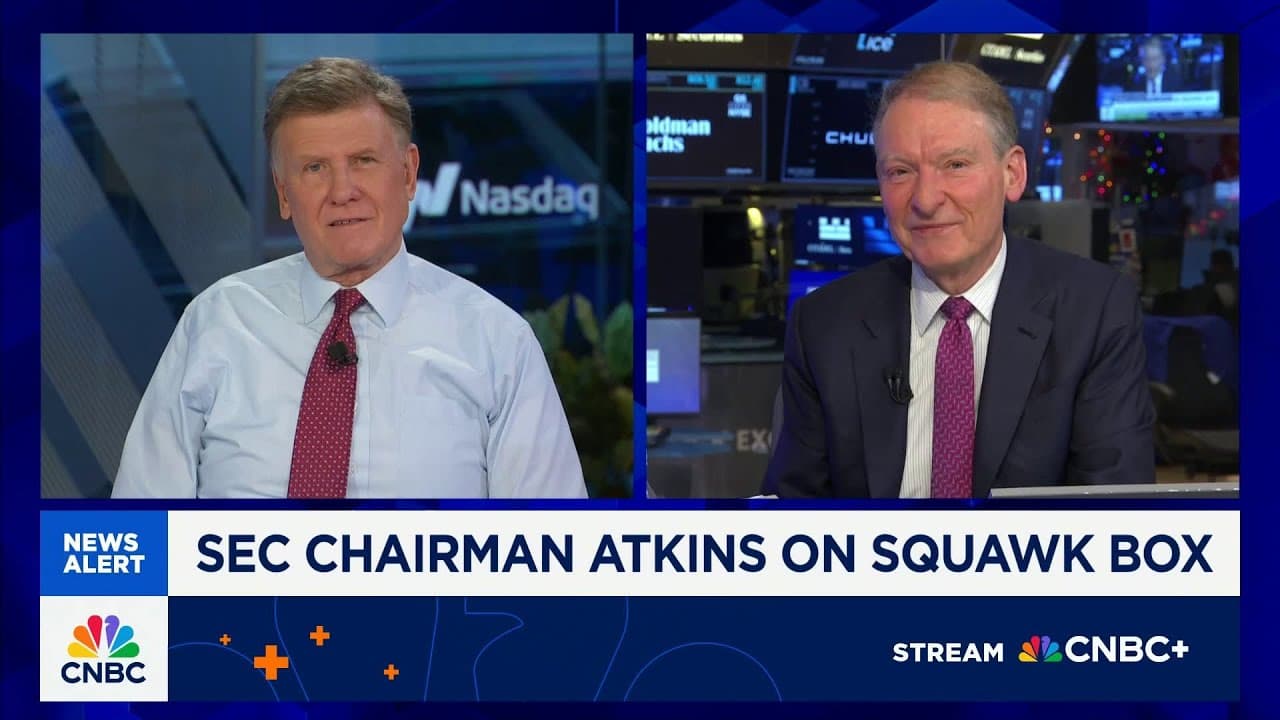
OUR NEXT GUEST IS GOING TO WEIGH IN ON CRYPTO REGULATIONS, CORPORATE GOVERNANCE AND MORE. JOINING US NOW SEC CHAIRMAN PAUL ATKINS. MR. CHAIRMAN I SEE WHERE YOU ARE RIGHT NOW AT THE NEW YORK STOCK EXCHANGE. YOU'RE GOING TO CELEBRATE OR AT LEAST TALK ABOUT AMERICA'S 250TH, WHICH IS COMING UP NEXT YEAR. AND THERE'S A CEREMONY AT THE OPENING BELL. A... Read More
Key Insights
- Capital markets are an engine of innovation because investors risk their money so entrepreneurs can develop products, pursue ambitious ideas, and build companies. Atkins links this process to America’s history of individual liberty, secure property rights, economic prosperity, and the pursuit of happiness.
- Risk-taking is a defining strength of U.S. investment culture, according to Atkins. He says observers in Europe and Japan view American capital markets with envy because they efficiently connect entrepreneurial ambitions with investors who can share in the value created by useful products and services.
- The number of U.S. public companies is roughly half what it was 30 years ago, as described earlier in the interview, while Atkins later characterizes the decline as about 40 percent. He believes the SEC should investigate the causes and make public capital raising more attractive.
- The SEC’s first IPO reform priority is modernizing its rulebook so regulations remain fit for purpose. Atkins wants rules that help both small and large companies attract capital while removing accumulated requirements that make public markets less efficient or appealing.
- The SEC’s second IPO reform priority is examining litigation risks, including strike suits and other actions Atkins characterizes as frivolous. He believes these legal pressures can discourage companies from becoming public and should be considered when evaluating the health of public markets.
- The SEC’s third IPO reform priority is simplifying corporate governance processes that consume management time without winning shareholder approval. Atkins says some shareholder proposals generate noise and can be weaponized by special-interest groups rather than contributing meaningfully to corporate decision-making.
- Crypto policy can advance under the SEC’s existing authority, according to Atkins, even as the agency works with Congress and provides technical assistance on legislation. He hopes to release an innovation exemption in about a month after work was delayed by the government shutdown.
- Private markets provide a useful outlet for venture capital, private equity, institutional money, and other investors because they have become more fluid and liquid. Atkins nevertheless argues that accumulated regulatory burdens should be removed so public markets can compete more effectively for companies and capital.
Install to Summarize YouTube Videos and Get Transcripts
Explore YouTube Video Summarizer or Get YouTube Transcript Extractor
Questions & Answers
Q: How does the SEC plan to make IPOs more attractive?
The SEC plans to pursue three main reforms: modernize its rulebook so regulations are fit for purpose, examine litigation risks such as strike suits and other actions Atkins calls frivolous, and simplify corporate governance processes that consume time without producing proposals shareholders adopt. Together, these changes are intended to reduce obstacles, improve efficiency, and attract capital back to public markets.
Q: Why has the number of U.S. public companies declined?
Atkins attributes the decline to several factors rather than a single cause. Private markets have become more fluid and liquid, giving venture capital, private equity, institutional money, and other investors an effective alternative to public markets. He also believes accumulated regulation, litigation exposure, and corporate governance burdens have made public ownership less attractive and should be examined by the SEC.
Q: Can the SEC advance crypto regulation without new legislation?
Atkins says the SEC has enough existing authority to move crypto policy forward, although the agency is also working with Congress and providing technical assistance on possible legislation. That assistance is intended to help proposed rules make sense and fit with other laws. He does not predict whether Congress will complete legislation before the end of the year.
Q: What is the SEC innovation exemption for crypto?
The innovation exemption is a crypto-related measure that Atkins says the SEC has been discussing and hopes to release in about a month. He presents it as part of the agency’s effort to embrace a new area of innovation and create rules that help the sector move forward. The transcript does not provide specific eligibility requirements or operational details.
Q: How does Paul Atkins distinguish investing from gambling?
Atkins describes risk-taking as a continuum that includes both longer-term and shorter-term activity. He believes the overlap is manageable and focuses his comments on capital markets, while leaving futures and derivatives oversight to colleagues at the Commodity Futures Trading Commission. His central concern is preserving an investment culture that supplies capital to entrepreneurs while recognizing that people tolerate risk differently.
Q: Why does the SEC want to reform shareholder proposals?
Atkins says some corporate governance processes take substantial time while producing proposals that shareholders do not adopt. He argues that these proposals can create noise and be weaponized by particular special-interest groups. Reform is therefore part of his effort to return the SEC to basic purposes, make its rulebook fit for purpose, and improve the efficiency and growth of capital markets.
Q: What role do capital markets play in American innovation?
Atkins says capital markets allow investors to risk money on entrepreneurs who need funding to develop products and pursue new ideas. Investors can then share in the value created when those products meet needs and attract buyers. He connects this system to American prosperity, arguing that investment and risk-taking have supported national development and advances ranging from airplanes to space ambitions.
Q: Are expanding private markets good for the U.S. economy?
Atkins views the growth of private markets as a positive development because they are more fluid and liquid than in the past and provide a useful outlet for venture capital, private equity, institutional money, and other investors. However, he does not see private-market growth as a reason to neglect public markets. He wants regulatory obstacles removed so public listings can attract capital again.
Summary & Key Takeaways
-
Paul Atkins connects America’s economic development with individual liberty, property rights, and investors willing to risk capital on entrepreneurial ideas. He describes capital markets as an engine of innovation and prosperity, arguing that their ability to connect investors with entrepreneurs has supported products, technologies, and national growth throughout the country’s history.
-
The SEC chairman wants to reverse the long decline in listed public companies by pursuing three priorities: modernizing regulations, examining litigation that discourages public ownership, and reforming burdensome corporate governance processes. His stated objective is to remove accumulated regulatory obstacles and make public markets more efficient for companies seeking capital.
-
Atkins says the SEC can move crypto policy forward under its existing authority while providing technical assistance to Congress on possible legislation. He hopes to introduce an innovation exemption after delays caused by the government shutdown. He also views private markets positively but wants public listings to become more attractive and efficient.
Read in Other Languages (beta)
Share This Summary 📚
Summarize YouTube Videos and Get Video Transcripts with 1-Click
Try YouTube Summary with ChatGPT & Claude or YouTube Transcript Generator
Explore More Summaries from CNBC Television 📚


Summarize YouTube Videos and Get Video Transcripts with 1-Click
Try YouTube Summary with ChatGPT & Claude or YouTube Transcript Generator