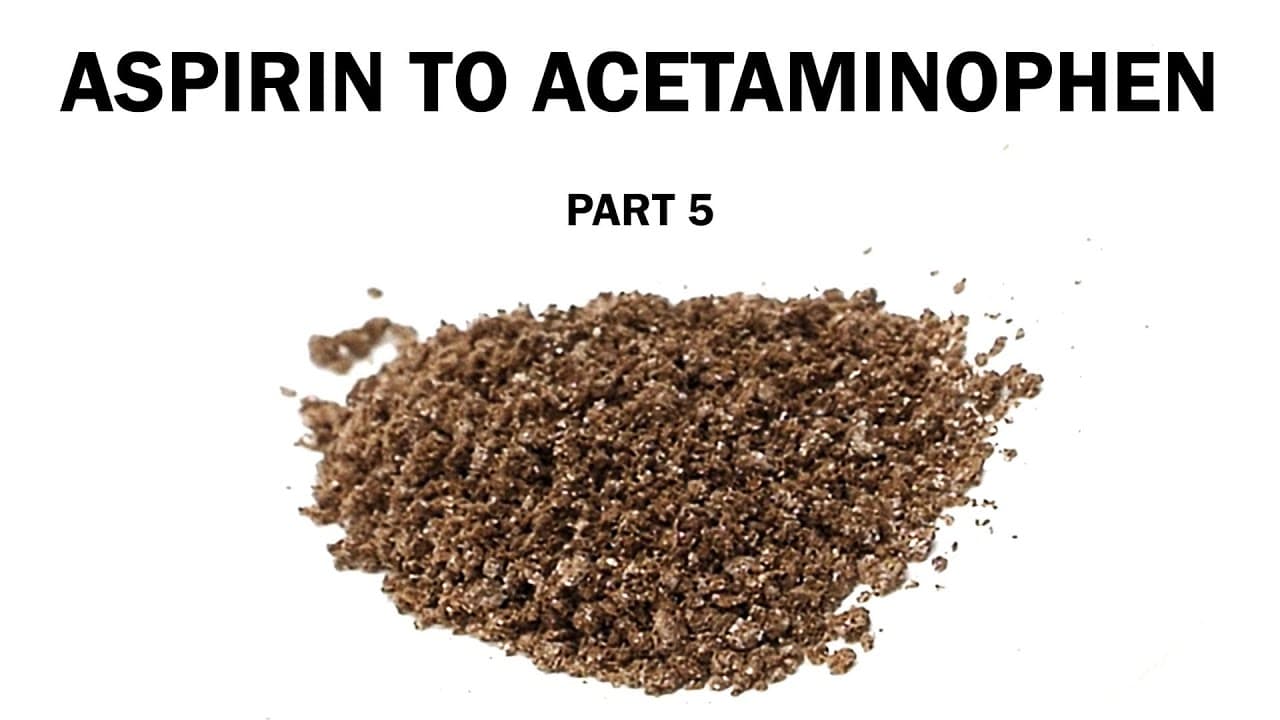
Aspirin to Acetaminophen - Part 5 of 6: Reducing p-nitrophenol to p-aminophenol
TL;DR
The fifth installment in a series about converting aspirin to paracetamol through a reduction reaction using sodium borohydride and padium on carbon.
Transcript
over a month ago I started the conversion of aspirin to paracetamol and I'm finally getting close to finishing it this is the fifth installment out of six and I've already done quite a bit in the past four videos just to recap I've extracted the Asa from aspirin pills hydrolized it decarbox it to phenol and then I nitrated it in this video I now ne... Read More
Key Insights
- 😀 The reduction reaction of p-nitrophenol to p-aminophenol is achieved using sodium borohydride and padium on carbon.
- 🎮 Temperature control is crucial during the reaction to prevent overheating or excessive cooling.
- 😀 Filtration is a critical step in separating impurities, but a vacuum filtration is recommended to minimize decomposition of p-aminophenol.
- 💁 The conversion of salted p-aminophenol back to its free base form is necessary for further purification.
- 😀 The yield of p-aminophenol may be affected by impurities in the starting material, workup techniques, and decomposition during the process.
- 🌱 The author plans to upload the final video in the series soon, aiming to improve the overall yield.
- 🎮 Supporters on Patreon receive recognition in the videos, and the author encourages subscriptions to stay updated.
Install to Summarize YouTube Videos and Get Transcripts
Explore YouTube Video Summarizer or Get YouTube Transcript Extractor
Questions & Answers
Q: What reagents are used in the reduction reaction to convert p-nitrophenol to p-aminophenol?
Sodium borohydride and padium on carbon are used as reagents in the reduction reaction to convert p-nitrophenol to p-aminophenol.
Q: Why did the author choose to use the sodium borohydride and padium on carbon method instead of the classic iron and hydrochloric acid method?
The author chose the sodium borohydride and padium on carbon method because it is cleaner and easier to perform, although the reagents are more expensive and harder to obtain.
Q: How does the author ensure temperature control during the addition of p-nitrophenol?
The author keeps the temperature between 13°C and 17°C by adding p-nitrophenol in small portions and using an ice bath when needed.
Q: What is the purpose of adding hydrochloric acid in the reduction reaction?
The hydrochloric acid serves to neutralize any unreacted sodium borohydride and dissolve the p-aminophenol salt, creating a more soluble form.
Summary & Key Takeaways
-
The content showcases the reduction of p-nitrophenol to p-aminophenol using sodium borohydride and padium on carbon.
-
The author describes the process of adding reagents, maintaining temperature control, and adding hydrochloric acid to neutralize remaining sodium borohydride.
-
The author highlights the challenges faced during the filtration process and the importance of converting the salted p-aminophenol back to its free base form using sodium bicarbonate.
Read in Other Languages (beta)
Share This Summary 📚
Summarize YouTube Videos and Get Video Transcripts with 1-Click
Try YouTube Summary with ChatGPT & Claude or YouTube Transcript Generator
Explore More Summaries from NileRed 📚


Summarize YouTube Videos and Get Video Transcripts with 1-Click
Try YouTube Summary with ChatGPT & Claude or YouTube Transcript Generator