How Does the Esterification Reaction Work in Chemistry?
TL;DR
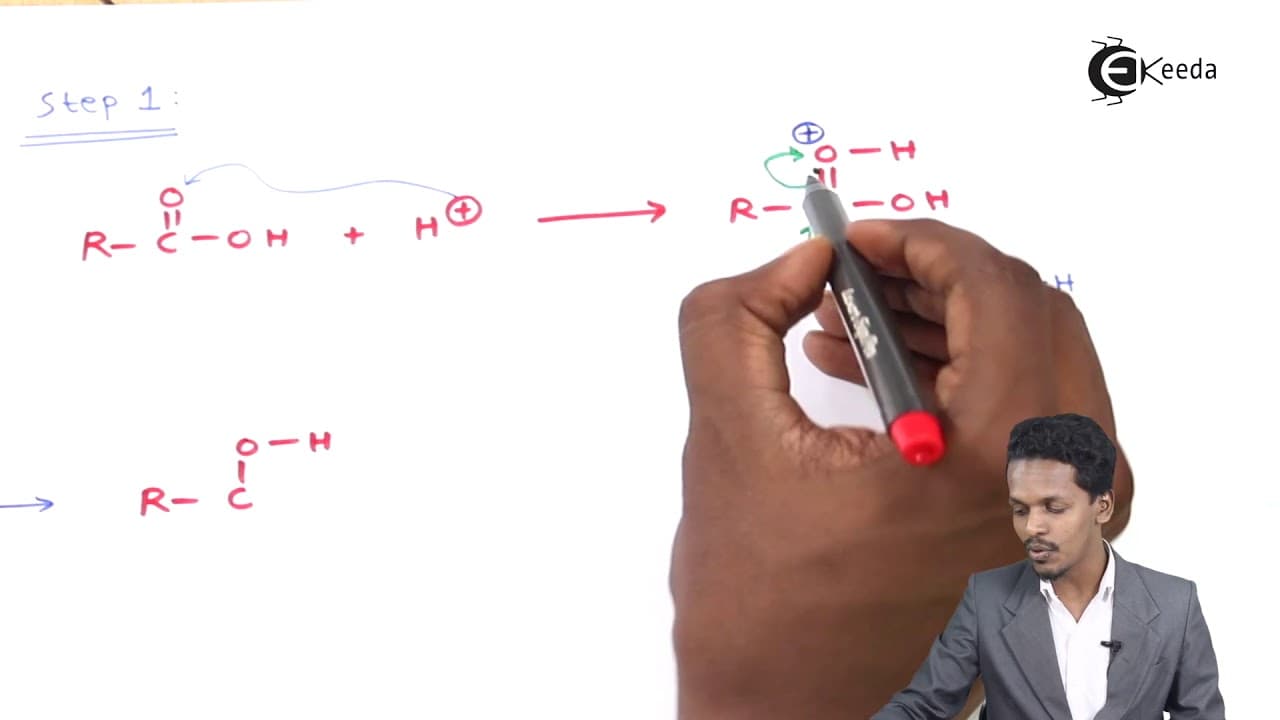
The esterification reaction occurs when a carboxylic acid reacts with an alcohol in the presence of an acid catalyst, typically sulfuric acid, resulting in the formation of an ester and water. The mechanism involves two key steps: the formation of a tetrahedral intermediate and its conversion into the final ester product.
Transcript
click the bell icon to get latest videos from akira elephants in the previous lecture we have understood that is what is the effect of these substrates on the acidic strength of the carboxylic acid and now we are going to talk about the mechanism of the earth stood if occasionally action so now let us discuss about that so friends here we are going... Read More
Key Insights
- 🈸 Esterification is a chemical reaction used to create esters, which have various applications in industries.
- 🔉 The reaction requires an acidic medium, with sulfuric acid being a commonly used catalyst.
- 💁 The esterification mechanism involves the formation of a tetrahedral intermediate and its subsequent conversion into an ester.
- 🤽 The acid catalyst plays a crucial role in initiating the reaction and facilitating the removal of water as a by-product.
- 🫀 Stabilization of positive charges on oxygen atoms is crucial in the reaction steps.
- 🆘 The presence of alcohol helps in stabilizing the intermediate and facilitating the reaction.
- ❓ Esterification is an important process in the synthesis of fragrances, flavors, and solvents.
Install to Summarize YouTube Videos and Get Transcripts
Explore YouTube Video Summarizer or Get YouTube Transcript Extractor
Questions & Answers
Q: What is esterification?
Esterification is a chemical reaction between a carboxylic acid and an alcohol to produce an ester. It is commonly used in the synthesis of fragrances, flavors, and solvents.
Q: What role does the acid catalyst play in esterification?
The acid catalyst, usually sulfuric acid (H2SO4), provides protons (H+) that initiate the reaction by attacking the oxygen of the carboxylic acid. It also helps in the removal of water as a by-product.
Q: How does the formation of a tetrahedral intermediate occur in esterification?
In the first step of the mechanism, the acid catalyst (H+) attacks the oxygen of the carboxylic acid, resulting in the formation of a tetrahedral intermediate. This intermediate is unstable and is stabilized by the presence of alcohol, which attacks the positively charged carbon.
Q: What happens in the second step of esterification mechanism?
In the second step, the tetrahedral intermediate is converted into an ester. The acid catalyst (H+) attacks the oxygen of the intermediate, leading to the release of a water molecule. The resulting product is an ester.
Summary & Key Takeaways
-
Esterification is the reaction between a carboxylic acid and an alcohol to form an ester.
-
This reaction occurs in an acidic medium, with the acid catalyst facilitating the reaction.
-
The mechanism of esterification involves two steps: the formation of a tetrahedral intermediate and the conversion of the intermediate into an ester.
Read in Other Languages (beta)
Share This Summary 📚
Summarize YouTube Videos and Get Video Transcripts with 1-Click
Try YouTube Summary with ChatGPT & Claude or YouTube Transcript Generator
Explore More Summaries from Ekeeda 📚





Summarize YouTube Videos and Get Video Transcripts with 1-Click
Try YouTube Summary with ChatGPT & Claude or YouTube Transcript Generator