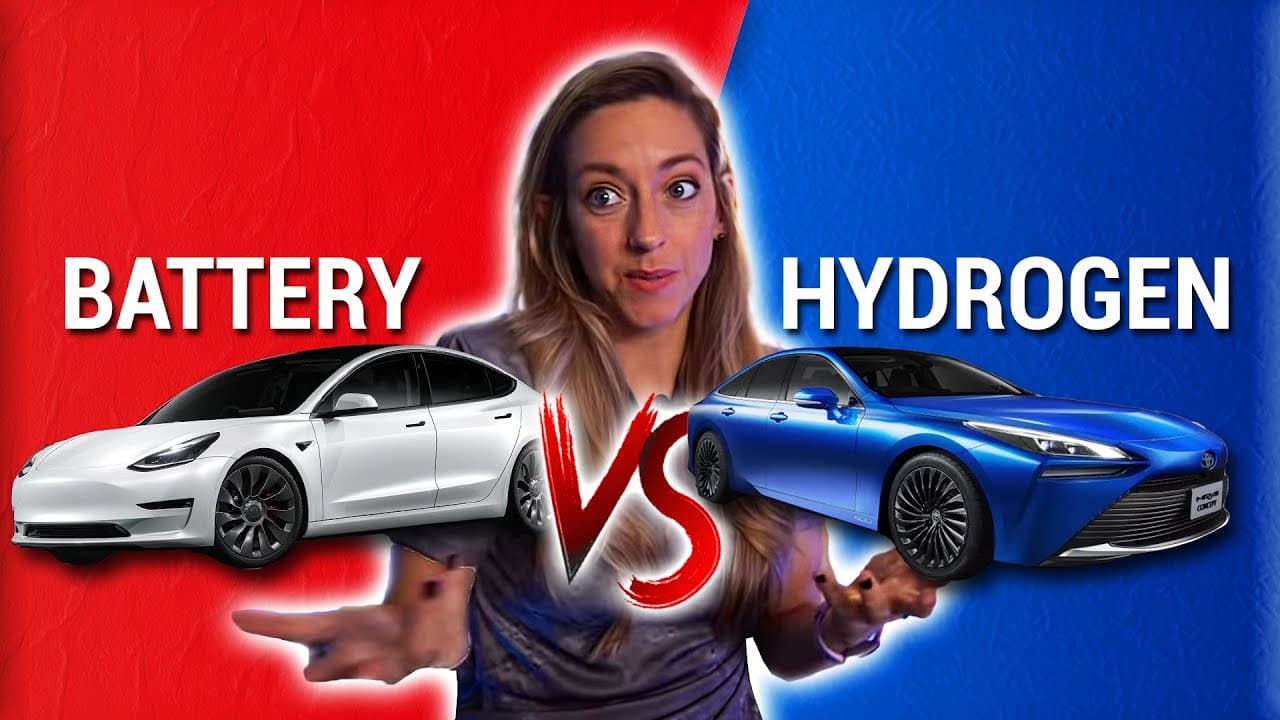
Hydrogen vs. Battery Electric Cars: Which Is Better?
TL;DR
Hydrogen fuel cell vehicles offer a comparable driving range to battery-electric cars, with some exceeding 400 miles. Refueling a hydrogen car takes about five minutes, while charging a battery-electric vehicle can take hours. However, battery-electric vehicles are more efficient and have a more developed infrastructure, making both technologies necessary for future transportation solutions.
Transcript
- [Goldstein] We have 17,000 trucks. What do you think it would take to take a quarter of those offline and charge them overnight? What would the utility requirements be like? - We are talking about batteries versus hydrogen cars. Hey, I'm Dianna, you're watching Physics Girl. We are back with our renewable energy series. My production team and I w... Read More
Key Insights
- 🚙 Hydrogen fuel cell vehicles have a comparable driving range to battery-electric vehicles, with some models even surpassing battery-electric vehicles in range.
- 🚙 Refueling time is significantly faster for hydrogen cars, taking about five minutes compared to hours needed to charge a battery-electric vehicle.
- 🚉 Infrastructure for battery-electric vehicles is more developed, with thousands of charging stations available, while hydrogen refueling stations are scarce.
- ✋ Battery-electric vehicles have higher overall efficiency due to fewer energy losses during conversion and transportation compared to hydrogen fuel cells.
- 🛳️ Hydrogen fuel cells have advantages in higher weight capacity and longer ranges for transportation beyond passenger cars, such as trucks, ships, and planes.
- 🚙 The development of both battery-electric vehicles and hydrogen fuel cells is crucial for energy diversification and reducing emissions.
- 👨🔬 More research and development are needed to improve the reliability and efficiency of hydrogen refueling stations, and to establish a more comprehensive infrastructure.
Install to Summarize YouTube Videos and Get Transcripts
Explore YouTube Video Summarizer or Get YouTube Transcript Extractor
Questions & Answers
Q: How does the driving range of battery-electric vehicles compare to hydrogen cars?
Battery-electric vehicles typically have a range of 100 to 200 miles, while hydrogen cars average around 300 miles, with some models going up to 402 miles.
Q: What is the difference in refueling time for battery-electric vehicles and hydrogen cars?
It takes hours to fully charge a battery-electric vehicle, while refueling a hydrogen car only takes about five minutes.
Q: What is the current state of infrastructure for battery-electric vehicles and hydrogen cars?
There are over 5,000 super-charging stations for battery-electric vehicles, while there are only around 45 hydrogen refueling stations in California. Battery-electric vehicles have more extensive infrastructure.
Q: What are the efficiency differences between hydrogen fuel cells and batteries?
Battery-electric vehicles have an overall efficiency of 70-90%, while fuel cells have an efficiency of 25-35%. Batteries have higher efficiency due to fewer energy losses in the conversion and transportation processes.
Summary & Key Takeaways
-
Battery-electric vehicles and hydrogen fuel cell vehicles are both types of electric vehicles, but they have different technologies and characteristics.
-
Battery-electric vehicles have a driving range of 100 to 200 miles, while hydrogen cars have a range of around 300 miles, with some models reaching up to 402 miles.
-
Charging a battery-electric vehicle can take hours, while refueling a hydrogen car only takes about five minutes, but hydrogen refueling stations are much less common compared to electric charging stations.
Read in Other Languages (beta)
Share This Summary 📚
Summarize YouTube Videos and Get Video Transcripts with 1-Click
Try YouTube Summary with ChatGPT & Claude or YouTube Transcript Generator
Explore More Summaries from Physics Girl 📚






Summarize YouTube Videos and Get Video Transcripts with 1-Click
Try YouTube Summary with ChatGPT & Claude or YouTube Transcript Generator