How to Structure a Straight Line Sales Conversation
TL;DR
Guide a sales conversation through a fixed sequence: establish control, ask intelligent questions, build rapport, transition to a tailored presentation, and request the order. The method aims to increase a prospect’s certainty by matching the proposed solution to needs, pain points, values, and financial qualifications uncovered during questioning.
Transcript
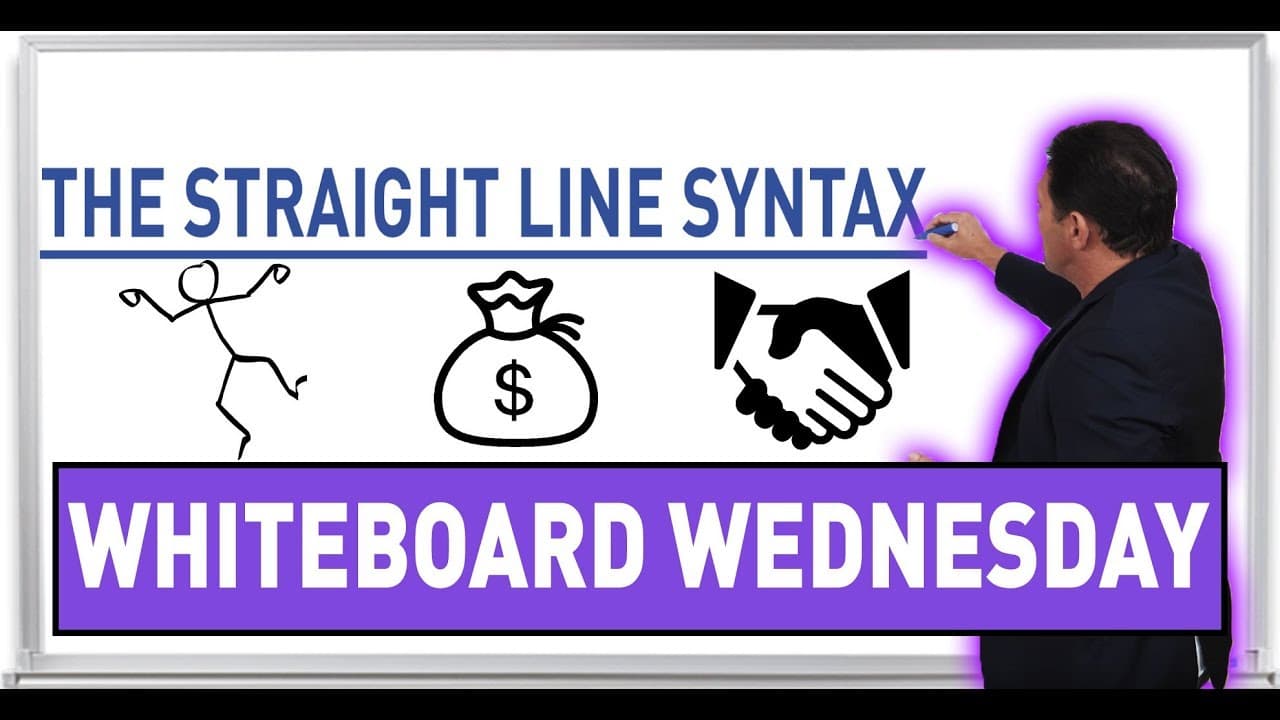
hey Jordan don't fall here and it is whiteboard Wednesday and the topic for today is a really really awesome one it's actually the basis for the entire straight line system so the topic the title is called the straight line syntax and just so you know I never really teach this publicly like this yeah but I thought it'd be good to just do a an overl... Read More
Key Insights
- Every goal-oriented sale can follow the same underlying structure even though prospects have different needs, values, beliefs, pain points, and experiences. The repeatable element is not the customer’s situation, but the ordered communication process used to understand that situation and create certainty.
- Straight Line syntax is the defined order in which a salesperson performs the stages of persuasion. The approach treats selling as a transfer of certainty, moving a prospect from relatively low certainty toward strong confidence through a sequence that remains consistent across encounters.
- Immediate control is the first stage of the sales conversation. Control is gained by being perceived as a sharp, knowledgeable expert whom the prospect can trust to guide the interaction, and it must be established within the first few seconds of the encounter.
- The purpose of conversational control is to enable intelligent questioning, not continuous talking. A salesperson needs enough control to ask questions in a useful order and discover the prospect’s pain points, needs, values, financial qualification, and other information required to assess suitability.
- Rapport is built simultaneously with intelligence gathering when questions are delivered with appropriate tonality and body language. Careful listening helps the salesperson appear like a trusted adviser who wants to understand and assist, rather than an intrusive interrogator collecting information without empathy.
- A transition connects discovery to the proposed solution after the necessary questions have been answered. The salesperson summarizes that the offer appears to be a suitable fit based on what the prospect said, then introduces an explanation of why the solution applies.
- The presentation should connect product or service features and benefits to the problems uncovered during intelligence gathering. Its persuasive value depends on relevance, since the salesperson first learns what matters to the prospect and then explains how the proposed solution addresses those concerns.
- The first request for the order occurs at the end of the presentation, after control, questioning, rapport building, and the transition. A prospect may accept, reject, or raise an objection, with the first objection beginning the next stage of the process described in the transcript.
Install to Summarize YouTube Videos and Get Transcripts
Explore YouTube Video Summarizer or Get YouTube Transcript Extractor
Questions & Answers
Q: What is the Straight Line sales syntax?
The Straight Line sales syntax is an ordered process for conducting goal-oriented communication. Syntax means the order in which actions occur. In selling, the process begins with immediate control, continues through intelligence gathering and rapport building, moves into a transition and tailored presentation, and then reaches the first request for the order and the prospect’s response.
Q: Why does the order of a sales conversation matter?
The order matters because each stage creates the conditions needed for the next one. A salesperson first establishes enough control to ask organized questions, uses the answers to understand the prospect and build rapport, then presents a relevant solution. Presenting before discovering needs would remove the information needed to explain why the offer fits the prospect’s situation.
Q: How should a salesperson take control of a conversation?
A salesperson should take control in the first few seconds by being perceived as sharp, knowledgeable, and expert enough to guide the encounter. The prospect is more likely to yield control when the salesperson demonstrates credible expertise. That control should then be used to direct an orderly discovery process, not as permission to dominate the discussion with nonstop talking.
Q: What information should a salesperson gather from a prospect?
A salesperson should ask smart questions that reveal the prospect’s needs, pain points, values, prior experiences, and financial qualification. This information serves two purposes: it helps determine whether the prospect is qualified, and it gives the salesperson the material needed to connect the eventual presentation to the prospect’s specific problems and desired outcomes.
Q: How can sales questions build rapport instead of causing discomfort?
Sales questions can build rapport when they are asked with suitable tonality and body language and followed by attentive listening. The salesperson should come across as a trusted adviser or a professional trying to identify the right solution. If the same questions feel nosy or mechanical, the prospect may instead perceive the salesperson as an interrogator and withdraw trust.
Q: How do you transition from discovery to a sales presentation?
After gathering all necessary information, the salesperson should explicitly connect the prospect’s answers to the proposed solution. A simple transition states that, based on what the prospect has shared, the offer appears to be a suitable fit, followed by an explanation of why. This signals that questioning is complete and makes the presentation feel relevant rather than generic.
Q: What should a Straight Line sales presentation focus on?
A Straight Line presentation should focus on the product or service’s features and benefits, especially those that solve problems uncovered during the questioning stage. The salesperson uses the prospect’s own needs and pain points to determine which benefits deserve emphasis. This makes the presentation a response to gathered information instead of a disconnected recitation of everything the offer includes.
Q: When should a salesperson ask for the order?
The salesperson should ask for the order for the first time at the end of the presentation. By then, the salesperson has established control, gathered intelligence, built rapport, transitioned to a suitable solution, and explained its relevant benefits. The prospect may agree, refuse, or present an objection, and an objection leads into the next stage of the sales process.
Summary & Key Takeaways
-
The Straight Line System treats goal-oriented sales conversations as repeatable processes. Its syntax specifies the order in which a salesperson should create certainty. Following the sequence matters because each stage prepares the conditions for the next, much like ingredients in a recipe must be combined in the correct order.
-
The opening stages are taking immediate control, gathering intelligence, and building rapport. Control should come from being perceived as a knowledgeable expert, not from dominating the conversation. It enables the salesperson to ask organized questions about the prospect’s needs, values, pain points, experiences, and financial qualification.
-
After questioning, the salesperson transitions by connecting the prospect’s answers to an appropriate solution. The presentation then emphasizes relevant features, benefits, and problem-solving value. At its conclusion, the salesperson asks for the order. The next stage begins when the prospect raises a first objection rather than immediately agreeing or refusing.
Read in Other Languages (beta)
Share This Summary 📚
Summarize YouTube Videos and Get Video Transcripts with 1-Click
Try YouTube Summary with ChatGPT & Claude or YouTube Transcript Generator
Explore More Summaries from The Wolf of Wall Street 📚





Summarize YouTube Videos and Get Video Transcripts with 1-Click
Try YouTube Summary with ChatGPT & Claude or YouTube Transcript Generator