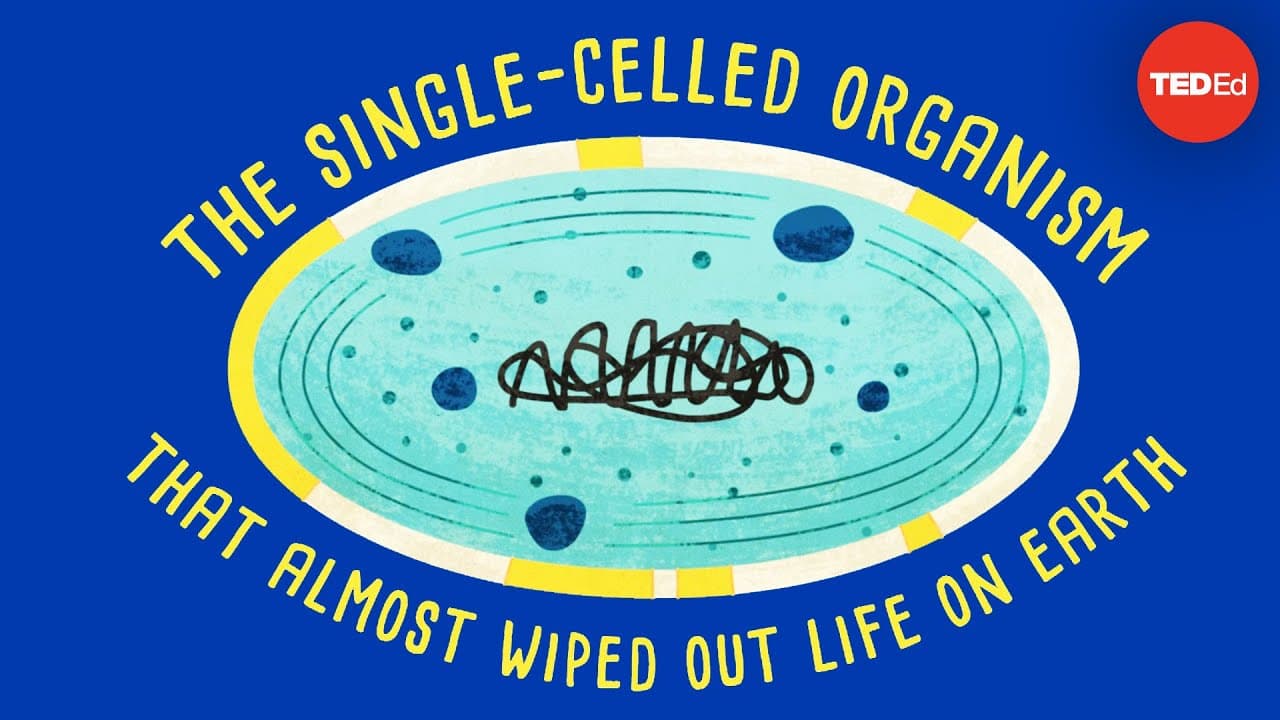
How a single-celled organism almost wiped out life on Earth - Anusuya Willis
TL;DR
Cyanobacteria, as single-celled organisms, revolutionized Earth's atmosphere by producing oxygen, triggering mass extinctions, and paving the way for complex life.
Transcript
There's an organism that changed the world. It caused both the first mass extinction in Earth's history and also paved the way for complex life. How? By sending the first free oxygen molecules into our atmosphere, and they did all this as single-celled life forms. They're cyanobacteria, and the story of these simple organisms that don't even have ... Read More
Key Insights
- 💆 Cyanobacteria initiated the Great Oxygenation Event, driving mass extinctions and atmospheric transformations.
- 🤕 Oxygen production by cyanobacteria led to Earth's first ice age, known as the Huronian Glaciation.
- 😮 The evolution of aerobic organisms was a direct result of the rise in oxygen levels caused by cyanobacteria.
- 🥺 Endosymbiosis with cyanobacteria led to the development of chloroplasts and plant cells, essential for photosynthesis.
- 🖐️ Cyanobacteria continue to play a crucial role in oxygen production and nitrogen fixation, vital for the diversity and sustainability of life on Earth.
- 🤪 The impact of cyanobacteria goes beyond their initial role, influencing the course of evolution and the development of complex life forms.
- 🙂 Understanding the history and contributions of cyanobacteria sheds light on the interconnectedness of life and the delicate balance of Earth's ecosystems.
Install to Summarize YouTube Videos and Get Transcripts
Explore YouTube Video Summarizer or Get YouTube Transcript Extractor
Questions & Answers
Q: How did cyanobacteria change Earth's atmosphere?
Cyanobacteria, through photosynthesis, converted carbon dioxide and water into oxygen gas, significantly altering the atmospheric composition and paving the way for complex life forms.
Q: What impact did the Great Oxygenation Event have on Earth?
The Great Oxygenation Event led to a mass extinction of most life forms on Earth due to the toxic nature of oxygen-rich air, triggering Earth's first ice age and forcing the evolution of aerobic organisms.
Q: What role did cyanobacteria play in the evolution of plant cells?
Through endosymbiosis, cyanobacteria were engulfed by prehistoric microbes, leading to the creation of chloroplasts and plant cells, which are essential for photosynthesis and the sustainability of life on Earth.
Summary & Key Takeaways
-
Cyanobacteria, through photosynthesis, released the first free oxygen molecules into the atmosphere, transforming Earth's composition over billions of years.
-
The Great Oxygenation Event caused a mass extinction as oxygen levels rose, leading to Earth's first ice age and subsequent evolution of aerobic organisms.
-
Cyanobacteria's role in endosymbiosis eventually led to the creation of chloroplasts and plant cells, shaping the diversity of life on Earth.
Read in Other Languages (beta)
Share This Summary 📚
Summarize YouTube Videos and Get Video Transcripts with 1-Click
Try YouTube Summary with ChatGPT & Claude or YouTube Transcript Generator
Explore More Summaries from TED-Ed 📚





Summarize YouTube Videos and Get Video Transcripts with 1-Click
Try YouTube Summary with ChatGPT & Claude or YouTube Transcript Generator