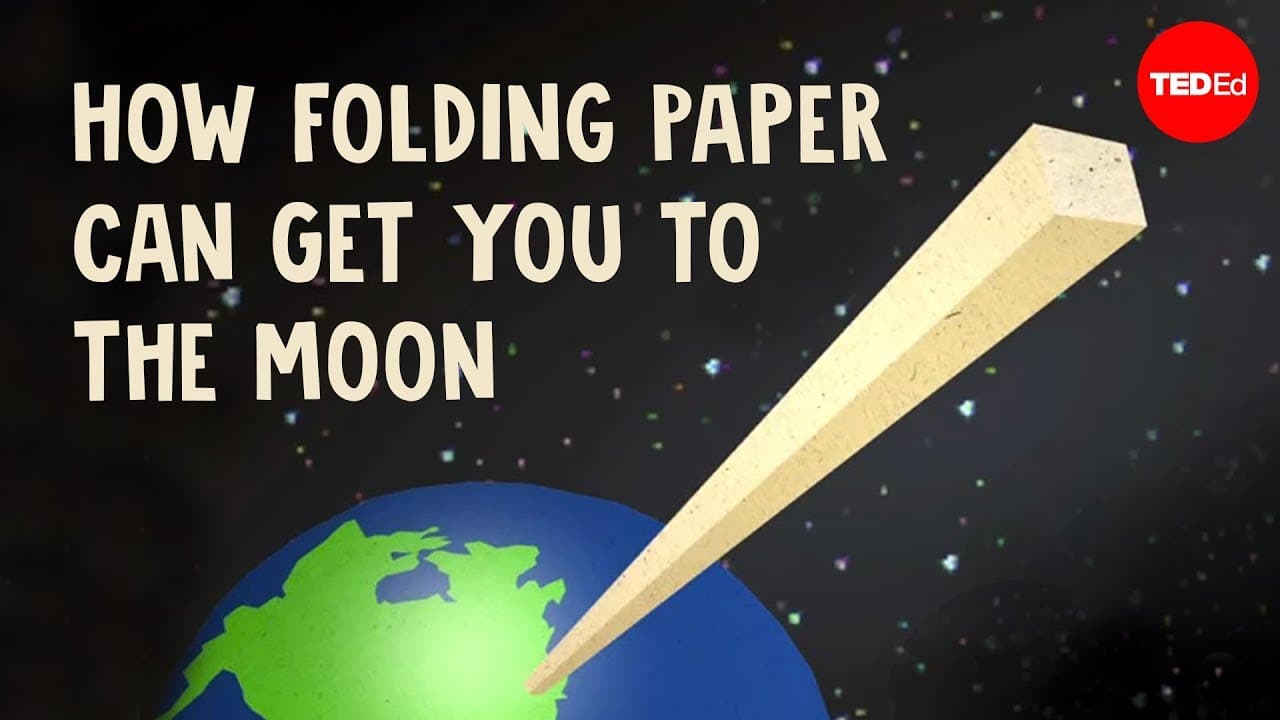
Exponential growth: How folding paper can get you to the Moon
TL;DR
Folding a very fine piece of paper in half multiple times results in exponential growth, with each fold doubling the paper's thickness.
Transcript
How many times can you fold a piece of paper? Assume that one had a piece of paper that was very fine, like the kind they typically use to print the Bible. In reality, it seems like a piece of silk. To qualify these ideas, let's say you have a paper that's one-thousandth of a centimeter in thickness. That is 10 to the power of minus three centimete... Read More
Key Insights
- 🙏 Folding a paper in half repeatedly demonstrates exponential growth.
- 🙏 The thickness of the paper doubles with each fold.
- 😀 Folding the paper 25 times results in a thickness of almost a quarter of a mile.
- 🥺 Continuing to fold the paper leads to significant increases in thickness.
- 🛰️ After 40 folds, the thickness of the paper is nearly 7,000 miles, similar to the average GPS satellite orbit.
- 😀 Folding the paper 48 times results in a thickness over one million miles.
- 😀 The distance between the Earth and the Moon is less than 250,000 miles, achievable by folding a piece of Bible paper 45 times.
Install to Summarize YouTube Videos and Get Transcripts
Explore YouTube Video Summarizer or Get YouTube Transcript Extractor
Questions & Answers
Q: What is the thickness of the paper after 10 folds?
After 10 folds, the paper is one thousand and 24 thousandths of a centimeter thick, which is slightly over one centimeter.
Q: How tall would the folded paper be if it was folded 17 times?
If folded 17 times, the paper would be 131 centimeters thick, which is just over four feet tall.
Q: What is the thickness of the paper after folding it 25 times?
Folding the paper 25 times results in a thickness of 33,554 centimeters, which is just over 1,100 feet.
Q: How many times do you need to fold the paper to reach the Moon?
Starting with a piece of Bible paper, folding it 45 times would result in a thickness that reaches the Moon. Folding it one more time would bring it back to Earth.
Summary
In this video, the concept of folding a piece of paper and its exponential growth is explored. The video begins by posing two questions: how many times can a piece of paper be folded, and what would the thickness of the paper be after a certain number of folds. The video goes on to explain that with each fold, the paper doubles in thickness. Through calculations, it is shown that folding a piece of paper 25 times would result in a thickness of almost a quarter of a mile. The video ends by highlighting the concept of exponential growth and its implications.
Questions & Answers
Q: How many times can a piece of paper be folded?
Assuming that the paper is very fine and thin, like the kind used to print the Bible, it can be folded multiple times. As demonstrated in the video, the paper doubles in thickness with each fold.
Q: What would the thickness of the paper be after folding it 30 times?
If the paper is folded 30 times, its thickness would reach 6.5 miles. This is approximately the average height at which planes fly.
Q: How thick would the paper be after folding it 40 times?
Folding the paper 40 times would result in a thickness of nearly 7,000 miles. This is equivalent to the average GPS satellite's orbit.
Q: How thick would the paper be after folding it 48 times?
After folding the paper 48 times, its thickness would exceed one million miles. This is an astonishing distance, considering that the distance between the Earth and the Moon is less than 250,000 miles.
Q: What is the significance of folding a paper multiple times?
Folding the paper multiple times demonstrates the concept of exponential growth. Each fold exponentially increases the thickness of the paper, resulting in astounding distances.
Q: What can we learn from this exponential growth?
This exponential growth showcases how something as simple as folding a piece of paper can lead to significant results. It serves as a reminder of how exponential growth can quickly propel us far beyond our initial expectations.
Q: Can exponential growth be observed in other scenarios?
Yes, exponential growth can be observed in various fields and applications. It is a fundamental concept in mathematics, biology, finance, and technology, among others.
Q: How does the concept of exponential growth apply to real-life situations?
In real-life, exponential growth can have profound consequences. It can lead to rapid advancements and breakthroughs, as well as unpredictable outcomes. Understanding and harnessing exponential growth is crucial in many areas of life.
Q: Why is it important to consider exponential growth?
Recognizing and considering exponential growth helps us comprehend the potential for rapid change and the need to adapt and plan accordingly. It allows us to anticipate the future and make informed decisions in various domains.
Q: What are the implications of exponential growth?
Exponential growth can bring both opportunities and challenges. It amplifies the possibilities of progress and innovation, but it can also lead to unforeseen consequences and disruptions. It requires careful monitoring and management to ensure positive outcomes.
Takeaways
The video provides a fascinating demonstration of exponential growth by folding a piece of paper. It highlights how even a simple action can result in significant changes over time. This concept of exponential growth applies to various aspects of life, and it is crucial to understand its implications. The video encourages us to consider the potential of exponential growth and its transformative power.
Summary & Key Takeaways
-
Folding the paper in half doubles its thickness with each fold.
-
After 10 folds, the paper is a little over one centimeter thick.
-
Folding the paper 25 times results in a thickness of almost a quarter of a mile.
Read in Other Languages (beta)
Share This Summary 📚
Summarize YouTube Videos and Get Video Transcripts with 1-Click
Try YouTube Summary with ChatGPT & Claude or YouTube Transcript Generator
Explore More Summaries from TED-Ed 📚





Summarize YouTube Videos and Get Video Transcripts with 1-Click
Try YouTube Summary with ChatGPT & Claude or YouTube Transcript Generator