5 tips to improve your critical thinking - Samantha Agoos
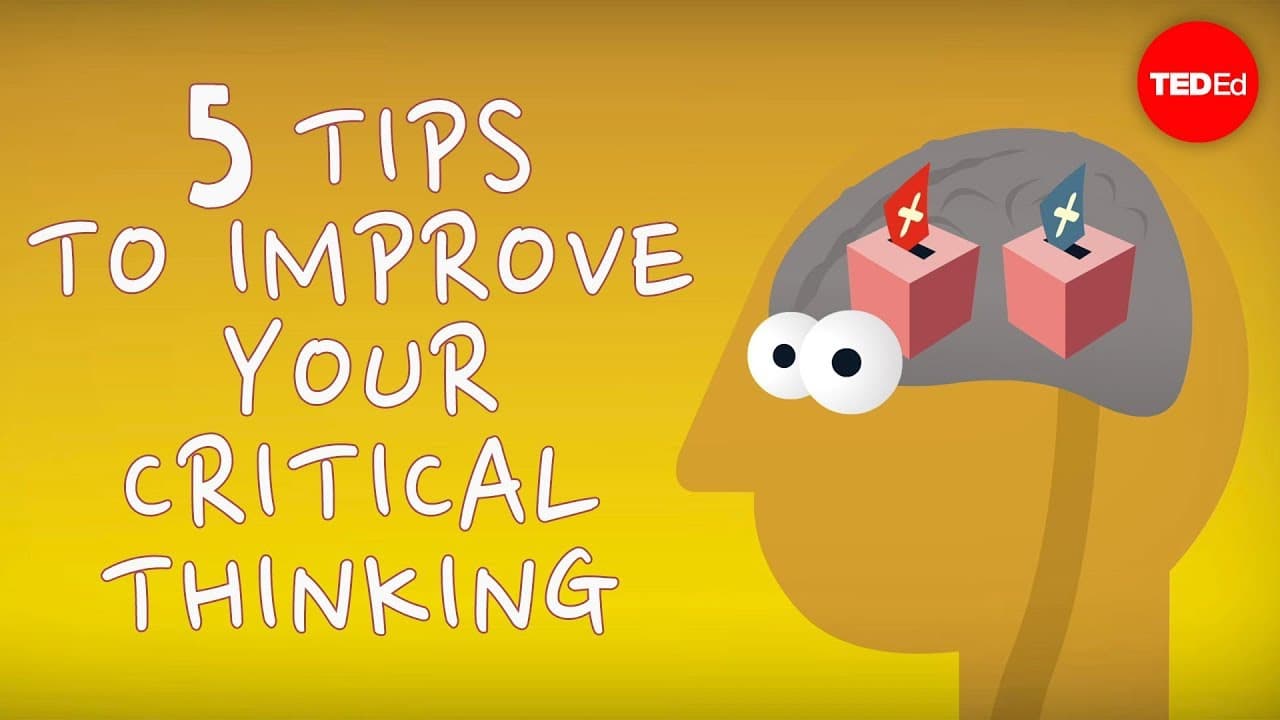
TL;DR
To enhance your critical thinking, follow a five-step process: first, clearly formulate your question; second, gather relevant information; third, critically evaluate this information; fourth, consider the implications of your choices; and fifth, explore different perspectives. This structured approach helps you make informed decisions by systematically analyzing options and minimizing bias and manipulation.
Transcript
Every day, a sea of decisions stretches before us. Some are small and unimportant, but others have a larger impact on our lives. For example, which politician should I vote for? Should I try the latest diet craze? Or will email make me a millionaire? We're bombarded with so many decisions that it's impossible to make a perfect choice every time.... Read More
Key Insights
- 💁 Critical thinking involves careful deconstruction, analysis, and scrutiny of information to make well-informed decisions.
- 🤔 The five-step process of critical thinking includes formulating a clear question, gathering relevant information, applying critical questioning techniques, considering implications, and exploring alternative viewpoints.
- 🤔 Critical thinking helps individuals avoid manipulation, bias, and faulty reasoning in decision-making.
- 💁 Articulating a clear question helps individuals focus their information gathering efforts.
- 💁 Applying critical questioning techniques helps individuals evaluate the logic and validity of information.
- 🍉 Considering the implications enables individuals to assess the potential long-term effects of their decisions.
- 🆘 Exploring alternative viewpoints helps individuals gain a more comprehensive understanding of the options available.
Install to Summarize YouTube Videos and Get Transcripts
Explore YouTube Video Summarizer or Get YouTube Transcript Extractor
Questions & Answers
Q: What is critical thinking and how does it differ from simply following one's instincts?
Critical thinking involves subjecting available options to scrutiny and skepticism instead of relying solely on gut feelings or initial impressions. It goes beyond intuition by carefully evaluating information, identifying biases, and considering logical reasoning.
Q: Why is formulating a clear question important in critical thinking?
Formulating a clear question allows individuals to have a specific goal or purpose in mind while gathering information. It helps eliminate distractions and enables them to focus on finding the information that directly relates to their decision-making process.
Q: Why is it crucial to consider the implications of a decision in critical thinking?
Considering the implications helps individuals understand the potential consequences of their decisions. It allows them to think beyond the immediate benefits and consider the long-term effects or unintended consequences, promoting a more comprehensive evaluation.
Q: How does exploring other points of view contribute to better decision-making?
Exploring other points of view encourages individuals to question their own biases and preconceptions. It helps them understand the diverse perspectives that exist and can facilitate a more well-rounded evaluation of their choices.
Key Insights:
- Critical thinking involves careful deconstruction, analysis, and scrutiny of information to make well-informed decisions.
- The five-step process of critical thinking includes formulating a clear question, gathering relevant information, applying critical questioning techniques, considering implications, and exploring alternative viewpoints.
- Critical thinking helps individuals avoid manipulation, bias, and faulty reasoning in decision-making.
- Articulating a clear question helps individuals focus their information gathering efforts.
- Applying critical questioning techniques helps individuals evaluate the logic and validity of information.
- Considering the implications enables individuals to assess the potential long-term effects of their decisions.
- Exploring alternative viewpoints helps individuals gain a more comprehensive understanding of the options available.
- Critical thinking can lead to more informed decisions, ultimately contributing to a more reasonable world.
Summary
This video discusses the concept of critical thinking as a technique to improve decision-making. Critical thinking involves deconstructing a situation, revealing hidden issues, and making the best decision by subjecting all available options to scrutiny. The video presents a five-step process for critical thinking: 1) Formulate your question, 2) Gather information, 3) Apply the information by asking critical questions, 4) Consider the implications, and 5) Explore other points of view. By using critical thinking, individuals can make more informed decisions and contribute to a more reasonable world.
Questions & Answers
Q: What is critical thinking and how does it improve our decision-making?
Critical thinking is a methodical approach to decision-making that involves carefully deconstructing a situation, revealing hidden issues, and making the best decision by subjecting all available options to scrutiny and skepticism. By using critical thinking, individuals can improve their decision-making by eliminating biased or unreliable information and focusing on the most useful and reliable information.
Q: Can you explain the five-step process for critical thinking?
The five-step process for critical thinking is as follows:
- Formulate your question: Clearly define what you are looking to accomplish or solve in a given situation. This clarity enables you to approach the situation critically and find the information you need to make a decision.
- Gather information: Collect relevant information that can help you weigh different options and make an informed decision. This information can come from experts, testimonials, or other reliable sources.
- Apply the information: Ask critical questions to evaluate the information you've gathered. Identify the concepts at work, challenge assumptions, and assess the logical soundness of your interpretations.
- Consider the implications: Think about the potential long-term or unintended consequences of your decision. Consider the broader impact it may have on different aspects of the situation.
- Explore other points of view: Seek out and understand alternative perspectives, even if you disagree with them. This exercise allows you to evaluate your own choices and make more informed decisions.
Q: How does formulating a clear question help in critical thinking?
Formulating a clear question is essential in critical thinking because it helps you define what you are trying to accomplish or solve in a given situation. When faced with decisions, our reasons for choosing a particular option may be obscured by various factors. By formulating a clear question, you can cut through the noise, understand your true objectives, and sift through information critically to find what you're looking for.
Q: Why is information gathering an important step in critical thinking?
Information gathering is crucial in critical thinking because it helps you collect relevant information that can inform your decision-making process. There is an abundance of information available, so having a clear idea of your question or objective will enable you to determine what information is relevant and what can be disregarded. By gathering information, you can weigh different options and make a more well-informed decision.
Q: What are some critical questions to ask when applying the gathered information?
When applying the gathered information, it is important to ask critical questions such as: "What concepts are at work in this situation?", "What assumptions exist?", and "Is my interpretation of the information logically sound?". By asking these questions, you can challenge the sources of bias and manipulation, evaluate the validity of the information, and ensure sound reasoning in your decision-making process.
Q: Why is it important to consider the implications of a decision?
Considering the implications of a decision is essential because it helps you think beyond the immediate consequences and evaluate the potential long-term and unintended effects. By considering the broader impact of your decision, you can identify any potential negative consequences and weigh them against the immediate benefits. This enables you to make more thoughtful and responsible choices.
Q: How does exploring other points of view contribute to critical thinking?
Exploring other points of view is an important aspect of critical thinking because it expands your understanding of a situation and helps you evaluate your own choices. By seeking out and understanding alternative perspectives, even if you disagree with them, you can gain insights into why certain policies or options may appeal to others. This exercise allows you to explore alternatives, challenge your own biases, and make more informed decisions.
Q: Can critical thinking completely eliminate difficult decisions from our lives?
No, critical thinking cannot completely eliminate difficult decisions from our lives. Difficult decisions are a natural part of life, and critical thinking is a tool that helps us navigate those decisions more effectively. It provides us with a systematic approach to analyze information, challenge assumptions, and consider the implications of our choices. While critical thinking cannot eliminate the complexity of decision-making, it can enhance our ability to make more reasoned and informed decisions.
Q: How can critical thinking contribute to making the world a more reasonable place?
Critical thinking, if widely adopted, has the potential to make the world a more reasonable place. By encouraging individuals to think critically, analyze information, and evaluate their choices, critical thinking fosters a culture of reason and rationality. This can lead to more informed decision-making, fewer instances of bias and manipulation, and ultimately contribute to a more reasonable and just society.
Q: What are the benefits of using critical thinking in decision-making?
The benefits of using critical thinking in decision-making include:
- Improved decision-making by eliminating biased or unreliable information.
- Increased ability to evaluate and challenge assumptions.
- Enhanced understanding of the implications and consequences of decisions.
- Greater empathy and consideration of alternative perspectives.
- Capacity to make more informed and thoughtful choices that align with personal goals and values.
Takeaways (in one paragraph)
The concept of critical thinking offers a powerful technique to improve decision-making. By applying a five-step process, including formulating clear questions, gathering relevant information, applying critical questions, considering implications, and exploring other points of view, individuals can make more informed decisions that align with their goals and values. Critical thinking helps us sift through a sea of information and find what we're looking for, ultimately making the world a more reasonable place.
Summary & Key Takeaways
-
Critical thinking is a powerful approach to decision-making that involves carefully analyzing a situation, identifying hidden biases and manipulations, and making the best choice.
-
The five-step process of critical thinking includes formulating the question, gathering relevant information, applying critical questioning techniques, considering the implications, and exploring alternative viewpoints.
-
By using critical thinking, individuals can make more informed decisions and improve the overall quality of their choices.
Read in Other Languages (beta)
Share This Summary 📚
Summarize YouTube Videos and Get Video Transcripts with 1-Click
Try YouTube Summary with ChatGPT & Claude or YouTube Transcript Generator
Explore More Summaries from TED-Ed 📚






Summarize YouTube Videos and Get Video Transcripts with 1-Click
Try YouTube Summary with ChatGPT & Claude or YouTube Transcript Generator