What Are Fractions and Their Types?
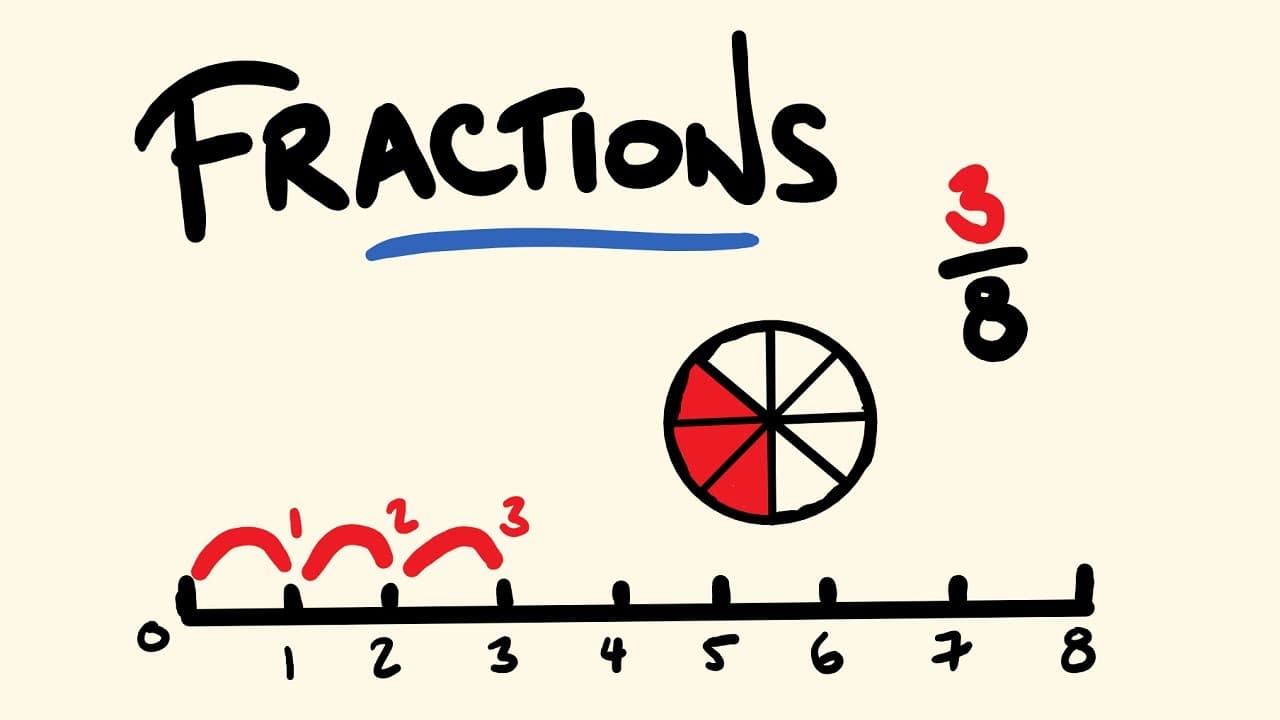
TL;DR
Fractions describe parts of a whole, comprised of a numerator and a denominator. They can be proper, improper, or mixed numbers, with proper fractions having a smaller numerator than the denominator, while improper fractions have a larger numerator. Understanding these types helps in converting between fractions, decimals, and percentages.
Transcript
good day in this video what we're going to be doing is we're going to is having a look at the basics of fractions now fractions are numbers which are used to describe parts of a hole and you'll often see them written as follows uh I'll write one down right now 3/4 a common fraction but I'll just go through to explain the different parts and the dif... Read More
Key Insights
- ❓ Fractions consist of numerators and denominators, with the numerator representing the part being considered and the denominator representing the whole.
- ➗ Fractions can be represented as divisions, with the numerator divided by the denominator giving the decimal representation.
- 🛩️ Proper fractions have numerators smaller than denominators, while improper fractions have numerators larger than denominators.
- #️⃣ Mixed numbers combine whole numbers and fractions, allowing for more flexible representation of quantities.
- ❓ Equivalent fractions have different numerator and denominator values but represent the same portion of a whole.
- 🫥 Number lines can be used to visually represent fractions and understand their relationships to each other.
- 😑 Converting between fractions, decimals, and percentages allows for different ways to express the same value.
Install to Summarize YouTube Videos and Get Transcripts
Explore YouTube Video Summarizer or Get YouTube Transcript Extractor
Questions & Answers
Q: What is the numerator and denominator in a fraction?
The numerator is the top number of a fraction, representing the part being considered, while the denominator is the bottom number, representing the whole.
Q: How can a fraction be represented as a decimal and a percentage?
To convert a fraction to a decimal, divide the numerator by the denominator. To convert to a percentage, multiply the decimal representation by 100.
Q: What is the difference between a proper fraction and an improper fraction?
A proper fraction has a numerator smaller than the denominator, while an improper fraction has a numerator larger than the denominator.
Q: How can an improper fraction be converted to a mixed number?
An improper fraction can be converted to a mixed number by dividing the numerator by the denominator and expressing the quotient as a whole number plus a fraction.
Summary & Key Takeaways
-
Fractions are numbers used to describe parts of a whole, with the numerator representing the top number and the denominator representing the bottom number.
-
Fractions can be thought of as divisions, where the numerator divided by the denominator gives the decimal representation of the fraction.
-
Proper fractions have numerators smaller than denominators, improper fractions have numerators larger than denominators, and mixed numbers combine whole numbers and fractions.
Read in Other Languages (beta)
Share This Summary 📚
Summarize YouTube Videos and Get Video Transcripts with 1-Click
Try YouTube Summary with ChatGPT & Claude or YouTube Transcript Generator
Explore More Summaries from tecmath 📚
Summarize YouTube Videos and Get Video Transcripts with 1-Click
Try YouTube Summary with ChatGPT & Claude or YouTube Transcript Generator