What Makes a Number Prime or Composite?
TL;DR
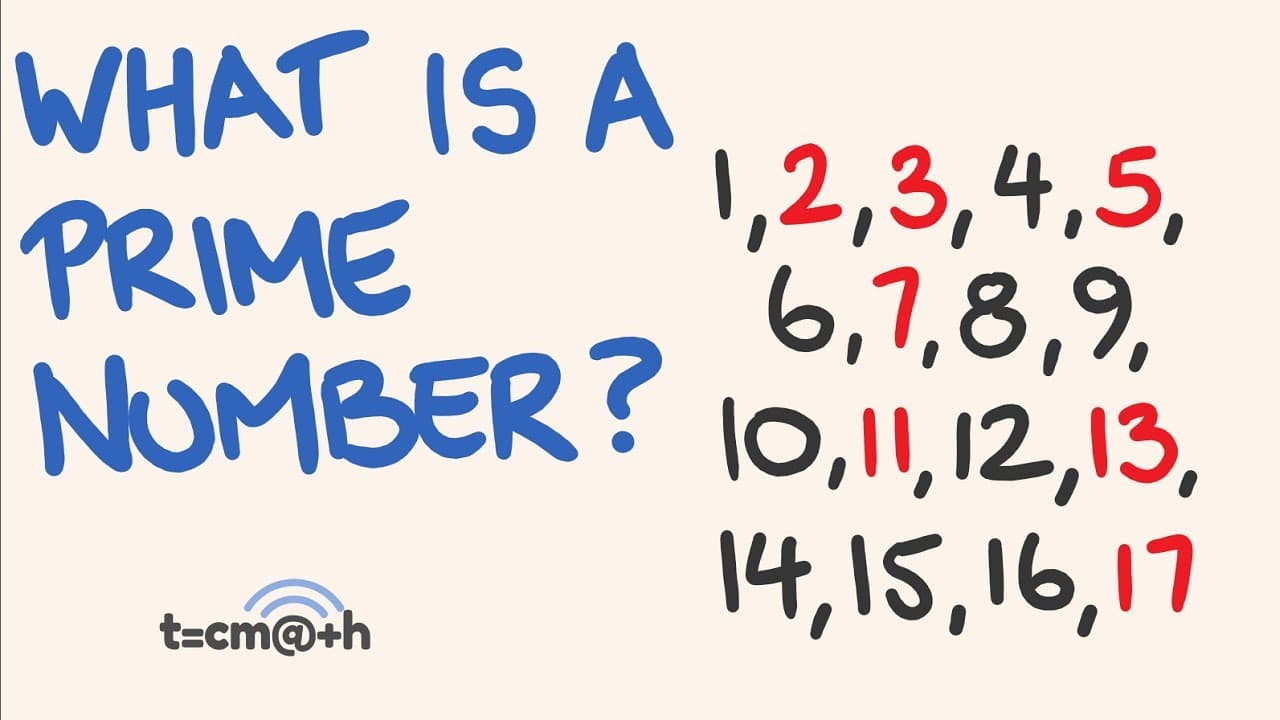
Prime numbers are defined as counting numbers that have exactly two factors: 1 and the number itself. In contrast, composite numbers possess more than two factors. Notably, the number 2 is the only even prime number, while examples of composite numbers include 6 and 15.
Transcript
hello welcome to this video series looking at indices and primes in this particular video what we're going to be having a look at is prime numbers and composite numbers so let's start with a definition a prime number is a counting number that has exactly two factors itself and one now counting number by the way these are just numbers 1 2 3 4 5 6 yo... Read More
Key Insights
- 🧑🏭 Prime numbers have exactly two factors, while composite numbers have more than two factors.
- #️⃣ 2 is the only even prime number.
- ❤️🩹 Composite numbers can be identified by having endings of 5 or 0, excluding 5 itself.
- 🧑🏭 Understanding factors helps determine whether a number is prime or composite.
- #️⃣ Prime numbers are indivisible except by 1 and themselves.
- 🧑🏭 Composite numbers have multiple factors other than 1 and themselves.
- #️⃣ Identifying prime and composite numbers can be done without extensive calculation through certain clues.
Install to Summarize YouTube Videos and Get Transcripts
Explore YouTube Video Summarizer or Get YouTube Transcript Extractor
Questions & Answers
Q: What is a prime number?
A prime number is a counting number with exactly two factors, itself and one. Examples of prime numbers include 3, 7, and 2.
Q: What are composite numbers?
Composite numbers are counting numbers with more than two factors. Examples are 6 and 15, which have factors other than 1 and themselves.
Q: Why is 2 a special prime number?
2 is a special prime number because it is the only even prime number. It only has two factors, 2 and 1.
Q: How can we determine if a number is composite?
Apart from being an even number that is not 2, a good clue to identify composite numbers is if the number ends in a 5 or 0, but is not 5. Most numbers divisible by 5 will have these endings.
Summary & Key Takeaways
-
Prime numbers are counting numbers with only two factors, themselves, and one.
-
Examples of prime numbers are 3, 7, and 2 (which is the only even prime number).
-
Composite numbers have more than two factors, such as 6 and 15.
Read in Other Languages (beta)
Share This Summary 📚
Summarize YouTube Videos and Get Video Transcripts with 1-Click
Try YouTube Summary with ChatGPT & Claude or YouTube Transcript Generator
Explore More Summaries from tecmath 📚

Summarize YouTube Videos and Get Video Transcripts with 1-Click
Try YouTube Summary with ChatGPT & Claude or YouTube Transcript Generator