How to Reverse Engineer Software Using AI Tools
TL;DR
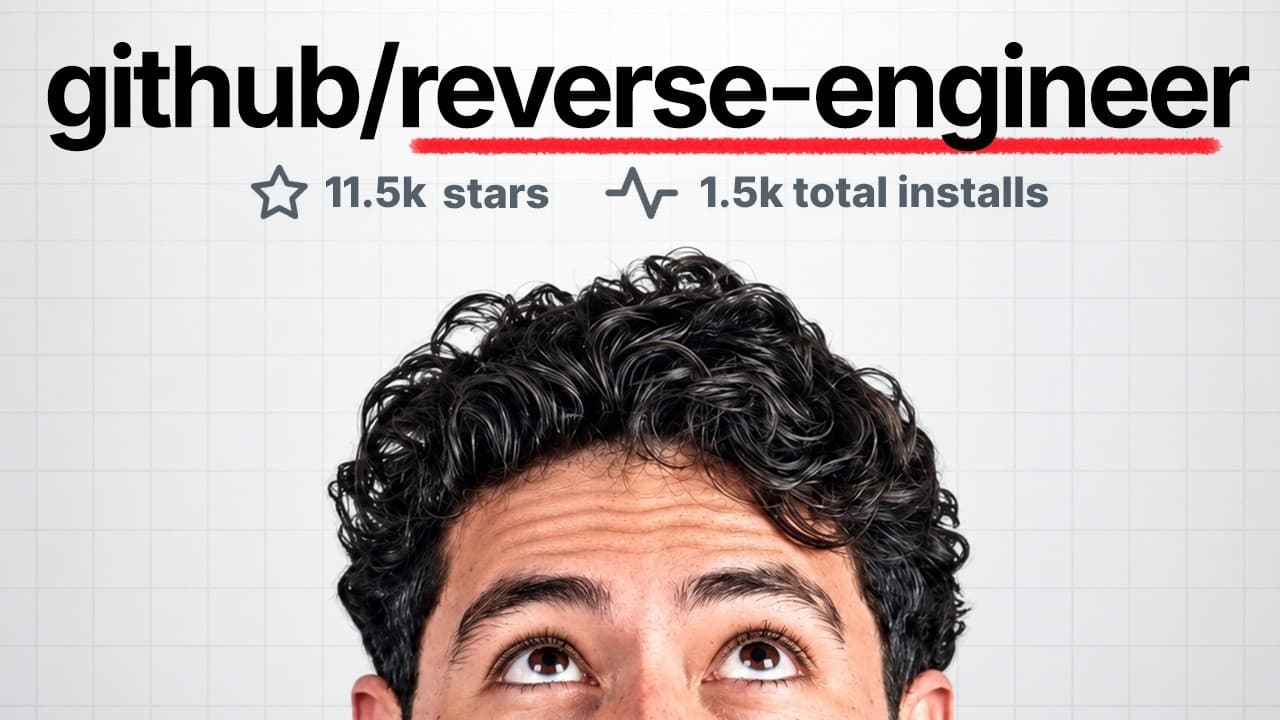
Reverse Engineer Everything (REA) allows users to decompile and rebuild software using AI agents. It leverages existing tools like GIDRA, Hopper, and IDA to facilitate this process. While REA simplifies access to these tools, the underlying technology isn't new, and its significance is more about accessibility than innovation.
Transcript
Reverse engineer everything or REA is an MCP that allows you to virtually rebuild any software you want by actually decompiling the source app and then giving your AI agent a bunch of instructions behind how to recreate and replicate those features. Pretty much everybody is talking about it and doing cool demos like reverse engineering their Apple ... Read More
Key Insights
- Reverse Engineer Everything (REA) is a tool that allows AI agents to decompile and rebuild software applications.
- REA uses existing software tools like GIDRA, Hopper, and IDA to reverse engineer applications.
- The novelty of REA lies in its ability to provide a simple interface for AI to access these tools.
- While REA is trending, the underlying technology is not new, as tools like GIDRA have existed since 2019.
- REA's popularity highlights a cultural moment rather than a groundbreaking technological advancement.
- The trend towards open-source software is expected to continue as AI capabilities evolve.
- Many existing software applications may become commoditized as AI improves its reverse engineering capabilities.
- Despite the hype, REA and similar technologies face limitations in intellectual property and practical applications.
Install to Summarize YouTube Videos and Get Transcripts
Explore YouTube Video Summarizer or Get YouTube Transcript Extractor
Questions & Answers
Q: How does Reverse Engineer Everything (REA) work?
Reverse Engineer Everything (REA) works by allowing an AI agent to decompile and rebuild software applications. It connects the AI to existing reverse engineering tools like GIDRA, Hopper, and IDA, which analyze the software's structure and functionality. The AI then uses this information to recreate the software, providing pseudo code and insights into its operations. REA simplifies this process by offering a user-friendly interface for accessing these tools.
Q: What tools does REA use for reverse engineering?
REA utilizes several established tools for reverse engineering, including GIDRA, Hopper, and IDA. GIDRA, released by the NSA in 2019, is a software reverse engineering tool. Hopper is a disassembler that has been around since 2011, and IDA is a long-standing tool from the 1990s. These tools help analyze software, allowing AI agents to decompile and rebuild applications more effectively.
Q: Is the technology behind REA new?
The technology behind REA is not new. While REA itself provides a novel interface for AI to access reverse engineering tools, the tools it uses, such as GIDRA, Hopper, and IDA, have been around for years. The excitement around REA is more about its accessibility and the cultural moment it represents, rather than a groundbreaking technological innovation.
Q: What are the implications of REA for software development?
REA has significant implications for software development, particularly in making reverse engineering more accessible. It could lead to more software becoming open-source as AI capabilities improve. However, it also raises concerns about intellectual property rights and the commoditization of software applications. As AI-driven reverse engineering becomes more common, developers may need to adapt to these changes in the industry.
Q: Why is REA trending despite not being new technology?
REA is trending because it represents a shift in how reverse engineering tools are accessed and used, rather than introducing new technology. Its popularity is driven by the cultural moment and the potential for AI to democratize software development. The excitement is also fueled by the ease with which REA allows users to interact with established tools, making reverse engineering more approachable for a broader audience.
Q: Can REA reverse engineer any software perfectly?
While REA can decompile and rebuild software, it does not guarantee perfect replication of the original application's functions. The AI may produce more efficient code in some cases, but there are limitations to what can be accurately reproduced. The reverse engineering process is complex, and while REA simplifies access to the tools needed, it does not ensure flawless results.
Q: What are the limitations of using REA?
The limitations of using REA include potential intellectual property issues, as reverse engineering can infringe on software copyrights. Additionally, while REA simplifies the process, it does not guarantee perfect replication of software functions. The AI's ability to accurately recreate applications depends on the complexity of the software and the tools used. Practical applications may also be limited by these factors.
Q: How might REA influence the future of software engineering?
REA could influence the future of software engineering by making reverse engineering more accessible and potentially leading to more open-source software. As AI capabilities improve, the process of decompiling and rebuilding software may become more efficient, reducing barriers to entry for developers. However, this shift could also lead to increased commoditization of software applications and raise challenges related to intellectual property rights.
Summary & Key Takeaways
-
Reverse Engineer Everything (REA) allows AI to decompile and rebuild software using tools like GIDRA, Hopper, and IDA. While it simplifies access, the technology isn't new, and the hype is more cultural than revolutionary.
-
REA's popularity underscores a trend towards open-source software and highlights the potential for AI to commoditize software development. However, challenges remain in intellectual property and practical applications.
-
The video explores how REA works, its implications for software development, and the broader trend of AI-driven reverse engineering. Despite its potential, REA is not a new technological breakthrough.
Read in Other Languages (beta)
Share This Summary 📚
Summarize YouTube Videos and Get Video Transcripts with 1-Click
Try YouTube Summary with ChatGPT & Claude or YouTube Transcript Generator
Explore More Summaries from Nick Saraev 📚






Summarize YouTube Videos and Get Video Transcripts with 1-Click
Try YouTube Summary with ChatGPT & Claude or YouTube Transcript Generator