How Do Sex Differences Shape Lifespan and Disease?
TL;DR
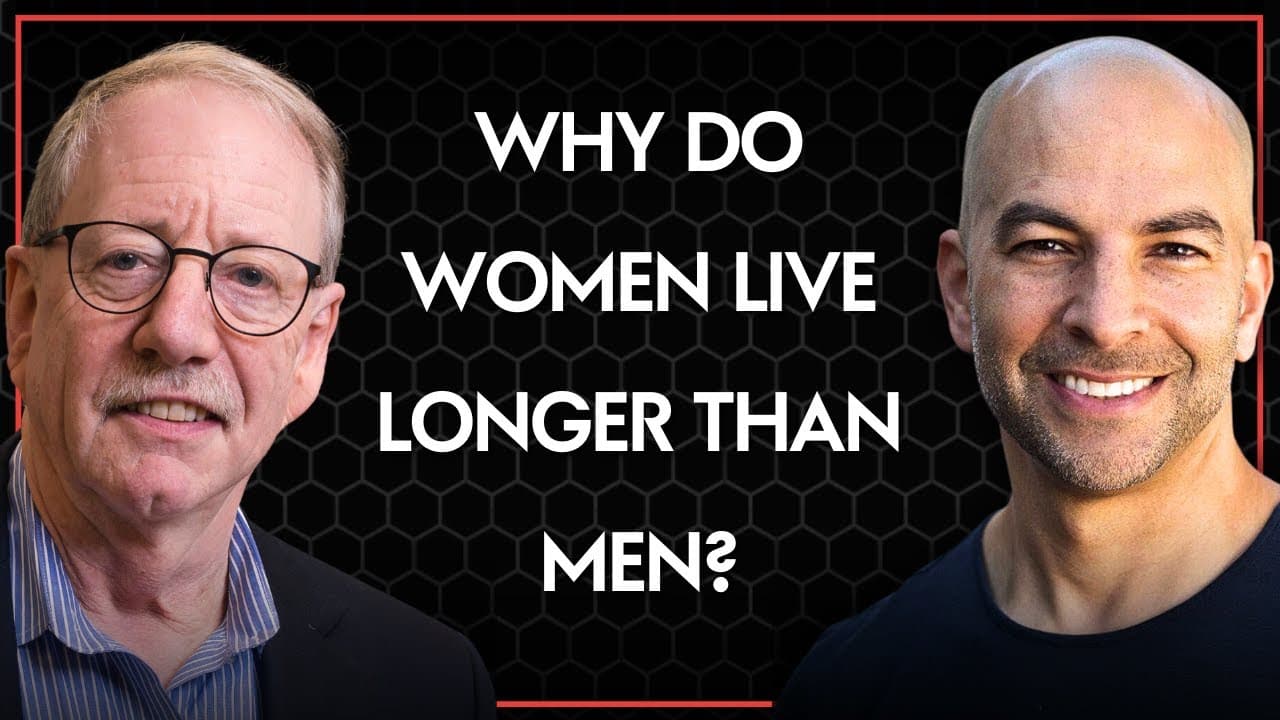
The difference in lifespan between men and women is evident across ages and conditions, suggesting a biology rooted in sex rather than only environment. Women show longer survival across infancy to old age, while Alzheimer disease stands out as a condition with higher female risk. Hormonal and genetic factors are debated.
Transcript
speaking of human longevity Steve what do you think is the best explanation for the sex difference between men and women um in the United States today and much of the developed World it probably accounts for about two years of difference doesn't it more like five is it that much wow yeah okay what what's our best attribution well it's a really inte... Read More
Key Insights
- Women survive better at every life stage, suggesting a robust biological advantage.
- The role of sex hormones in longevity remains uncertain and debated.
- Women show longer life in epidemics and famines, pointing to inherent biology beyond environment.
- Infant mortality and early life survival hint at prenatal or early developmental factors.
- Alzheimer disease is noted as an exception to the longevity pattern, being more common in women.
- Two studies on castration hint at hormone influence but do not provide a simple mortality link.
- Redundancy from a second X chromosome could contribute to longevity differences.
- Mitochondrial and nuclear genome compatibility may differ by sex and influence lifespan.
Install to Summarize YouTube Videos and Get Transcripts
Explore YouTube Video Summarizer or Get YouTube Transcript Extractor
Questions & Answers
Q: A real search query question about the video (e.g. 'How to...', 'What is...', 'Why does...', 'When should...'). Question 1
What is the main explanation for why women live longer than men across many ages and conditions? The discussion emphasizes that women survive better in infancy, childhood, and adulthood and during good times, epidemics, and famines, suggesting a robust biological feature rather than solely behavioral or environmental factors. The exact mechanism remains uncertain.
Q: Question 2
How do sex hormones relate to longevity according to the conversation? The speakers consider sex hormone factors as a possible explanation but acknowledge the evidence is not conclusive. They discuss castration studies and hormone replacement therapy as provocative data points that do not clearly prove a simple causal link to mortality differences.
Q: Question 3
What does the dialogue say about the impact of the women's health initiative on mortality? The speakers note that the WHI did not show a difference in overall mortality by the end of the study, despite headline findings about breast cancer risk in a subgroup. The nuance includes timing of hormone therapy initiation and study design concerns.
Q: Question 4
Why is Alzheimer disease highlighted in the longevity discussion? It is presented as an exception to the general pattern of longer female survival, suggesting possible autoimmune or genetic interactions that merit further exploration and hypotheses about sex-based disease susceptibility.
Q: Question 5
What genetic factors are proposed as potential contributors to female longevity? The conversation mentions the redundancy of genes on the second X chromosome as a possible protective factor, with Turners and X chromosome dynamics discussed as contrasting cases that may influence lifespan.
Q: Question 6
How might mitochondrial and nuclear genome interactions influence sex differences in aging? The dialogue suggests that because mitochondrial DNA is maternally inherited, compatibility with the nuclear genome could differ between sexes and across generations, potentially affecting longevity in women versus men.
Q: Question 7
What behavioral factors are considered in the longevity discussion? The speakers acknowledge that behaviors may contribute to observed mortality differences, such as risk-taking tendencies, but emphasize that biology likely plays a major role since differences appear across many life stages and conditions.
Q: Question 8
Are there any testable predictions or future research directions mentioned? The conversation points to the need for better understanding of sex hormones, early life exposure, X chromosome dynamics, and mitochondrial-nuclear interactions to explain why women live longer and how Alzheimer disease fits into the pattern, inviting further study.
Summary & Key Takeaways
-
A cross age advantage shows women live longer across infancy, childhood, and adulthood, implying a robust biological factor beyond external conditions.
-
Different disease patterns between sexes are discussed, with Alzheimer’s disease highlighted as more common in women, prompting questions about immune and genetic contributions.
-
The discussion explores possibilities such as sex hormones, X chromosome redundancy, and mitochondrial interactions as potential explanations for longevity differences.
Read in Other Languages (beta)
Share This Summary 📚
Summarize YouTube Videos and Get Video Transcripts with 1-Click
Try YouTube Summary with ChatGPT & Claude or YouTube Transcript Generator
Explore More Summaries from Peter Attia MD 📚






Summarize YouTube Videos and Get Video Transcripts with 1-Click
Try YouTube Summary with ChatGPT & Claude or YouTube Transcript Generator