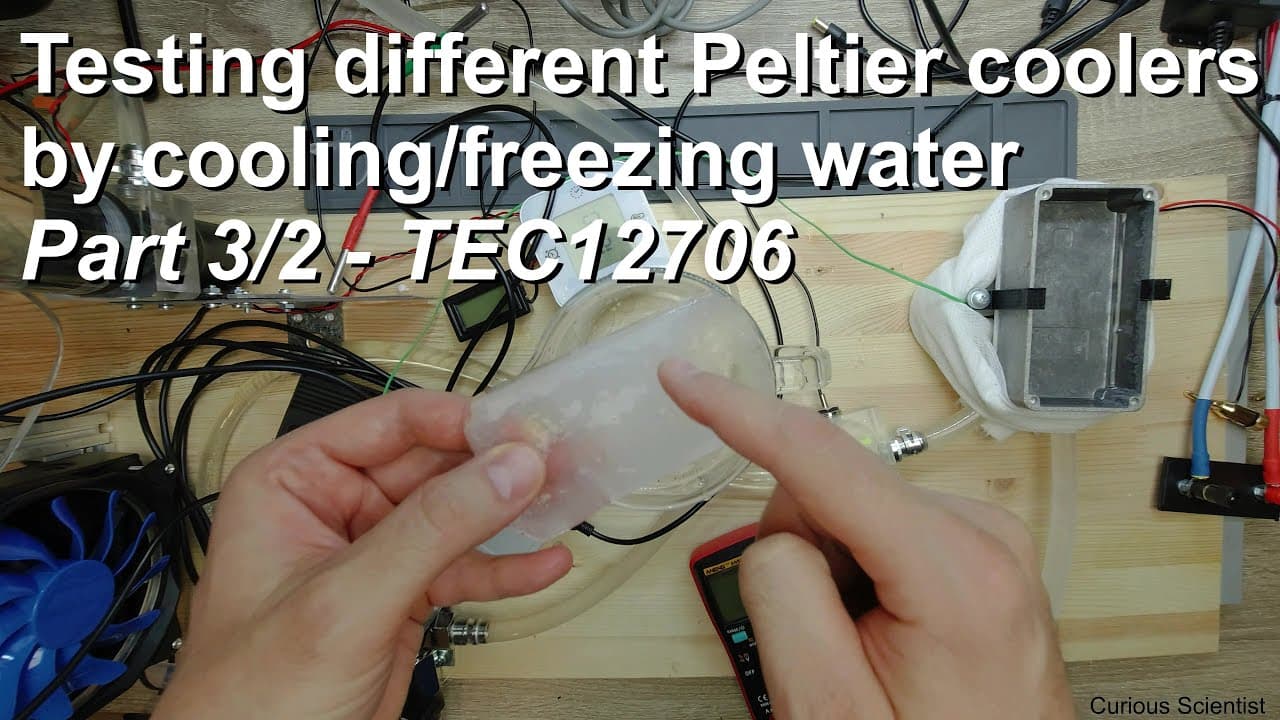
Testing different Peltier coolers by cooling/freezing water - Part 3/2 - TEC12706
TL;DR
Testing the TEC 706 patio cooler reveals temperature drop performance for freezing water.
Transcript
welcome everyone in this video I'm going to do another freezing test and I will test the tec 706 patio cooler so I already tested this unit for the minimum temperature and I was using a regular CPU cooler with heat pipes and a lot of things and two fans but here I will be using as you can see here water cooling and I have the patty in this bathtub ... Read More
Key Insights
- 🥵 Initial temperature and latent heat requirements critically affect the time taken to freeze water.
- 😎 Temperature sensors must be placed strategically to accurately measure cooling performance.
- 🥵 The cooling performance of the TEC 706 patio cooler diminished with increased water mass and latent heat demands.
- 🖤 Lack of stirring in the water caused temperature stratification, delaying the freezing process.
- 💦 Future experiments should incorporate mechanisms to enhance thermal uniformity in the water.
- 🪡 The need for reproducibility in experimental setups is essential for reliable scientific conclusions.
- 😎 Understanding the difference between no-load and operational load conditions is vital for evaluating cooling efficiency.
Install to Summarize YouTube Videos and Get Transcripts
Explore YouTube Video Summarizer or Get YouTube Transcript Extractor
Questions & Answers
Q: What was the main objective of the freezing test on the TEC 706 patio cooler?
The primary goal of the test was to assess the cooling performance of the TEC 706 patio cooler by observing how effectively it could freeze water. By using temperature sensors and a water cooling system, the experiment aimed to gather quantitative data on temperature changes over time until the water reached freezing.
Q: How were the temperature measurements collected during the experiment?
Temperature readings were collected using custom-built waterproof temperature loggers with four sensors positioned in different areas: two in the bathtub, one in the water tank, and one measuring air temperature exiting the fan. This arrangement allowed for a comprehensive understanding of temperature differentials throughout the cooling process.
Q: What challenges were encountered during the freezing experiment?
A significant challenge faced was the lack of stirring in the water, which resulted in uneven temperature distribution. This meant that while some areas cooled rapidly, others remained non-frozen, highlighting that efficient heat transfer requires better mixing to equalize temperatures throughout the water mass.
Q: What insights were gained regarding the cooling efficiency of the TEC 706 patio cooler?
The experiment revealed that while the TEC 706 could achieve low temperatures, the cooling capacity was significantly reduced when there was a load. The measurements indicated that the cooler struggled to effectively maintain colder temperatures once the process of freezing began, primarily due to latent heat requirements.
Q: Why was it important to control various factors during this experiment?
Controlling factors such as water stirring, positioning of sensors, and power supply was crucial to ensure accurate, repeatable results. Variability in these parameters could lead to misleading conclusions about the cooling system's effectiveness and its capability to freeze water under specific conditions.
Q: How did the initial water temperature affect the experiment's results?
The initial water temperature was significant because it impacted the time and energy needed for the water to reach freezing. With a starting temperature of approximately 27 degrees Celsius, the cooler needed to remove substantial heat energy to facilitate the transition to ice, making the experiment challenging.
Q: What role did the latent heat of fusion play in the freezing process?
The latent heat of fusion is the energy required to change water from liquid to solid without any temperature change. In the experiment, this energy requirement hindered the system's cooling efficiency since significant energy was needed to freeze the water, demonstrating the challenges involved in the freezing process.
Q: What conclusions can be drawn about the performance of the TEC 706 patio cooler from the experiment?
The experiment emphasized that while the TEC 706 patio cooler could achieve low temperatures under no load, its performance decreased significantly under operational conditions. The test highlighted the importance of comprehensive thermal management and heat transfer methods for effective cooling and freezing applications.
Summary & Key Takeaways
-
The video walks through an experimental procedure to test the cooling performance of a TEC 706 patio cooler using water cooling methods and various temperature sensors.
-
Detailed measurements were taken from four temperature sensors strategically placed in the cooling setup to track changes and monitor the efficiency of the cooling system.
-
The experiment demonstrated challenges in achieving efficient cooling due to water stratification and the absence of stirring, impacting the overall freezing process.
Read in Other Languages (beta)
Share This Summary 📚
Summarize YouTube Videos and Get Video Transcripts with 1-Click
Try YouTube Summary with ChatGPT & Claude or YouTube Transcript Generator
Explore More Summaries from Curious Scientist 📚
![Building a Peltier cooler-based cooling box - First iteration, improvements [Part 2/6] thumbnail](/_next/image?url=https%3A%2F%2Fi.ytimg.com%2Fvi%2F0YlNw0EGnzI%2Fhqdefault.jpg&w=750&q=75)




Summarize YouTube Videos and Get Video Transcripts with 1-Click
Try YouTube Summary with ChatGPT & Claude or YouTube Transcript Generator