How to Build Products With OpenAI Codex Agents
TL;DR
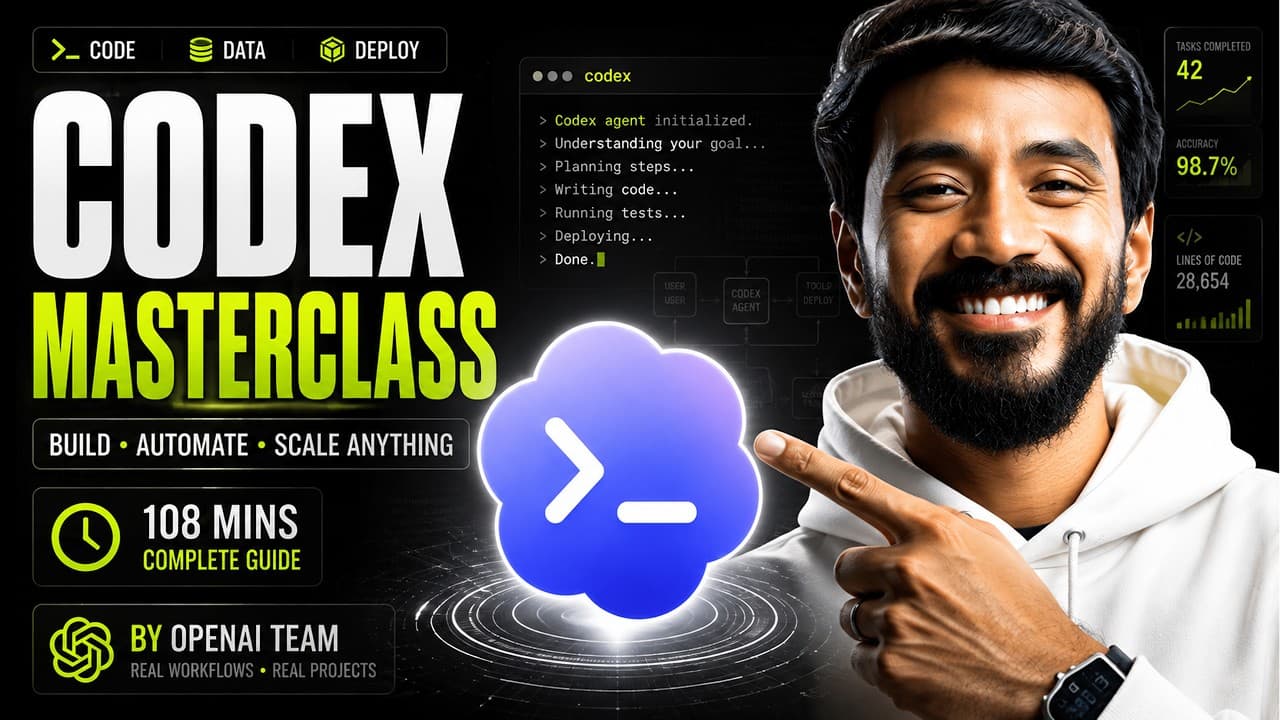
Use Codex agents to move from an idea to a working product by assigning parallel research, presentation, coding, testing, and deployment tasks, then giving each agent ways to validate its own output. The new app combines Chat, Work, and Code workflows, while the Sol, Terra, and Luna model family lets users balance intelligence, speed, and cost.
Transcript
OpenAI just released the most powerful model they've ever built, GPD 5.6. And with that, they launched a brand new app. It's designed to be working like a super app that can help you build agents, create products, write code, and solve real-time problems, whether you're a developer or someone who has never written a single line of code. And as you'... Read More
Key Insights
- The new app unifies ChatGPT and Codex capabilities so users can handle conversations, knowledge work, and software development within one project environment. Projects remain available when switching modes, allowing reusable context and skills to support different kinds of work.
- Work mode is designed for research, presentations, slides, and related knowledge tasks, while Code mode emphasizes repository exploration, feature development, technical implementation, and bug fixing. Users who prefer Codex can still perform some general work tasks directly within its coding-focused environment.
- The model family consists of Sol, Terra, and Luna, giving users a spectrum of capability, speed, and cost. Sol targets the hardest tasks, Terra offers a balanced trade-off, and Luna provides a smaller and cheaper option for less demanding workloads.
- Sol is the frontier model in the described family and shows improvements in coding, front-end development, implicit instruction understanding, and long-running knowledge work. Its ability to interpret underspecified requests reduces the need for users to describe every desired detail explicitly.
- Terra is presented as a practical balance between intelligence, speed, and cost. When asked to choose one model for 30 days, the OpenAI leader selected Terra because its trade-off could make it suitable for many everyday tasks.
- Validation loops allow an agent to assess its own work, identify remaining problems, and continue until the task is finished. This shifts attention from crafting a single perfect prompt toward designing an iterative process with checks, feedback, and continued execution.
- Persistent agents combine customization with long-running collaboration. They can remain available on a computer over time, use specialized instructions, and coordinate with subagents, making them more suitable for recurring workflows than a temporary one-off conversation.
- The demonstrated product workflow uses agents for parallel research, pitch-deck creation, interface concept generation, application coding, browser-based testing, bug correction, recurring automation, expense-report submission, and dashboard deployment. These examples show that the app extends beyond code generation into broader operational work.
Install to Summarize YouTube Videos and Get Transcripts
Explore YouTube Video Summarizer or Get YouTube Transcript Extractor
Questions & Answers
Q: How can Codex agents build a product from an idea?
Codex agents can divide product development into connected tasks, including research, pitch-deck creation, interface concept generation, application coding, testing, bug fixing, and deployment. The demonstration starts with an idea and progresses toward a working web application and live dashboard. Parallel agents handle research, while validation loops and computer interaction help inspect results, identify problems, and continue improving the product.
Q: What is the difference between Work mode and Code mode?
Work mode is oriented toward research, presentations, slides, and other forms of knowledge work. Code mode is intended for technical activities such as exploring a repository, developing software, adding features, and fixing bugs. The modes share the same underlying projects, so users can switch their focus without creating separate workspaces, and reusable skills can support tasks in both environments.
Q: What are Sol, Terra, and Luna in the new model family?
Sol, Terra, and Luna are models positioned along a spectrum of capability, speed, and cost. Sol is the frontier option and is intended for difficult coding and long-running knowledge tasks. Terra is slightly smaller and offers a balance between intelligence, speed, and cost. Luna is smaller and cheaper, making it appropriate when a task does not require the strongest available model.
Q: Which model offers the best balance of intelligence and cost?
Terra is presented as the model with a particularly useful balance of intelligence, speed, and cost. When asked which single model he would use for the next 30 days, the OpenAI leader said he might choose Terra because of that trade-off. Sol remains the preferred choice for especially difficult tasks, while Luna serves workloads where lower cost matters more.
Q: What is loop engineering for AI agents?
Loop engineering is the practice of giving an agent a process for evaluating its own work and continuing until the required outcome is achieved. Instead of relying only on one carefully written prompt, the workflow includes validation, feedback, correction, and repeated execution. The described model has stronger built-in understanding of how to validate results and keep working when a task remains incomplete.
Q: How do Codex agents find and fix application bugs?
A computer-use agent can open a browser, interact with a web application, observe its behavior, and look for defects. In the demonstration, the application is deliberately broken so the agent can click through it, identify bugs, and fix them on its own. This creates a practical validation loop that combines interface testing with code changes instead of stopping after the initial implementation.
Q: What are persistent agents in the new OpenAI app?
Persistent agents are customized agents that remain available on a computer and collaborate with the user over time. They combine some of the customization associated with a custom GPT with long-running execution and the ability to use subagents. This structure can support recurring or extended workflows because the agent is not limited to a single short interaction or isolated response.
Q: How can plugins expand what Codex agents can do?
Plugins connect the app to external information and specialized tools needed for real work. The examples mentioned include spreadsheets, Dropbox, Notion, Hugging Face models, Supabase, and an OpenAI developers plugin. These connections allow agents to work with existing files, services, and technical resources, extending the unified app beyond its built-in models, projects, and coding environment.
Summary & Key Takeaways
-
OpenAI's new app combines capabilities developed through ChatGPT and Codex in one unified experience. Work mode focuses on research, presentations, slides, and other knowledge tasks, while Code mode supports repository exploration, software development, feature implementation, and bug fixing. Users can keep the same projects and reusable skills across these different modes.
-
The demonstrated workflow moves from an initial startup idea to a shipped product. Parallel agents conduct research, help build a venture capital pitch deck, generate interface concepts with Image Gen 2, code a working web application, and use computer interaction to test the application, identify deliberately introduced bugs, and attempt their own fixes.
-
The model family includes Sol, Terra, and Luna, which represent different balances of capability, speed, and cost. Sol is positioned as the frontier model for difficult coding and long-running knowledge work. Terra offers a middle-ground trade-off, while Luna is smaller and cheaper for tasks that do not require maximum capability.
Read in Other Languages (beta)
Share This Summary 📚
Summarize YouTube Videos and Get Video Transcripts with 1-Click
Try YouTube Summary with ChatGPT & Claude or YouTube Transcript Generator
Explore More Summaries from Vaibhav Sisinty 📚




Summarize YouTube Videos and Get Video Transcripts with 1-Click
Try YouTube Summary with ChatGPT & Claude or YouTube Transcript Generator