How Does Deep Learning Work from the Basics?
TL;DR
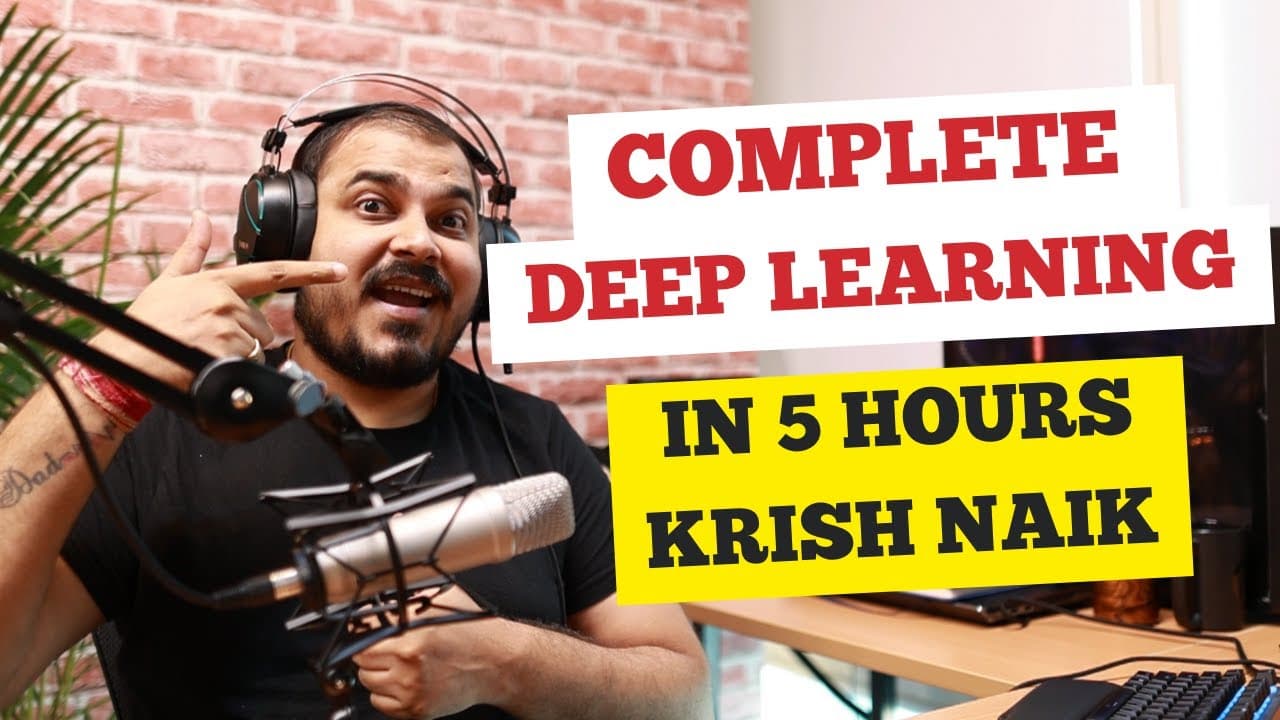
Deep learning uses multilayer neural networks to imitate aspects of how humans learn, with perceptrons serving as a foundational model. A complete learning path should connect weights, bias, forward and backward propagation, derivatives, activation and loss functions, optimizers, artificial neural networks, convolutional neural networks, and practical implementation, while also addressing vanishing gradients and model interpretability.
Transcript
so let me share my screen and uh here you go so day one of deep learning we are going to cover we are going to cover completely from basics and uh it will definitely be helpful for your interviews and the other things definitely whatever i'm teaching those kind of questions are usually asked in an interview and everybody can follow this so hit like... Read More
Key Insights
- Artificial intelligence is presented as a broad category of applications that can perform tasks without ongoing human intervention. Examples named in the tutorial include Netflix recommendations, Amazon recommendations, self-driving cars, chatbots, and software enhanced by an integrated recommendation model.
- Machine learning is described as a subset of artificial intelligence that supplies statistical tools for analyzing and visualizing data. Its listed tasks include prediction, forecasting, and clustering, while tools such as Python and statistical concepts support the work.
- Deep learning is described as a subset of machine learning whose central aim is to mimic aspects of the human brain. The tutorial connects this aim to making machines learn in a way that resembles how human beings learn.
- Deep learning research is said to date back to 1958, rather than being a recent development. Its growing popularity is attributed to the increasing amount of available data and advances in GPU hardware that support the training of demanding models.
- A perceptron is introduced as a foundational neural network model and the starting point for understanding multilayer neural networks. The tutorial develops this foundation through weights and bias before moving into the larger learning process used by neural networks.
- Neural network training is organized around forward propagation, backward propagation, and weight updates. The mathematical foundation also includes the chain rule of derivatives, followed by discussion of the vanishing gradient problem that can arise during learning.
- Activation functions, loss functions, and optimizers are separate components covered after the propagation concepts. Together, these topics form part of the tutorial's progression from a high-level introduction toward the mathematics and implementation of neural networks.
- Practical implementation is included for both artificial neural networks and convolutional neural networks. The course also compares black-box and white-box models, while keeping its broader focus on mathematics, implementation, projects, and interview preparation.
Install to Summarize YouTube Videos and Get Transcripts
Explore YouTube Video Summarizer or Get YouTube Transcript Extractor
Questions & Answers
Q: What is the difference between AI, machine learning, and deep learning?
Artificial intelligence is presented as the broadest category, covering applications that perform tasks without ongoing human intervention. Machine learning is a subset of artificial intelligence that provides statistical tools for data analysis, visualization, prediction, forecasting, and clustering. Deep learning is then described as a subset of machine learning focused on multilayer neural networks and on imitating aspects of how the human brain learns.
Q: Why has deep learning become more popular?
Deep learning has become more prominent because much more data is being created and powerful GPU hardware is available for model training. The tutorial emphasizes that deep learning itself is not recent, stating that researchers were working on it from 1958. Current data volume and hardware capabilities have made it more practical to train sophisticated neural network models.
Q: What prerequisites are needed to start learning deep learning?
The stated prerequisites are knowledge of the Python programming language, familiarity with at least one machine learning algorithm, and some understanding of statistics. Knowing linear regression is described as sufficient machine learning preparation for beginning the material. These foundations support the tutorial's combination of mathematical explanations, neural network concepts, and practical artificial neural network and convolutional neural network implementation.
Q: What is a perceptron in deep learning?
A perceptron is introduced as a foundational neural network model and an entry point for studying multilayer neural networks. The tutorial uses it to begin explaining how weights and bias participate in a neural model. From that base, the lesson progresses to forward propagation, backward propagation, weight updates, activation functions, loss functions, and optimizers.
Q: How do forward and backward propagation fit into neural network training?
Forward propagation and backward propagation are presented as central parts of neural network learning. They are taught alongside the formula for updating weights, creating a sequence from processing through the network to changing its parameters. The chain rule of derivatives is then covered as mathematical preparation, followed by the vanishing gradient problem and the functions and optimizers used during training.
Q: What deep learning mathematics does the tutorial cover?
The mathematical coverage begins with perceptrons, weights, and bias, then continues through forward propagation, backward propagation, and the weight update formula. It also includes the chain rule of derivatives and the vanishing gradient problem. Activation functions, loss functions, and optimizers are treated as additional components needed to connect neural network theory with practical implementation.
Q: Does the tutorial include practical neural network implementation?
Yes. The schedule includes a practical implementation of an artificial neural network after the sections on perceptrons, propagation, derivatives, activation functions, loss functions, and optimizers. It later introduces convolutional neural networks and provides a practical convolutional neural network implementation. Projects are also identified as part of the broader learning plan for the live classes.
Q: How does the course support deep learning interview preparation?
Interview preparation is an explicit objective of the course. The instructor states that the concepts being taught correspond to questions commonly asked in interviews. The planned approach combines basic concepts, mathematics, implementation, and projects, with relevance for learners seeking roles as deep learning developers or planning to move into computer vision work.
Summary & Key Takeaways
-
The tutorial begins by distinguishing artificial intelligence, machine learning, deep learning, and data science. Artificial intelligence describes applications that perform tasks without ongoing human intervention, while machine learning is presented as its subset, providing statistical tools for analyzing and visualizing data and performing prediction, forecasting, and clustering tasks.
-
The deep learning foundation starts with perceptrons and progresses through weights, bias, forward propagation, backward propagation, and weight updates. The mathematical sequence also covers the chain rule of derivatives, vanishing gradients, activation functions, loss functions, and optimizers, linking the components required to understand how neural networks learn.
-
The later sections move from theory to implementation through an artificial neural network and a convolutional neural network. The tutorial also compares black-box and white-box models. Its stated goal is to combine mathematical understanding, practical implementation, project-oriented learning, and preparation for interview questions relevant to deep learning and computer vision roles.
Read in Other Languages (beta)
Share This Summary 📚
Summarize YouTube Videos and Get Video Transcripts with 1-Click
Try YouTube Summary with ChatGPT & Claude or YouTube Transcript Generator
Explore More Summaries from Krish Naik 📚





Summarize YouTube Videos and Get Video Transcripts with 1-Click
Try YouTube Summary with ChatGPT & Claude or YouTube Transcript Generator