Electron Microscopy - Lecture 2 - Main structure of a SEM
TL;DR
Overview of scanning electron microscope components and their functions.
Transcript
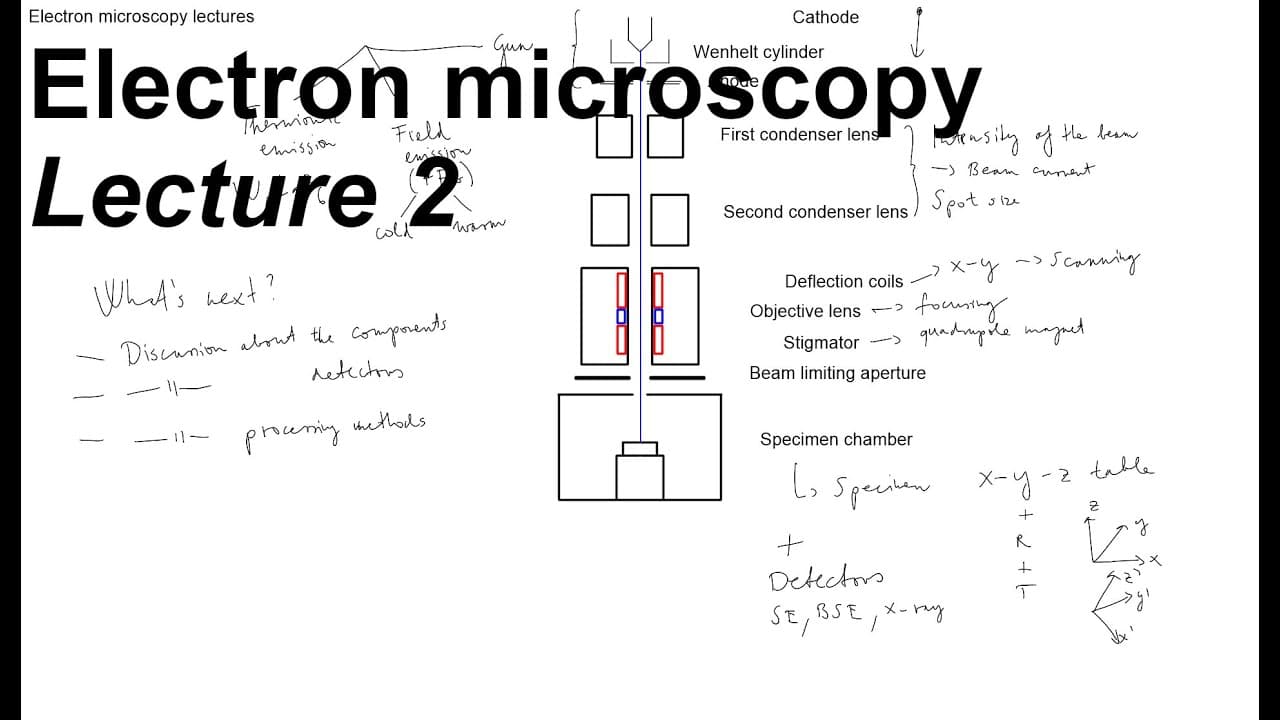
welcome again in this video I'm going to continue to discussion about the electron microscopes this is the second lecture and what you can see on the screen is the somatic schematics of the electron microscope the scanning electron microscope so I will discuss each part in brief tell what it does and then I will tell you what you can expect in the ... Read More
Key Insights
- 😁 Scanning electron microscopes leverage the interactions between electron beams and specimens to produce high-resolution images.
- 🏑 The choice between thermionic and field emission electron guns can significantly affect microscopy quality and efficiency.
- 😁 Magnetic fields replace traditional optical lenses in electron microscopy, allowing for nuanced control of beam properties.
- ❓ Proper alignment and focusing, facilitated by objective lenses and stigmators, are essential for achieving accurate imaging.
- 🎮 Deflection coils enable controlled scanning patterns, helping to generate comprehensive images of the specimen surface.
- 📡 Multiple detectors are used in electron microscopy to analyze different types of signals produced by electron-specimen interactions.
- 👨🔬 Future lectures will address methods of processing electron microscope images and practical applications in scientific research.
Install to Summarize YouTube Videos and Get Transcripts
Explore YouTube Video Summarizer or Get YouTube Transcript Extractor
Questions & Answers
Q: What is the primary function of the electron gun in an electron microscope?
The electron gun generates a beam of electrons necessary for scanning and imaging specimens. It typically includes a cathode that emits electrons, an anode to accelerate them, and a van Houde cylinder. Two types of guns are used, thermionic emission and field emission guns, each with its own advantages in electron emission efficiency and beam quality.
Q: How do condenser lenses differ in electron microscopy compared to traditional optical lenses?
Unlike traditional optical lenses made from glass, condenser lenses in electron microscopy use magnetic coils to manipulate electron beams. These lenses adjust the intensity and convergence of the electron beam, influencing the spot size and ultimately affecting the quality of the images produced in the scanning electron microscope.
Q: What role do deflection coils play in scanning electron microscopy?
Deflection coils are essential for directing the electron beam across the specimen surface, similar to how a CRT television operates. They modify the x and y coordinates of the beam, allowing for precise scanning of the sample, which is synchronized with detectors to gather detailed information from each scanned point.
Q: Why is the size of the electron beam's spot crucial in electron microscopy?
The spot size directly influences image resolution; smaller spot sizes allow for higher resolution images, capturing finer details of the specimen. This is achieved through careful manipulation of the electron beam with condenser lenses and beam limiting apertures, refining the beam's convergence before interacting with the specimen.
Summary & Key Takeaways
-
The video discusses the anatomy and function of scanning electron microscopes, focusing on components like the electron gun, condenser lenses, and deflection coils. These elements work together to create high-quality images of specimens.
-
Two types of electron guns are highlighted: thermionic emission and field emission guns, with an emphasis on their material composition and performance advantages in advanced microscopy.
-
Future lectures will delve into the specifics of each component, including detectors and image processing methods, providing practical knowledge and real-life applications in electron microscopy.
Read in Other Languages (beta)
Share This Summary 📚
Summarize YouTube Videos and Get Video Transcripts with 1-Click
Try YouTube Summary with ChatGPT & Claude or YouTube Transcript Generator
Explore More Summaries from Curious Scientist 📚

![Building a Peltier cooler-based cooling box - First iteration, improvements [Part 2/6] thumbnail](/_next/image?url=https%3A%2F%2Fi.ytimg.com%2Fvi%2F0YlNw0EGnzI%2Fhqdefault.jpg&w=750&q=75)
![Building a coil winder [Part 6] - A few improvements thumbnail](/_next/image?url=https%3A%2F%2Fi.ytimg.com%2Fvi%2F3eyxG_g2iUA%2Fhqdefault.jpg&w=750&q=75)
Summarize YouTube Videos and Get Video Transcripts with 1-Click
Try YouTube Summary with ChatGPT & Claude or YouTube Transcript Generator