Alex Karp on Palantir's Q2 Earnings: Growth Explained
TL;DR
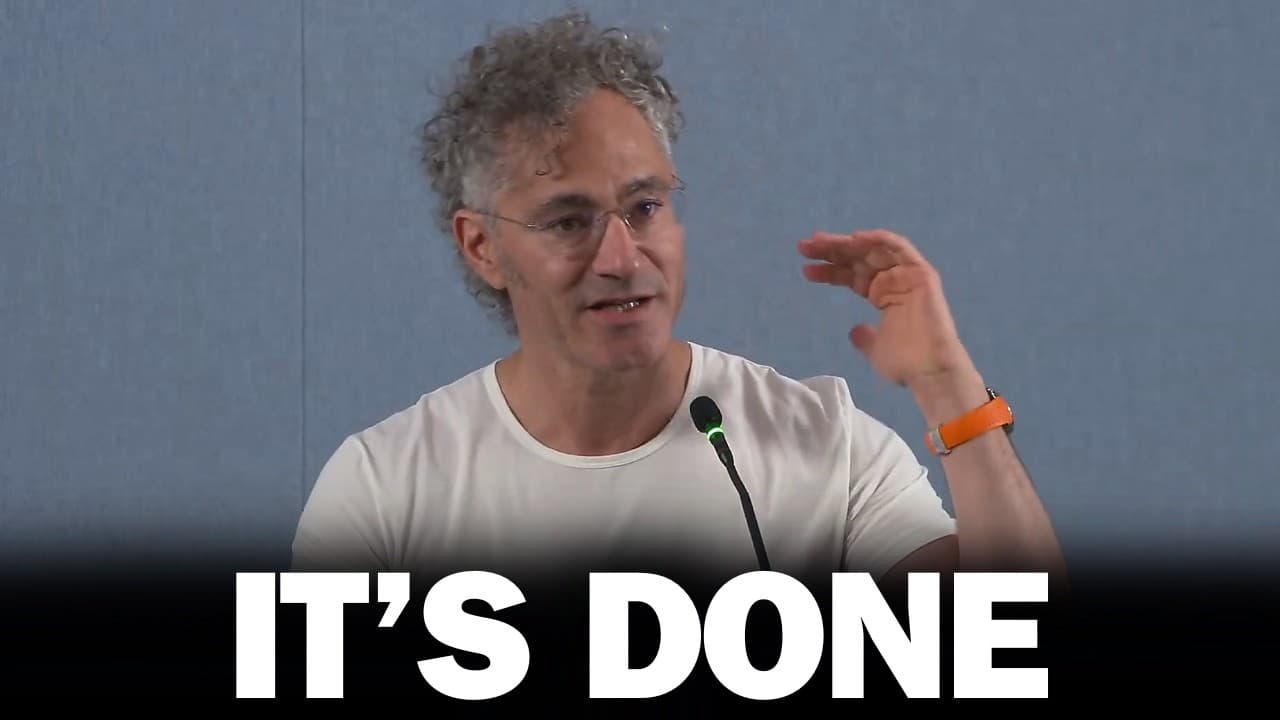
Palantir posted 93% growth in US commercial, 53% in US government, and 68% overall US growth, which CEO Alex Karp called a once-in-a-generation quarter. The company credits its no-parasitic-elements model, ontology and foundry products, and a strategy where existing customers sell to new ones rather than a large direct salesforce.
Transcript
Well, as usual, I've been cautioned to be a little modest about our bombastic numbers, but it's honestly there's no authentic way to be anything but have enormous pride and gratefulness about these extraordinary numbers. Now, when you're look obviously looking at numbers, there's numbers and what do they mean? So if you take I would say the truly o... Read More
Key Insights
- Palantir reported 93% growth in US commercial, 53% growth in US government (USG), and 68% growth in the US overall, which Alex Karp described as a truly once-in-a-generation, anomalous quarter off a large base.
- The Rule of 40 is used to judge the meaning of the growth numbers; Karp says results in the 50s, 60s, or 70s are strong, and Palantir's figures represent among the most impressive numbers any enterprise software company has ever seen.
- Palantir claims to have built a company where every component is value-accretive with almost no parasitic elements, featuring a small salesforce, flat hierarchy, and an orchestration engine that deploys engineers everywhere.
- The company operates with no large direct salesforce; its primary sales channel is current customers telling other customers to bring Palantir in, which lets deals start from high credibility rather than complete ignorance.
- Karp frames AI as an agency-enhancing revolution, noting that in US government work, people with less than a college education sometimes create more value using Palantir's products than college-educated workers.
- The American Tech Fellowship and Sham's initiative aim to arm blue-collar and working-class workers with AI skills, empowering self-taught autodidacts who build AI applications rather than just using them.
- Real-world AI use cases cited include ICU nurses gaining more patient time, submarine industrial base factory workers reclaiming three days of parts quoting, and Panasonic Energy training EV battery workers.
- Palantir reached roughly a billion-dollar run rate and Karp forecasts 10x revenue growth in the US over the next five years, driven by customers who move between companies and call Palantir first at each new role.
Install to Summarize YouTube Videos and Get Transcripts
Explore YouTube Video Summarizer or Get YouTube Transcript Extractor
Questions & Answers
Q: What growth numbers did Palantir report on its Q2 earnings call?
Palantir reported 93% growth in US commercial (US comm) off a large base, 53% growth in US government (USG), and 68% growth in the US overall. Alex Karp referenced the figures 94, 93, 68, and 53 as astonishing and incredible. He called it a once-in-a-generation, truly anomalous quarter, noting the company now works off a very large base with a significant billion-dollar run rate.
Q: What is the Rule of 40 and how does Palantir measure up?
The Rule of 40 is used to tell the meaning of a growth number. According to Karp, if that number is somewhere in the 50s, 60s, or 70s, that is 'pretty baller.' He argued Palantir's figure is the single most impressive number he thinks any enterprise software company has ever seen, indicating something anomalous is going on beyond what the raw growth percentages already suggest.
Q: How does Palantir grow without a large direct salesforce?
Palantir rejected the traditional software model of useless, parasitic products sold through thousands of steak dinners. Its primary salesforce is current customers telling other customers to bring Palantir in and listen to how they orchestrate culture and products. This lets Palantir enter deals with enormous credibility, so buyers already believe it will make them money, save expenses, or make soldiers safer and more lethal. It still keeps a small, nimble sales team for large deals.
Q: How is Palantir making AI useful for frontline workers, not just data scientists?
Responding to a question from Christina, Sham said AI is giving American workers superpowers rather than the doomerism coming from AI researchers in the ivory tower. Examples include ICU nurses spending more time with patients, submarine industrial base factory workers reclaiming three days of parts quoting to solve production problems, and Panasonic Energy developing AI to train EV battery workers whose background was casinos. The work is described as job-expanding, empowering, and pro-agency.
Q: What is the American Tech Fellowship?
The American Tech Fellowship is Palantir's initiative to find, empower, credential, and train creative AI builders. The company's lived experience is that some of the most creative AI applications come from blue-collar workers and self-taught autodidacts with a little bit of self-taught knowledge, not classically trained computer scientists. The goal is not just using AI but building AI applications that change businesses, then unleashing these people on the American economy.
Q: What does Alex Karp mean by an American revolution led by ontology and chips?
Karp described the moment as a perfect time for a revolution in the United States, being led by ontology and chips and to some extent large language model providers. He said the prediction that all attendees would be downstream from the value, meaning chips and ontology, is being proven not as a thesis but as a reality. He expressed being very bullish on America and all aspects of American life, especially blue-collar workers.
Q: Why does Palantir say its model has no parasitic elements?
Karp claims Palantir created a company where every single component is value-accretive with almost no parasitic elements. It has a small salesforce, very little internal BS, a flat hierarchy, and the most qualified and heterodox people. It uses an orchestration engine that deploys engineers everywhere. The company believes it will always be downstream from the value it creates and able to capture that value, a model everyone despised until a quarter ago.
Q: What is Palantir's revenue forecast for the coming years?
Karp said Palantir is going to get 10x revenue in the US over what he views as the next five years, and certainly what the company forecasted for this year. He attributed this to customers arriving with different credibility and leverage, coming in at a much higher level and ratcheting up. As CEOs, CIOs, and chief revenue officers hear peers on earnings calls describe dramatically changing their business at lower cost, they rush to get Palantir on the phone.
Summary & Key Takeaways
-
Alex Karp opened Palantir's Q2 earnings call expressing pride in what he called bombastic, once-in-a-generation numbers: 93% US commercial growth, 53% US government growth, and 68% US growth, all achieved off an already large base with a billion-dollar run rate.
-
Karp emphasized Palantir built these results with no compromise on values, running a company with a small salesforce, flat hierarchy, little internal BS, and value-accretive components. Products like ontology, foundry, and maven, once disdained, are now proven realities on the front line.
-
The company champions AI as agency-enhancing for blue-collar workers through the American Tech Fellowship, citing nurses, factory workers, and Panasonic Energy. Its growth engine is customers selling to customers, entering deals with high credibility rather than a large direct salesforce, forecasting 10x US revenue in five years.
Read in Other Languages (beta)
Share This Summary 📚
Summarize YouTube Videos and Get Video Transcripts with 1-Click
Try YouTube Summary with ChatGPT & Claude or YouTube Transcript Generator
Explore More Summaries from David Carbutt 📚






Summarize YouTube Videos and Get Video Transcripts with 1-Click
Try YouTube Summary with ChatGPT & Claude or YouTube Transcript Generator