What Is Vascular Anatomy for Dialysis Access?
TL;DR
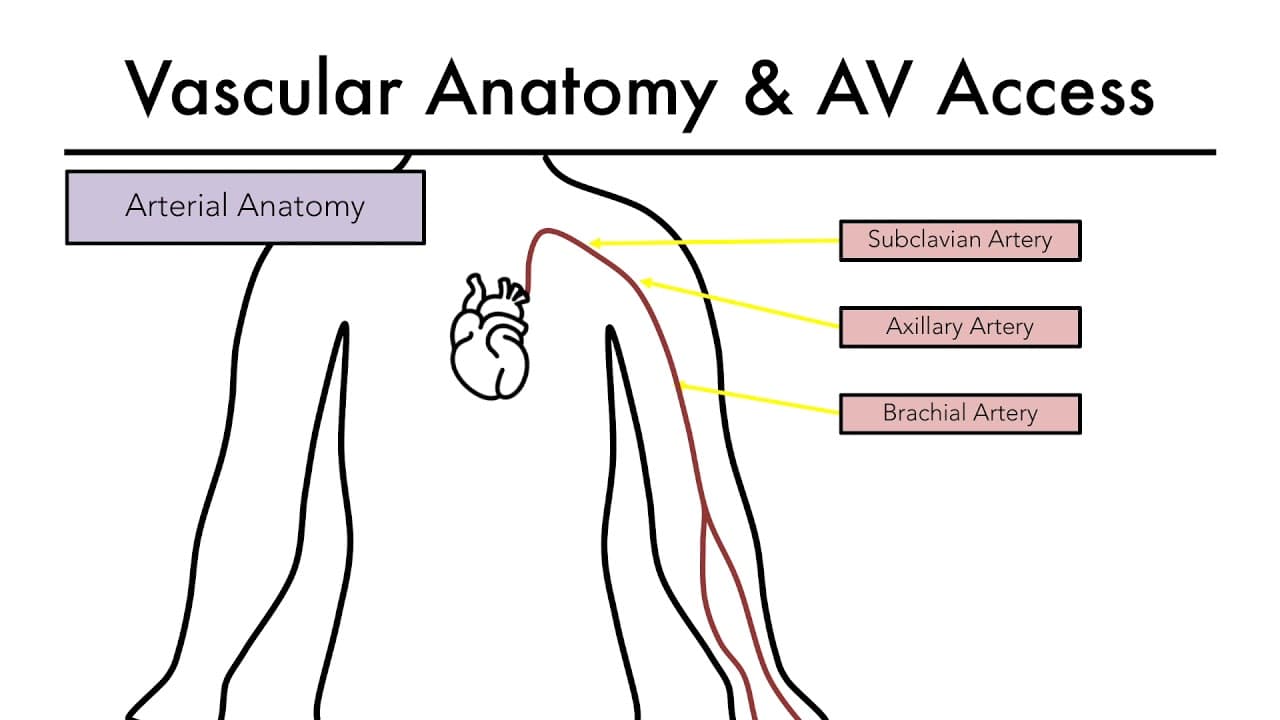
Vascular anatomy for dialysis access involves using the cephalic and basilic veins in the upper extremity. The cephalic vein is easily accessible, while the basilic vein may require transposition for easier access. Additionally, arteries like the subclavian, axillary, and brachial are utilized to create arteriovenous fistulas.
Transcript
let's review the vascular anatomy of the upper extremity as it pertains to dialysis axis the light blue are the superficial veins and the dark blue are the deep veins of the arm and forearm the two main superficial veins in the upper extremity that are used for dialysis axis are the cephalic vein and the basilic vein the cephalic and the basilic ve... Read More
Key Insights
- ♿ The cephalic vein and basilic vein are the primary superficial veins used for dialysis access in the upper extremity.
- ♿ Arteries, such as the subclavian, axillary, brachial, and radial arteries, are also utilized for creating dialysis access.
- ♿ Basilic vein transposition may be necessary to access the basilic vein more easily.
- 😋 AV fistula scars can provide clues about the type and location of the created fistula.
Install to Summarize YouTube Videos and Get Transcripts
Explore YouTube Video Summarizer or Get YouTube Transcript Extractor
Questions & Answers
Q: What are the two main superficial veins used for dialysis access in the upper extremity?
The cephalic vein and the basilic vein are the two main superficial veins used for dialysis access in the upper extremity. They connect at the antecubital fossa by the median cubital vein.
Q: What is the procedure called when the basilic vein is brought to a more superficial plane for easier access?
The procedure is called basilic vein transposition. It involves bringing the basilic vein up along a more superficial plane to facilitate easier access for needle insertion.
Q: Which artery is often used for access in the arm to create a brachiocephalic or brachiobasilic fistula?
The axillary artery, which is a continuation of the subclavian artery, is often used for access in the arm to create a brachiocephalic or brachiobasilic fistula.
Q: What are the three most common sites for AV fistula creation from distal to proximal in the arm?
The three most common sites for AV fistula creation in the arm are the radial-cephalic at the wrist, brachiocephalic in the distal arm, and brachiobasilic more proximally. The median cubital vein can also be used in the absence of a suitable forearm cephalic vein.
Summary & Key Takeaways
-
The cephalic and basilic veins are the main superficial veins used for dialysis access in the upper extremity.
-
The cephalic vein is easily accessible along the lateral aspect of the arm, while the basilic vein runs deeper and requires transposition for easier access.
-
Arteries, such as the subclavian, axillary, brachial, and radial arteries, are also used for creating dialysis access.
Read in Other Languages (beta)
Share This Summary 📚
Summarize YouTube Videos and Get Video Transcripts with 1-Click
Try YouTube Summary with ChatGPT & Claude or YouTube Transcript Generator
Explore More Summaries from YaleCourses 📚






Summarize YouTube Videos and Get Video Transcripts with 1-Click
Try YouTube Summary with ChatGPT & Claude or YouTube Transcript Generator