How to Create Meta Ads That Perform in 10 Minutes
TL;DR
Raw, low-production image ads with direct messaging can outperform polished Meta creatives, according to the campaign tests presented. The recommended approach is to choose the correct objective, use broad targeting, upload new creatives regularly, and rapidly design each concept from the first compelling lines that come to mind, since creative and messaging now drive campaign performance.
Transcript
Something very strange is happening to meta ads. What used to work a year ago doesn't work anymore. We have spent hundreds of millions of dollars on meta ads. And what works on meta ads always keeps changing. But this time it's very drastic. Now look at these ads. They look like a post in a Facebook group raw and very low production quality. And yo... Read More
Key Insights
- Creative is the primary campaign variable in the presenter’s 2025 framework because Meta’s AI absorbs many decisions about bidding, placements, targeting, audience testing, and campaign structure. Advertisers are therefore advised to concentrate their effort on the message and the advertisements they upload.
- Creative functions as targeting because Meta can use an advertisement’s content to identify the audience most likely to respond. The recommended campaign setup is consequently simple: select the correct objective, use broad targeting, and let each creative help determine who should receive it.
- Only one in every 10 tested ads became a performance outlier across the presenter’s recent creative experiments. This result implies that advertisers seeking regular winners need sustained creative volume rather than expecting every idea to deliver exceptional campaign performance.
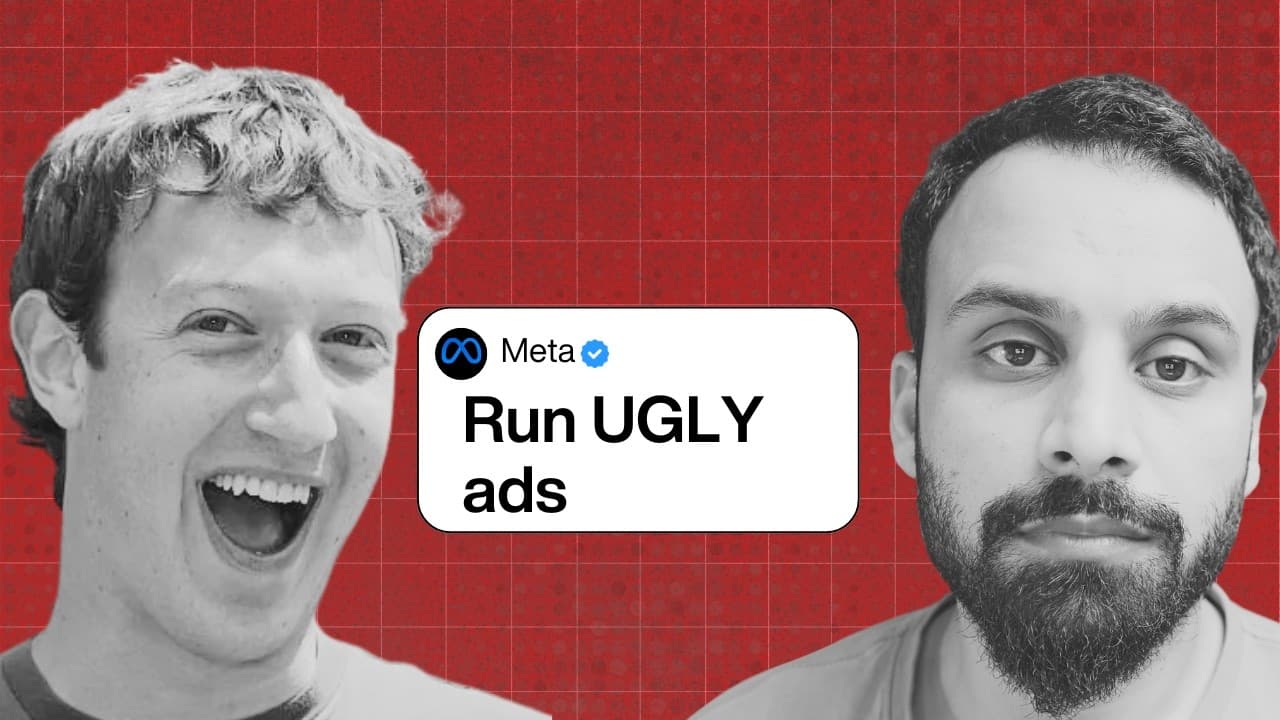
- Ugly ads are raw, low-production creatives that may resemble ordinary Facebook group posts rather than conventional advertisements. Their rough typography, colors, layouts, and simple text can violate familiar design preferences while still attracting attention and producing stronger commercial results.
- The featured rough image reduced purchase cost from about 36 dirhams for the best earlier video to about 21 dirhams. It generated 10 sales and reportedly achieved approximately 15x return on ad spend, despite receiving comments that criticized its visual design.
- Audience preferences drive the algorithm because people determine which advertisements receive attention and engagement. The presenter therefore attributes changing performance patterns to evolving viewer behavior, rather than treating Meta’s algorithm as an independent cause of weak results.
- Strong messaging matters more than visual polish in the proposed framework. Examples use direct claims, questions, jokes, and observations about programmatic advertising, Google Ads, or AI marketing, while presenting those ideas through deliberately basic text-heavy layouts.
- The creation framework begins with the first few lines that naturally come to mind about a product or service. Those lines become the message, and a rough version produced within 2–5 minutes becomes the final advertisement instead of being refined by a designer.
Install to Summarize YouTube Videos and Get Transcripts
Explore YouTube Video Summarizer or Get YouTube Transcript Extractor
Questions & Answers
Q: What types of Meta ads worked in the presented 2025 tests?
Raw, low-production advertisements with direct, text-heavy messaging performed best in the tests presented. These creatives looked more like rough social posts than polished branded advertising and sometimes ignored basic design principles. Examples focused on programmatic advertising, structured Google Ads training, and AI marketing. Despite negative comments about their appearance, several reportedly produced stronger results than polished videos.
Q: How do you create an ugly Meta ad in 10 minutes?
Start by thinking about the product or service being promoted, or discuss it briefly with another person. Write down the first few compelling lines that come to mind and use them as the creative message. Then spend 2–5 minutes making a rough layout as if it were a draft for a designer. That initial, unfinished-looking version becomes the actual advertisement.
Q: Why can low-production Meta ads outperform polished creatives?
The presenter’s explanation is that audiences increasingly respond to content that feels native, raw, and less like conventional advertising. Meta’s algorithm follows audience behavior, including what people notice and engage with. A rough creative can therefore win even when viewers dislike its design. The central claim is that attention and effective messaging matter more than compliance with traditional visual standards.
Q: What campaign setup is recommended for Meta ads in 2025?
The recommended setup is to choose the correct campaign objective, use broad targeting, and upload new creatives regularly, either every week or every three days. The presenter argues that Meta’s AI now absorbs much of the work involving bidding, placements, audience testing, targeting, and campaign structure. Under this approach, campaign performance depends primarily on the uploaded creative and its message.
Q: What does creative is the new targeting mean for Meta ads?
Creative is the new targeting means that an advertisement’s content helps Meta identify the people most likely to respond to it. Instead of relying heavily on manual audience segmentation, the advertiser uses broad targeting and develops messages for relevant prospects. Meta then distributes each creative according to predicted audience interest, making the wording, concept, and presentation central to both reach and performance.
Q: How often should advertisers upload new Meta creatives?
The presenter recommends uploading new creatives regularly, with examples of either every week or every three days. This frequency supports continued experimentation because only one in every 10 tested ads became a performance outlier. Advertisers who want winning ads each week therefore need to produce and test enough concepts, rather than depending on a small number of polished advertisements for extended periods.
Q: What campaign results did the ugly Meta ad produce?
In the featured course campaign, total spending exceeded 8,300 dirhams, described as more than $2,000. The strongest earlier video averaged about 36 dirhams per purchase. One rough image subsequently generated 10 sales at about 21 dirhams per purchase, approximately half the video’s cost. The presenter also reports that this creative produced around 15x return on ad spend.
Q: Should Meta advertisers prioritize design quality or performance?
The presented tests favor performance when polished design and measurable results conflict. Several rough advertisements drew comments asking for better creative, yet their results were reportedly about twice as strong, with one producing around 15x return on ad spend and another generating a return of 9 to 10. The suggested approach is to test intentionally basic designs instead of assuming professional polish will improve outcomes.
Summary & Key Takeaways
-
Meta advertising creative evolved from polished static designs before 2018 to high-production video and then authentic UGC-style content during the TikTok era. The presenter argues that Meta's AI now absorbs many decisions involving bidding, placements, targeting, audience tests, and campaign structure, leaving creative and messaging as the main performance variables.
-
The presented course campaign spent more than 8,300 dirhams. Its strongest earlier video averaged about 36 dirhams per purchase, while an intentionally rough image generated 10 sales at about 21 dirhams per purchase. Although viewers criticized its design, that image reportedly generated approximately 15x return on ad spend.
-
The proposed creation process has two steps. First, consider the promoted product or discuss it with someone, then capture the first few compelling lines that arise as the message. Second, build a rough design within 2–5 minutes as though it were only a draft, but publish that initial version as the actual creative.
Read in Other Languages (beta)
Share This Summary 📚
Summarize YouTube Videos and Get Video Transcripts with 1-Click
Try YouTube Summary with ChatGPT & Claude or YouTube Transcript Generator
Explore More Summaries from Senator We Run Ads 📚




Summarize YouTube Videos and Get Video Transcripts with 1-Click
Try YouTube Summary with ChatGPT & Claude or YouTube Transcript Generator