Why Do People React Differently to the Same Foods?
TL;DR
Blood sugar, fiber, and drug responses are personal, not universal. Stanford geneticist Dr. Michael Snyder found some people are 'potato spikers' and others 'grape spikers,' so glycemic index alone cannot predict your reaction. Continuous glucose monitors, worn about 14 days and reading every five minutes, reveal which specific foods spike you and which you can eat freely.
Transcript
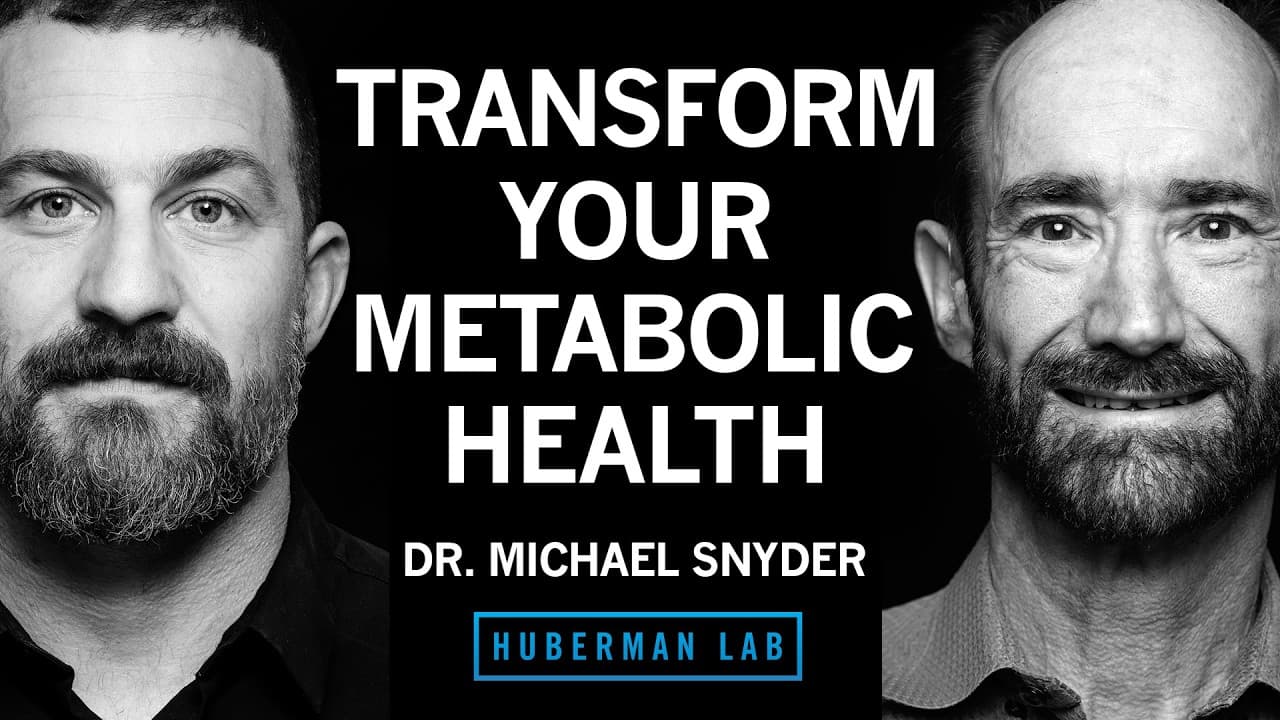
Welcome to the Huberman Lab podcast, where we discuss science and science-based tools for everyday life. I'm Andrew Huberman and I'm a professor of neurobiology and opthalmology at Stamford School of Medicine. My guest today is Dr. Michael Snyder. Dr. Michael Snyder is a professor of genetics at Stanford University School of Medicine. His laborator... Read More
Key Insights
- Individual variability is the central finding: not everyone responds the same way to a given behavior, drug, supplement, or food designed to improve health span and lifespan, because responses depend on which genes and proteins a person expresses.
- Glycemic index is not a reliable personal predictor. The Snyder lab identified 'potato spikers' and 'grape spikers' — people whose insulin spikes to potatoes but not grapes and vice versa — showing food responses depend on who you are.
- A healthy glucose response can include transient spikes. Eating a sugar-loaded grape or doing strength training causes a spike that resolves quickly, within about 30 to 60 minutes, and is considered normal rather than harmful.
- Time in range is a simple metric for glucose health. Healthy people are advised to keep glucose between 70 and 140, while diabetics aim for 70 to 180, with normal fasting values around 90.
- Continuous glucose monitors reveal hidden metabolic problems. Worn on the arm and reading glucose every five minutes for about 14 days, they exposed pre-diabetics who spike as badly as diabetics without knowing it.
- Glucotypes classify people as good controllers, moderate spikers, or severe spikers. This quantifies the surprising range of glucose control found even among people considered normal, not just diagnosed diabetics.
- Fiber affects people in opposite directions. Some people experience systemic brain and body inflammation from certain fiber types, while others get decreased inflammation from them, so the goal is identifying which category you fall into.
- Time in range correlates strongly with hemoglobin A1C, a steady-state glucose measure used to classify diabetes and pre-diabetes, but CGMs add real-time precision that periodic A1C tests cannot provide.
Install to Summarize YouTube Videos and Get Transcripts
Explore YouTube Video Summarizer or Get YouTube Transcript Extractor
Questions & Answers
Q: Why do people respond differently to the same foods?
According to Dr. Michael Snyder, food responses depend on which genes and proteins an individual expresses, so individual variability matters more than broad rules. His lab identified 'potato spikers' and 'grape spikers' — people whose insulin spikes in response to potatoes but not grapes, and vice versa. This means blanket claims that certain carbohydrates are universally good or bad are misleading, because the same food can spike one person's blood sugar while leaving another's unaffected.
Q: What is a healthy glucose spike versus an unhealthy one?
A healthy spike is transient and resolves quickly, typically within 30 to 60 minutes. Eating a sugar-loaded grape or doing strength training, which breaks down glucagon for energy, produces normal transient spikes. Unhealthy spikes are high and prolonged, and excessive spiking, especially in diabetics, is associated with cardiovascular disease and other problems. The goal is keeping glucose in range rather than avoiding every inflection, since some rise after eating or exercise is expected and healthy.
Q: What glucose range should a healthy person stay in?
Snyder explains that most healthy people have glucose around 90 and should try to keep it between 70 and 140, a metric called time in range. Diabetics are advised to stay between 70 and 180. He notes these thresholds are somewhat arbitrary but serve as a reasonable rule of thumb. Time in range correlates very well with hemoglobin A1C, a steady-state glucose measure, while offering real-time precision that periodic A1C testing cannot.
Q: How do continuous glucose monitors work?
Continuous glucose monitors are devices worn on the arm that measure glucose every five minutes, letting you see exactly what is happening in real time. They can be worn for about 14 days depending on the device and are now available over the counter. By wearing one, you can see precisely which foods do what to you, since responses are personal — some people spike to bananas, potatoes, pasta, white bread, or brown bread differently from others.
Q: What are glucotypes?
Glucotypes are a way Snyder's lab devised to quantify how well people control their glucose. When they put monitors on so-called normal people, pre-diabetics, and diabetics, they found some had very good glucose control, some were moderate spikers, and some spiked just as badly as diabetics without knowing it. Glucotypes classify these patterns, revealing that significant variation in glucose control exists even among people who consider themselves metabolically normal.
Q: How does fiber affect different people?
Fiber is generally believed to be good for health, but Snyder explains that different fiber types impact people differently. Some people experience systemic inflammation of their brain and body when they eat certain fibers, which is bad, while others experience systematic decreases in inflammation from certain fibers. The key is identifying which category you fall into and therefore which fibers to eat. Since different foods contain different fiber types, this is tractable and actionable.
Q: Why does strength training cause a glucose spike?
During strength training, the body breaks down glucagon, which Snyder describes as a polymer of sugar, to provide energy for exercise and training. This breakdown releases glucose and produces a spike. Snyder says he gets a glucose spike every morning when he weight trains. This is considered a normal, healthy spike because it is transient and goes away pretty quickly, unlike the prolonged high spikes that signal metabolic problems.
Q: How is diabetes classified using hemoglobin A1C?
Hemoglobin A1C measures your steady-state glucose and is the typical way people are classified for diabetes and pre-diabetes. Snyder explains that time in range, measured by continuous glucose monitors, correlates very well with A1C and serves as a surrogate measure. The advantage of CGMs is that you can precisely see what is going on in real time, unlike a hemoglobin A1C measurement, which is only obtained periodically rather than continuously throughout the day.
Summary & Key Takeaways
-
Dr. Michael Snyder, a Stanford genetics professor, studies why people respond differently to foods, supplements, and interventions. His lab showed insulin spikes to specific carbohydrates depend on the individual, identifying 'potato spikers' versus 'grape spikers,' proving that broad carbohydrate good-or-bad debates miss the point of personal biological variation.
-
Glucose spikes are not all harmful. Prolonged high spikes are bad, but transient ones from a grape or from strength training, which breaks down glucagon for energy, resolve within 30 to 60 minutes. Snyder, a type 2 diabetic, notes his own spikes run higher and longer.
-
Continuous glucose monitors, now over the counter, read glucose every five minutes for about 14 days, revealing exactly which foods spike each person. The episode also covers how fiber types trigger opposite inflammation responses, plus GLP-1 drugs, longevity, and psychological interventions affecting gene and protein expression.
Read in Other Languages (beta)
Share This Summary 📚
Summarize YouTube Videos and Get Video Transcripts with 1-Click
Try YouTube Summary with ChatGPT & Claude or YouTube Transcript Generator
Explore More Summaries from Andrew Huberman 📚





Summarize YouTube Videos and Get Video Transcripts with 1-Click
Try YouTube Summary with ChatGPT & Claude or YouTube Transcript Generator