How to structure LLM outputs with LangChain and PDL
TL;DR
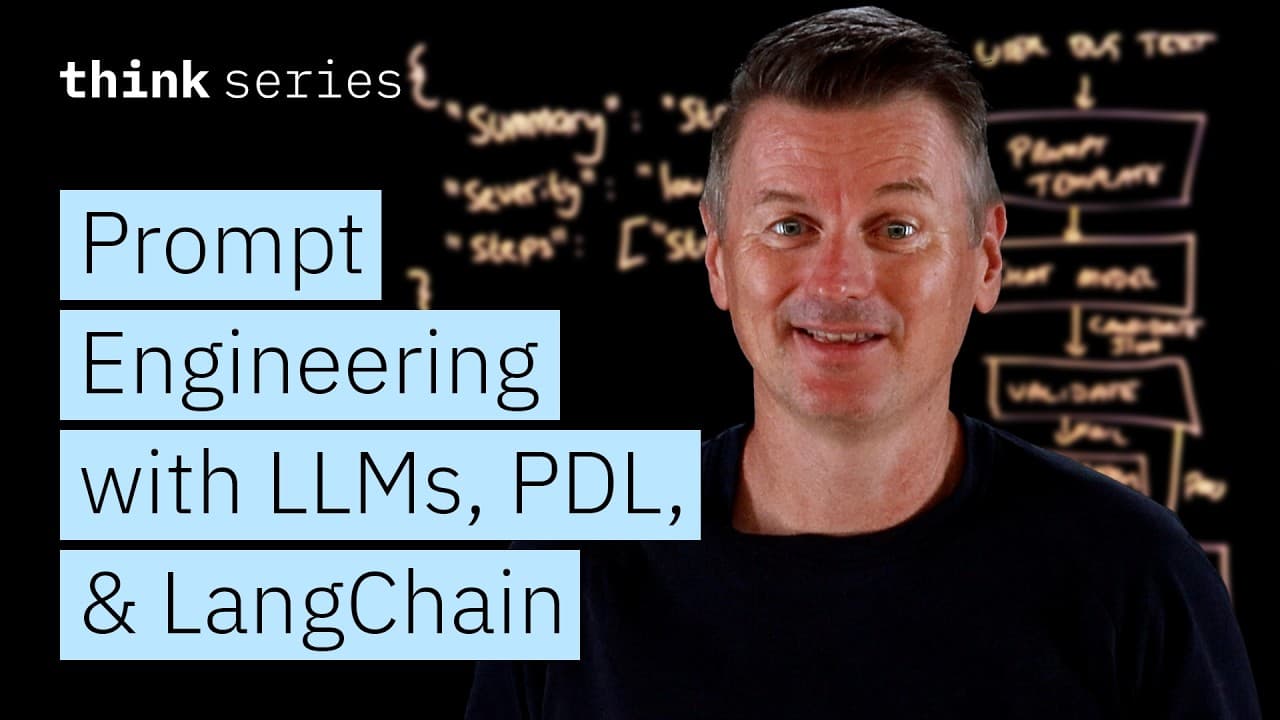
LangChain guides building LLM apps with runnable steps, while PDL enforces a strict contract and type checks for JSON outputs. Together they turn prompts into reliable software by validating responses, retrying on errors, and tracing changes. This video explains the difference and shows how to implement both in practice.
Transcript
Do you remember when rompt engineer was the hot new profession? Prompt engineers could whisper the right combination of magic words to a large language model to get them to do things that regular folks issuing regular prompts simply couldn't do. Well, as LLMs got smarter and better understanding intent, the title of prompt engineer has lost som... Read More
Key Insights
- LangChain is an open source framework for building LLM apps with a pipeline of composable steps.
- Prompts are probabilistic and can yield different responses when wording changes or temperature varies.
- A strict contract fixes the output shape and required keys to ensure predictable results.
- A control loop validates every response against the contract and can retry with tighter constraints.
- Observability, including tracing, helps identify which prompts produced which outputs.
- PDL is a declarative spec for LLM workflows stored in a YAML file.
- PDL enforces types, controls flow, and emits final data in a defined format.
- LangChain is code first while PDL is spec first, and both support reliable software engineering for LLMs.
Install to Summarize YouTube Videos and Get Transcripts
Explore YouTube Video Summarizer or Get YouTube Transcript Extractor
Questions & Answers
Q: A real search query question about the video (e.g. 'How to...', 'What is...').
Question 1: How does LangChain organize LLM workflows into a reusable pipeline? Answer: LangChain structures LLM interactions as runnable steps, where each box performs a specific task such as a prompt template, a model call, or a post processing step. This enables consistent behavior across runs and makes it easier to assemble complex workflows from simple, testable components.
Q: What is the role of a contract in prompt engineering?
Prompt engineering uses a contract to lock down the exact output shape, including keys and enums, so downstream software can reliably parse the result. The contract acts as the agreement between model output and the software consuming it, reducing drift and unexpected formats that can cause failures in automated systems.
Q: How does the control loop contribute to reliability?
The control loop continually validates model outputs against the contract, triggering retries or repairs when validation fails. This creates a feedback mechanism that catches deviations early, applies tighter instructions, or switches to a fallback path so the final data remains clean and usable within the application.
Q: Why is observability important in LLM workflows?
Observability, including tracing, is important to see exactly which prompts and model calls produced which outputs. It helps detect regressions, understand how changes affect results, and provides actionable data for improving prompts and model configurations before shipping changes to production.
Q: What does LangChain mean by a runnable in the pipeline?
In LangChain, a runnable is a step that takes input, performs an action, and outputs a result. Runnables can be prompt templates, model calls, or validation steps, and they are connected to form a repeatable pipeline that processes data consistently across executions.
Q: How does PDL differ from LangChain in approach?
PDL is a declarative spec stored in a YAML file that defines the prompt, the data contract, and the control flow, whereas LangChain is a code-first, pipeline-based framework of runnables. PDL emphasizes defining data shapes and type safety upfront, while LangChain emphasizes assembling steps in executable code.
Q: What happens if a JSON output drifts from the contract?
If the JSON output drifts from the contract, the validation step detects the mismatch, and the system can retry with tighter instructions or repair the response. This prevents malformed data from propagating into the application and maintains a stable interface for downstream components.
Q: What is the practical benefit of combining LangChain and PDL?
Combining LangChain and PDL provides a grownup toolbox for turning prompt whispering into reliable software engineering. LangChain handles the modular, executable workflow, while PDL enforces strict data contracts and type checks, together enabling observable, retryable, and maintainable LLM-powered software.
Summary & Key Takeaways
-
LangChain provides a pipeline of runnable steps for building LLM apps, allowing you to specify pre and post model actions.
-
PDL offers a declarative YAML spec that defines the data shapes, types, and control flow for LLM work.
-
Together, these tools convert flexible prompts into reliable software through contracts, validation, and observability.
Read in Other Languages (beta)
Share This Summary 📚
Summarize YouTube Videos and Get Video Transcripts with 1-Click
Try YouTube Summary with ChatGPT & Claude or YouTube Transcript Generator
Explore More Summaries from IBM Technology 📚
Summarize YouTube Videos and Get Video Transcripts with 1-Click
Try YouTube Summary with ChatGPT & Claude or YouTube Transcript Generator