What Are the Causes and Treatments for Autism?
TL;DR
The causes of autism are complex, involving genetic, environmental, and biological factors, with improved diagnosis contributing to increased detection rates. Novel treatments, such as oxytocin, show promise in enhancing social functioning, while early behavioral interventions can be effective as young as two years old.
Transcript
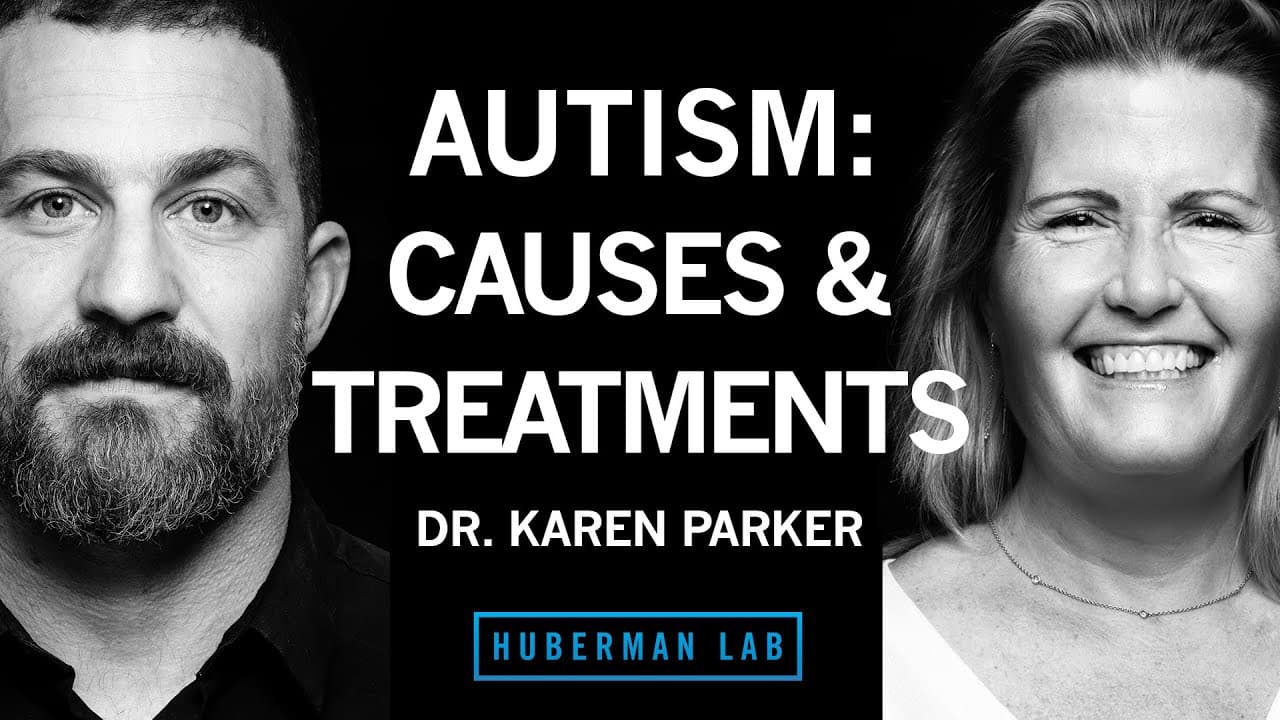
welcome to the huberman Lab podcast where we discuss science and science-based tools for everyday life I'm Andrew huberman and I'm a professor of neurobiology and Opthalmology at Stanford School of Medicine my guest today is Dr Karen Parker Dr Karen Parker directs the social neurosciences research program at the Stanford University School of Medici... Read More
Key Insights
- ❓ The increase in autism diagnoses is the result of improved detection methods and increased awareness.
- ❓ Autism is primarily diagnosed through behavioral observation, focusing on social interaction challenges and restricted repetitive behaviors.
- 🤕 Behavioral interventions can start as early as the age of two or three years in children with autism.
- ❓ Oxytocin and vasopressin are ancient peptides involved in social behavior across species.
- 😊 Studies have shown that oxytocin can reduce the amygdala's response to fearful stimuli, suggesting a pro-social effect.
- 🖐️ Autism is a highly heritable condition, with genetic variants playing a significant role.
- 🥶 The presence of neurogenetic syndromes often co-occurring with autism suggests a potential link to oxytocin deficiency.
- 😘 Oxytocin nasal spray has shown beneficial effects in individuals with lower pre-treatment baseline levels of oxytocin.
Install to Summarize YouTube Videos and Get Transcripts
Explore YouTube Video Summarizer or Get YouTube Transcript Extractor
Questions & Answers
Q: Why has there been a significant increase in autism diagnoses in recent years?
The increase in diagnoses can be attributed to improved detection methods, such as early screening for autism symptoms and increased awareness among pediatricians.
Q: Are there specific diagnostic tools used to identify autism in young children?
Autism is primarily diagnosed through behavioral observation by psychiatrists or psychologists. They look for social interaction challenges and restricted repetitive behaviors as the two core features.
Q: How early are behavioral interventions started in children with autism?
Behavioral interventions can begin as early as a diagnosis is made, typically around the age of two or three years. There are even studies where at-risk infants are enrolled in behavioral studies.
Q: Is there a single neural network associated with autism?
The specific neural network associated with autism is not fully identified. However, recent studies suggest that genes altered in autism impact synapses and neuronal connections in the brain.
Q: What role do oxytocin and vasopressin play in social behavior?
Oxytocin and vasopressin are small peptides involved in social behavior. Oxytocin is associated with mother-infant bonding, while vasopressin has roles in urine regulation and blood pressure. Both peptides are conserved across species.
Summary & Key Takeaways
-
The content is a podcast episode featuring Dr. Karen Parker, a researcher focusing on the social neurosciences and autism spectrum disorders.
-
The episode covers the increase in autism diagnoses, the theories and understanding of the biological basis of autism, and the unresolved questions surrounding its causes.
-
Dr. Parker shares her research on autism, including new findings on its causes and a novel treatment involving oxytocin.
Read in Other Languages (beta)
Share This Summary 📚
Summarize YouTube Videos and Get Video Transcripts with 1-Click
Try YouTube Summary with ChatGPT & Claude or YouTube Transcript Generator
Explore More Summaries from Andrew Huberman 📚


Summarize YouTube Videos and Get Video Transcripts with 1-Click
Try YouTube Summary with ChatGPT & Claude or YouTube Transcript Generator