How Does Ocean Pressure Cause an Implosion?
TL;DR
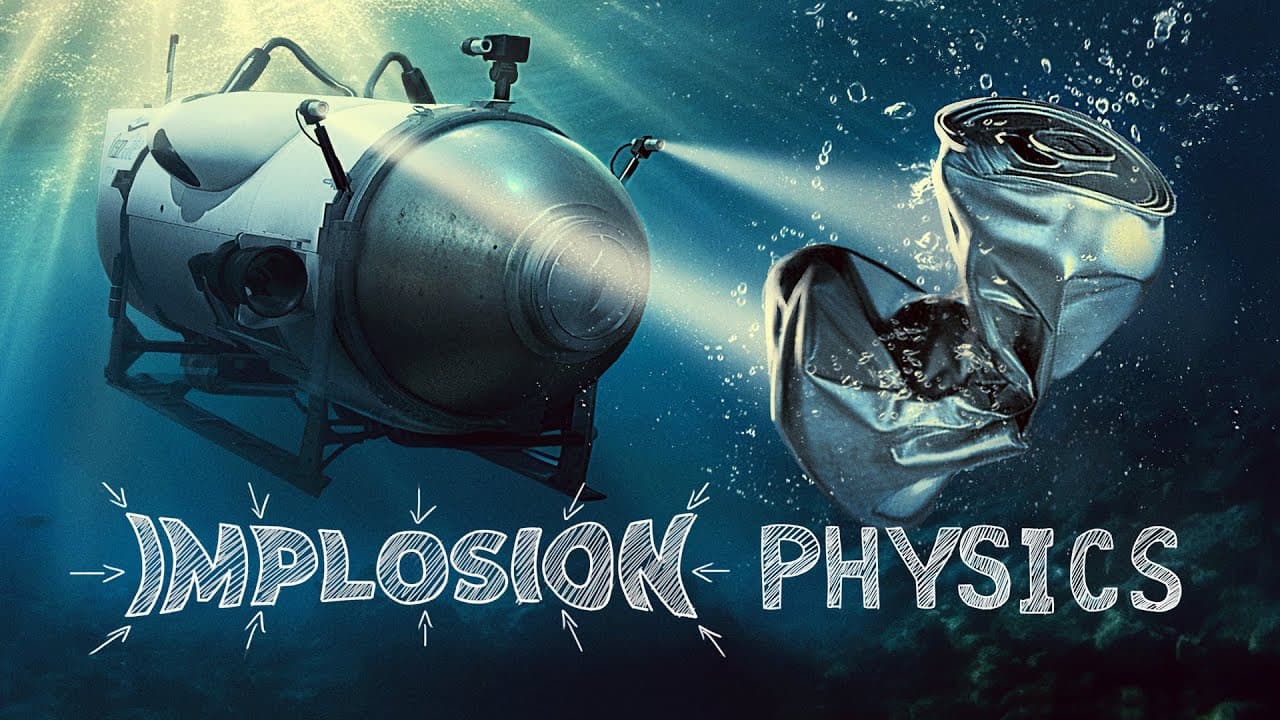
Ocean pressure can crush a sealed vessel when its internal pressure becomes much lower than the surrounding pressure and its structure cannot withstand the imbalance. A heated soda can demonstrates this process: cooling condenses the steam inside, creates a vacuum, and lets atmospheric pressure collapse the weakened container, while a sturdier can resists buckling and fills with water instead.
Transcript
the deep ocean is one of Earth's harshest environments the main reason why immense crushing pressure and you can demonstrate what happens when you don't respect that pressure like the Titans submersible at home now entering the facility by now you've likely heard of the Titan sub-disaster whether by news or by meme where five men imploded in a much... Read More
Key Insights
- Hydrostatic pressure is the pressure created by the weight of a fluid column above a point, and it can be calculated from fluid density, gravitational acceleration, and depth. Greater ocean depth therefore produces greater pressure on every exposed part of a submerged vessel.
- Ocean pressure increases by roughly one atmosphere for every 10 meters of descent under the rule of thumb presented. Near the Titanic wreck, which is roughly four kilometers deep, the surrounding pressure is described as approximately 400 atmospheres.
- Atmospheric pressure is normally unnoticed because organisms live with pressure acting both around and within them. The soda-can demonstration makes its force visible by creating a large pressure difference between the can's low-pressure interior and the surrounding air.
- The can experiment works by boiling water until steam displaces the air inside the container. Placing the hot can opening into ice water then seals it and rapidly condenses the steam, creating a vacuum that leaves the outside atmosphere largely unopposed.
- An ordinary soda can collapses because its thin structure cannot resist the external pressure after steam condenses inside. Water also rushes inward during pressure equalization, showing how a fluid moves rapidly toward a region with much lower pressure.
- A sturdier can can withstand the same atmospheric pressure difference without buckling or breaking. Instead, water enters and fills the low-pressure space, demonstrating that pressure equalization does not necessarily destroy a vessel when its structure is sufficiently resistant.
- The Titan failure is presented as a likely instantaneous equalization between its internal pressure and the immense external ocean pressure. Possible failure points discussed include carbon-fiber hull delamination and a viewport that was not rated for the operating depth.
- Engineering safety is essential because physical pressure cannot be overcome by disregarding warnings or reducing safeguards. The account emphasizes concerns raised by safety experts and former employees, along with questions about hull inspection, older materials, depth ratings, and organizational safety culture.
Install to Summarize YouTube Videos and Get Transcripts
Explore YouTube Video Summarizer or Get YouTube Transcript Extractor
Questions & Answers
Q: How does ocean pressure cause a vessel to implode?
Ocean pressure creates inward force across the vessel's exterior. If the pressure inside is far lower than the surrounding water pressure, the hull must carry that imbalance without deforming. When the hull, viewport, or another structural component fails, the surrounding water moves inward violently to equalize pressure, and a vessel that cannot resist the load collapses rapidly.
Q: What is hydrostatic pressure in the ocean?
Hydrostatic pressure is the pressure produced by the weight of the water above a particular point. The transcript describes it as fluid density multiplied by gravitational acceleration and the height of the fluid column, which corresponds to depth in the ocean. Because the water column becomes taller with descent, the pressure continually increases as an object travels deeper.
Q: How much does ocean pressure increase with depth?
The rule of thumb presented is that ocean pressure increases by roughly one atmosphere for every 10 meters of descent. This follows from approximate values for atmospheric pressure, water density, and gravitational acceleration. Since the Titanic wreck is roughly four kilometers deep, the transcript estimates that the pressure in that environment is approximately 400 atmospheres.
Q: How does the soda-can implosion experiment work?
A small amount of water is heated inside a soda can until boiling steam displaces the original air. The hot can is then inverted so its opening enters ice water, forming a seal. Rapid cooling condenses the steam into liquid, sharply reducing the internal pressure. The surrounding atmospheric pressure then crushes the can and forces some water into it.
Q: What safety equipment is needed for the can experiment?
The demonstration calls for eye protection, clothing that shields the arm from potentially boiling water, and a tool such as tongs for handling the hot can. It also requires a tray of ice water and a safe way to boil water in the can, such as a stove, hot plate, or kettle. The main immediate hazards are heat, steam, and boiling water.
Q: Why does a sturdier can resist implosion?
A sturdier can resists implosion because its thicker metal and stronger ribbing can withstand the pressure difference without buckling. In the demonstration, the stronger vessel still experiences pressure equalization, but it draws in a large amount of water rather than collapsing. It then holds to the glass by suction, while its walls remain intact and structurally stable.
Q: What likely caused the Titan submersible to implode?
The explanation presents a structural failure followed by rapid pressure equalization as the best guess. Possible causes discussed include delamination or complete failure of the carbon-fiber hull, which was reportedly made with old materials and not properly checked, or failure of a viewport that was not rated for that depth. The resulting inward collapse would have been instantaneous and violent.
Q: Why are material ratings and safety culture important for submersibles?
Material strength, construction quality, inspection, and depth ratings determine whether a submersible can resist immense external pressure without buckling or breaking. The can comparison shows that pressure equalization can occur without structural collapse when a vessel is sufficiently strong. The Titan account also stresses that ignored safety concerns and a weak safety culture can turn known engineering risks into fatal failures.
Summary & Key Takeaways
-
Hydrostatic pressure comes from the weight of the water above an object. It depends on fluid density, gravitational acceleration, and depth. A useful rule given in the demonstration is that ocean pressure increases by roughly one atmosphere for every 10 meters of descent, making deep-ocean environments exceptionally demanding for engineered vessels.
-
The soda-can experiment begins by boiling a small amount of water inside a can until steam displaces the original air. Inverting the opening into ice water seals the container while rapidly condensing the vapor. The resulting low-pressure interior allows the surrounding atmosphere to crush an ordinary can and push water inside.
-
A sturdier can behaves differently under the same demonstration because thicker metal and stronger ribbing prevent catastrophic buckling. It draws in water to equalize pressure and becomes attached to the container by suction. The comparison illustrates why careful materials, depth ratings, testing, and a strong safety culture are essential in submersible engineering.
Read in Other Languages (beta)
Share This Summary 📚
Summarize YouTube Videos and Get Video Transcripts with 1-Click
Try YouTube Summary with ChatGPT & Claude or YouTube Transcript Generator
Explore More Summaries from Kyle Hill 📚


![What Made MEGALODON So Huge? | [OFFICE HOURS] Podcast #025 thumbnail](/_next/image?url=https%3A%2F%2Fi.ytimg.com%2Fvi%2F2F_zCTfPt-I%2Fhqdefault.jpg&w=750&q=75)

![🔴 Viral "Hanger Reflex" Explained! | [OFFICE HOURS] Podcast 090 thumbnail](/_next/image?url=https%3A%2F%2Fi.ytimg.com%2Fvi%2F-GQPNu0erKc%2Fhqdefault.jpg&w=750&q=75)
Summarize YouTube Videos and Get Video Transcripts with 1-Click
Try YouTube Summary with ChatGPT & Claude or YouTube Transcript Generator