How Were Imaginary Numbers Invented and Why Matter?
TL;DR
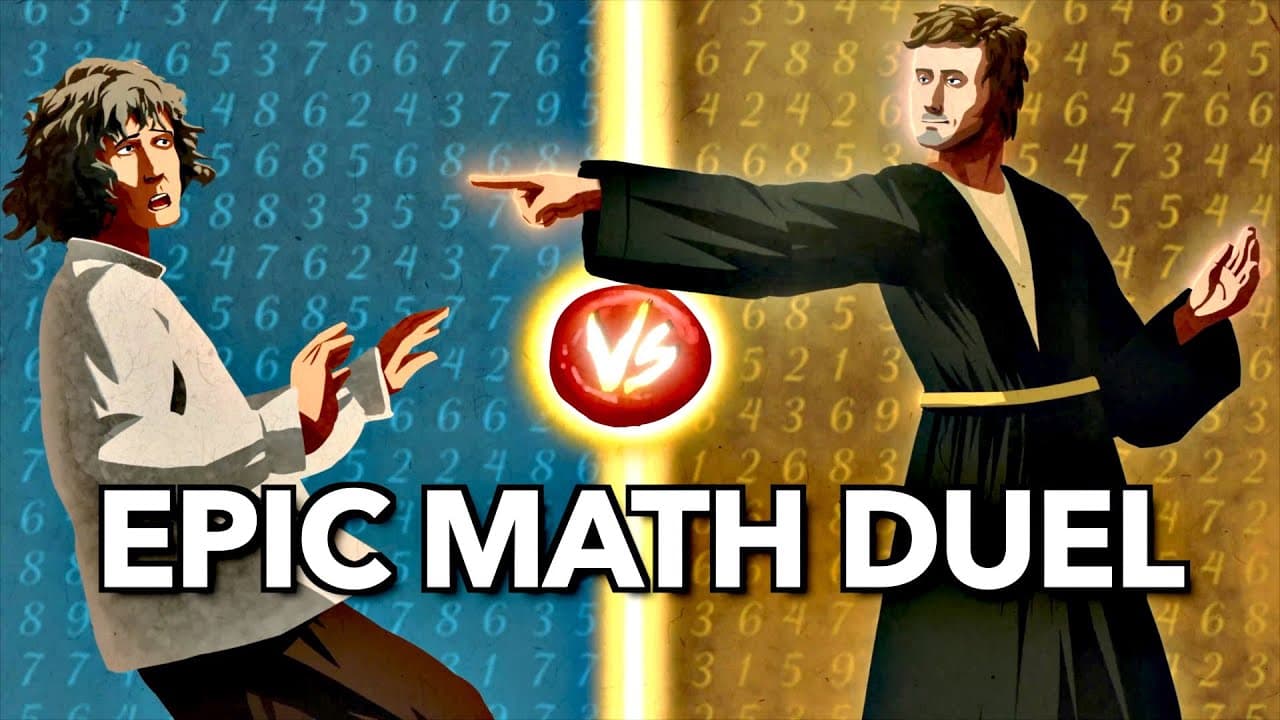
Imaginary numbers were invented to solve cubic equations that real numbers could not, separating mathematics from tangible reality. This shift allowed for a deeper understanding of complex concepts in physics and paved the way for modern mathematical frameworks, including the Schrödinger equation, highlighting their fundamental role in describing the universe.
Transcript
- Mathematics began as a way to quantify our world, to measure land, predict the motions of planets, and keep track of commerce. Then came a problem considered impossible. The secret to solving it was to separate math from the real world, to split algebra from geometry and to invent new numbers so fanciful they are called imaginary. Ironically, 400... Read More
Key Insights
- 🌍 Mathematics initially aimed to quantify the real world but encountered problems that required the invention of imaginary numbers.
- ❎ Geometric reasoning was used by ancient mathematicians to derive algebraic solutions to equations, such as completing the square to solve quadratics.
- 🥺 Negative numbers were initially rejected as they did not make sense in real-world measurements, leading to alternative approaches in solving cubic equations.
- 👶 The solution to the cubic equation remained elusive until mathematicians like Tartaglia, Cardano, and Bombelli introduced new methods and mathematical concepts like complex numbers.
Install to Summarize YouTube Videos and Get Transcripts
Explore YouTube Video Summarizer or Get YouTube Transcript Extractor
Questions & Answers
Q: Why did mathematicians in ancient times find it difficult to solve cubic equations?
Despite solving quadratic equations earlier, cubic equations posed a challenge because they required a new approach that involved finding a general solution for the cubic term, which was not present in quadratics.
Q: How did Tartaglia keep his method for solving depressed cubic equations a secret?
Tartaglia kept his method a secret to protect his job security, as mathematicians were often challenged for their positions based on their ability to solve math problems.
Q: When and how did complex numbers and square roots of negative numbers become accepted in mathematics?
Complex numbers and square roots of negatives gained acceptance in mathematics over the years as mathematicians recognized their usefulness in solving problems and representing wave-like behaviors.
Q: What role do imaginary numbers play in the Schrödinger equation?
In the Schrödinger equation, imaginary numbers describe the behavior of quantum particles by representing wave-like functions. The square root of negative one appears in the equation, allowing for a deeper understanding of atomic behavior.
Summary & Key Takeaways
-
Mathematics initially aimed to quantify and measure the real world, but the problem of solving the cubic equation required the invention of imaginary numbers.
-
Ancient mathematicians used geometric reasoning to derive algebraic solutions to equations, such as completing the square to solve quadratics.
-
Negative numbers were initially rejected by mathematicians since they did not make sense in the context of real-world measurements.
-
Mathematicians like Scipione del Ferro and Niccolo Fontana Tartaglia made significant progress in solving cubic equations, with Tartaglia revealing his method to Antonio Fior.
-
Gerolamo Cardano convinced Tartaglia to share his method, and Cardano further extended it to solve depressed cubics and the full cubic equation.
-
The square roots of negative numbers, also known as imaginary numbers, appeared in the solutions to some cubic equations and were later popularized by Rene Descartes.
-
Rafael Bombelli introduced the concept of complex numbers to handle equations with square roots of negatives, leading to the discovery of an algorithm for solving cubic equations.
-
Complex numbers and imaginary numbers reappeared in the Schrödinger equation, describing the behavior of quantum particles, revealing their fundamental role in physics.
Read in Other Languages (beta)
Share This Summary 📚
Summarize YouTube Videos and Get Video Transcripts with 1-Click
Try YouTube Summary with ChatGPT & Claude or YouTube Transcript Generator
Explore More Summaries from Veritasium 📚



Summarize YouTube Videos and Get Video Transcripts with 1-Click
Try YouTube Summary with ChatGPT & Claude or YouTube Transcript Generator