Why China Is KFC's Biggest and Fastest-Growing Market
TL;DR
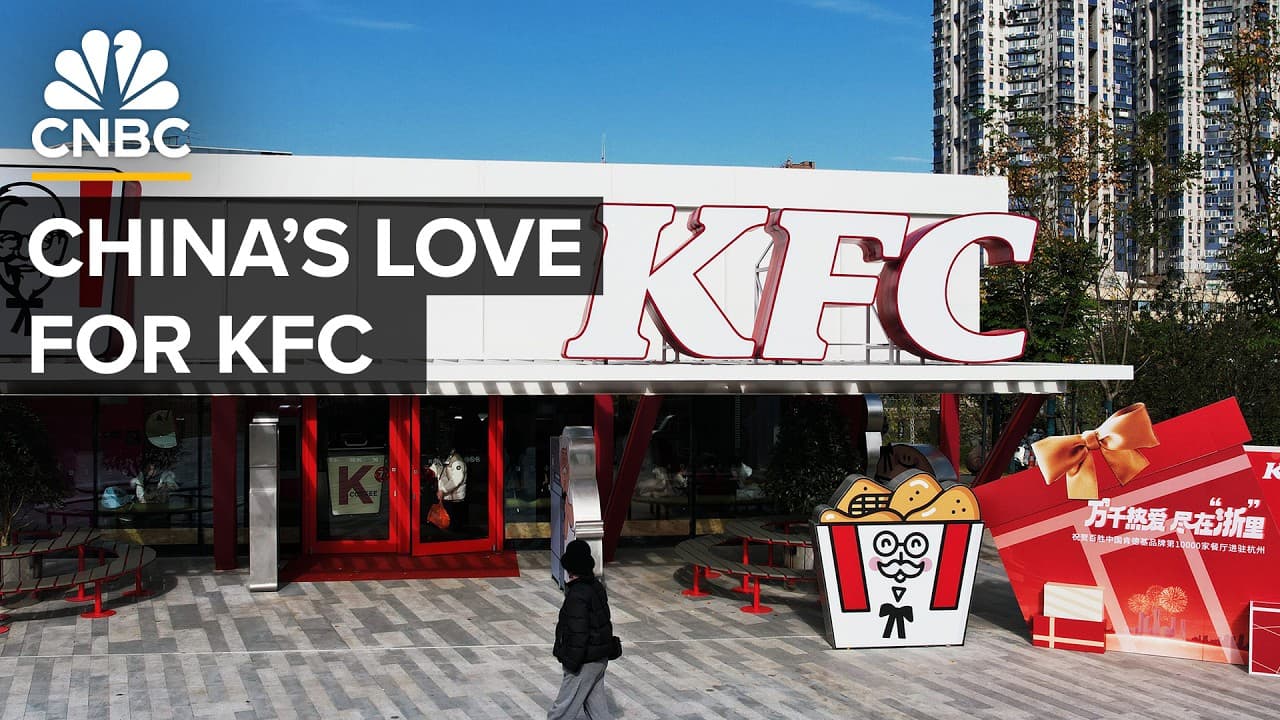
KFC opened its 10,000th China store in Hangzhou, more than double its roughly 4,300 US locations, and China now drives most of the chain's growth. Over 40% of its China stores opened in the last four years. A localized menu, company-owned stores, and 89% digital ordering made it Yum's largest KFC market.
Transcript
With more than 29,000 restaurants, 800,000 employees and a new location opening every 3.5 hours. Kfc is one of the world's largest fast food chains. But while much of the brand's early success came from the US today, the majority of that growth is in China. In the city of Hangzhou, about an hour outside of Shanghai, KFC China recently celebrated th... Read More
Key Insights
- KFC operates more than 29,000 restaurants worldwide with 800,000 employees and opens a new location roughly every 3.5 hours, but the majority of its recent growth comes from China rather than its original US market.
- China is Yum's largest KFC market, with over 14,000 restaurants across 1,900 cities; it recently opened its 10,000th KFC store in Hangzhou compared with a little over 4,300 KFC locations in the United States.
- KFC's early China advantage came from Yum owning the distribution business, letting it reach smaller cities first for a first-mover edge, plus chicken being a more naturally appealing protein than beef among Chinese consumers.
- Menu localization was central to success: KFC started with 8 products in 1987, now offers about 40 menu items, and introduces around 180 new products each year, including rice congee, steamed dumplings, and egg tart.
- Yum China owns and operates over 90% of its stores rather than franchising, unlike Yum Brands where 98% of stores are franchised; this equity model lets it open stores fast without negotiating with franchisees.
- Digital dominates Yum China's KFC business, with digital orders including delivery, mobile, and kiosk accounting for 89% of KFC sales in Q3 2023, and digital orders exceeding $8 billion in 2022.
- Food safety scandals in 2012 and 2014 hurt growth, causing same-store sales to decline 5% in 2014 and a further 4% the next year, prompting Yum to spin off Yum China as an independent company in 2016.
- China's importance to the parent is growing: in Q3 2023, China made up 25% of Yum Brands' KFC system sales while the US home market accounted for only 15%, and Yum China pays a 3% net sales license fee.
Install to Summarize YouTube Videos and Get Transcripts
Explore YouTube Video Summarizer or Get YouTube Transcript Extractor
Questions & Answers
Q: How many KFC stores are in China compared to the United States?
KFC China recently celebrated opening its 10,000th store in the city of Hangzhou, about an hour outside Shanghai. By comparison, the United States has a little over 4,300 KFC locations. China is now the largest KFC market for Yum, with over 14,000 total restaurants across 1,900 cities. More than 40% of KFC's China stores were built in the last four years alone, described as the highest speed of development in the chain's 36-year history there.
Q: Why did KFC become bigger than McDonald's in China?
According to the video, KFC overtook McDonald's in China for two main reasons. First, Yum owned the distribution business in China, which allowed it to access smaller cities first and gain a first-mover advantage. Second, chicken as KFC's core product is naturally more appealing in China, where chicken is a larger protein than beef. KFC launched in China in 1987, while McDonald's arrived in 1990, giving KFC an additional head start in the market.
Q: How did KFC adapt its menu for Chinese customers?
KFC localized heavily from the start. In 1987 it served only 8 products, and today its menu has about 40 items, but it introduces around 180 different new products to customers in China every year, more than any other Western food concept there. A typical China menu can include items like rice congee, steamed dumplings, and egg tart alongside chicken. Early leaders understood the need to introduce flavors resonating with the Chinese palate and to continually adjust the menu.
Q: What is Yum China and how is it different from Yum Brands?
Yum China is the operator of KFC, Pizza Hut, and Taco Bell in China. Yum Brands spun it off in 2016 to create an independent company incorporated in Delaware and listed on the New York and Hong Kong Stock Exchanges, following activist pressure to separate the businesses. Unlike Yum Brands, where 98% of stores are franchised, Yum China owns and operates over 90% of its stores. Yum China had $9.5 billion in revenue in 2022, compared with Yum Brands' $6.8 billion.
Q: Why does Yum China own most of its stores instead of franchising?
Over 90% of Yum China's stores are company-owned rather than franchised because the investment payback is described as incredible. Owning the equity stores lets the company open new locations very fast without negotiating with franchisees about how many to open per province. Analysts note this behavior usually indicates a company prefers to keep most profits rather than share them, signaling that the China stores are well operated and profitable on a per-unit basis. The model has helped boost the company's overall store count.
Q: How important is digital ordering to KFC China?
Digital ordering and delivery are a major component of the business. Digital orders, including delivery, mobile orders, and kiosk orders, accounted for 89% of Yum China's KFC sales in the third quarter of 2023, and digital orders exceeded $8 billion in 2022. The company invests in automation and AI, including AI that orders supplies like buns and chicken automatically and smart watches that tell managers when to marinate more chicken. Chinese consumers are described as digital-first across the board.
Q: What challenges has KFC faced in China?
KFC China faced food safety scandals in 2012 and 2014 that hurt growth, with same-store sales declining 5% in 2014 and a further 4% the next year. Covid lockdowns temporarily closed or limited over 4,300 stores by November 2022; total Yum China revenue fell 3% in 2022 and KFC same-store sales dropped 7%. Additional headwinds include a US-China trade war, rising unemployment, a slowing economy, concerns about Chinese consumer health, and possible backlash toward Western brands.
Q: How is KFC planning to keep growing in China?
KFC is pursuing several growth avenues. It plans to open more to franchisee business, potentially offering opportunities to former employees and alumni, and in 2019 announced its first KFC franchises at gas stations with China Petrochemical and China National Petroleum, which together operate more than 50,000 gas stations. Coffee is another target: KFC's in-house brand K Coffee has about 300 locations and expected to sell 180 million cups in 2023, competing with Starbucks, which has over 6,500 China stores since launching in 1999.
Summary & Key Takeaways
-
KFC entered China in 1987 with just 8 products and now runs over 14,000 restaurants in 1,900 cities. It recently opened its 10,000th store in Hangzhou, far ahead of the roughly 4,300 US locations, with over 40% of China stores built in the last four years.
-
Success came from Yum owning distribution to reach smaller cities first, chicken's natural appeal over beef, and heavy menu localization adding items like congee, dumplings, and egg tart. Roughly 180 new products launch yearly, and Colonel Sanders is affectionately known locally as old grandpa.
-
Yum China owns over 90% of its stores, enabling fast expansion, and generated $9.5 billion in revenue in 2022 versus Yum Brands' $6.8 billion. Digital orders reached 89% of KFC sales in Q3 2023, but food safety scandals, Covid, and a slowing economy remain headwinds.
Read in Other Languages (beta)
Share This Summary 📚
Summarize YouTube Videos and Get Video Transcripts with 1-Click
Try YouTube Summary with ChatGPT & Claude or YouTube Transcript Generator
Explore More Summaries from CNBC 📚





Summarize YouTube Videos and Get Video Transcripts with 1-Click
Try YouTube Summary with ChatGPT & Claude or YouTube Transcript Generator