How to Interpret Financial Statements: Benjamin Graham’s Top Five Takeaways
TL;DR
Benjamin Graham’s approach starts with using the income statement and balance sheet to understand a company’s present financial position before judging its investment potential. Key checks include net margin, the current ratio, and the P/B ratio, interpreted within the company’s industry. The F&M Schaefer example shows why even $40 million in reported intangible assets may deserve scrutiny. Read on for practical ways to assess the numbers.
Transcript
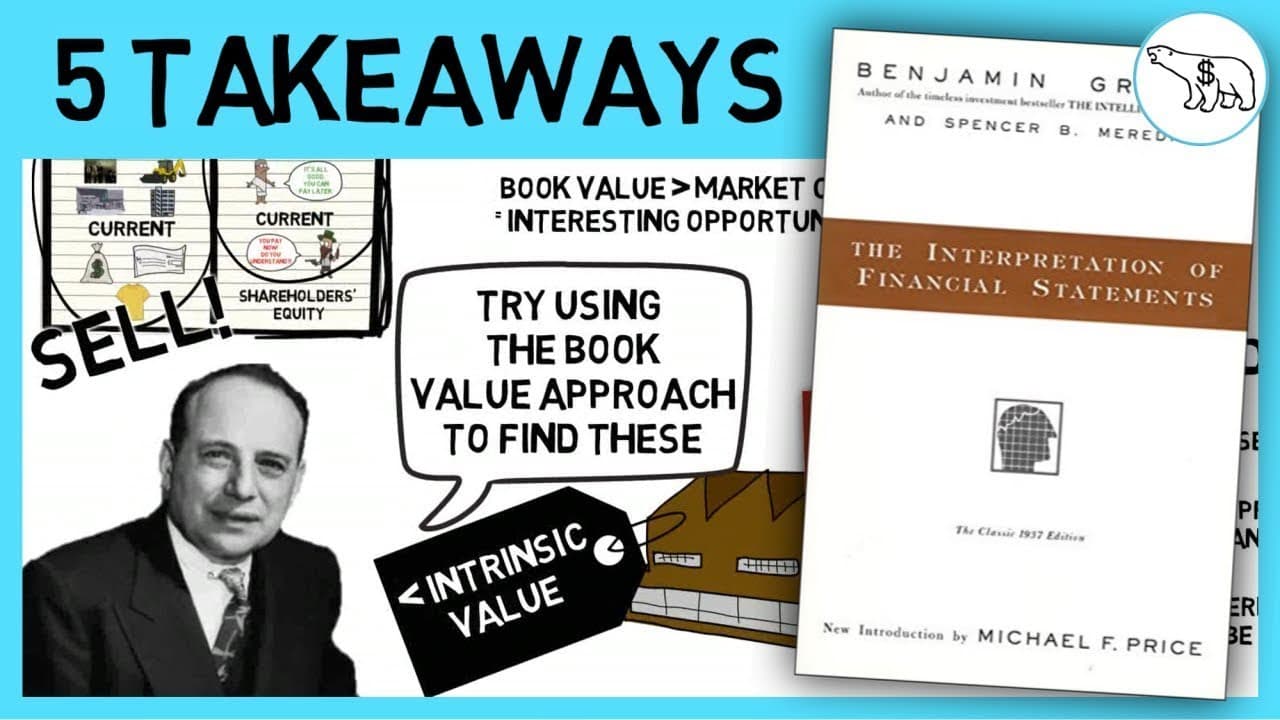
One day, I looked at a small brewery - the F&M Schaefer Brewing Company. I'll never forget looking at the balance sheet and noticing that the book value of the company was 40 million dollars higher than the current market cap, with 40 million dollars in intangible assets. I said to my colleague: "It looks cheap! It's trading for below its Book valu... Read More
Key Insights
- 🧘 Understanding income statements and balance sheets is crucial for interpreting a company's financial position.
- ❓ Industry-specific indicators provide valuable insights, but their interpretation should consider variations among industries.
- 🥺 "Watered stocks" with inflated assets can lead to future problems and negatively impact earnings.
- 🧑🏭 Stocks priced below book value can be favorable investment opportunities, but asset quality and industry-specific factors should be considered.
Install to Summarize YouTube Videos and Get Transcripts
Explore YouTube Video Summarizer or Get YouTube Transcript Extractor
Questions & Answers
Q: How do you interpret financial statements using Benjamin Graham’s approach?
Start by understanding what the income statement reveals about revenue, expenses, and net income, then use the balance sheet to assess assets, liabilities, and shareholders’ equity. Calculate indicators such as net margin, current ratio, and P/B ratio, but interpret each one in the context of the company’s industry and the quality of its reported assets.
Q: What is the difference between an income statement and a balance sheet?
An income statement reports a company’s revenue and expenses over a period, normally a quarter or a year, and ends with earnings or net income. A balance sheet is a snapshot at a specific point in time showing what the company owns and what it owes.
Q: How is operating income calculated from an income statement?
Begin with revenue, then subtract the cost of goods and other operating expenses such as wages, transportation, utilities, and depreciation. The result is operating income, also called EBIT, or earnings before interest and taxes.
Q: What does shareholders’ equity mean on a balance sheet?
Shareholders’ equity is listed on the liability side because, from the company’s perspective, it represents money owed to shareholders. It can also be viewed as the difference between assets and liabilities, representing the shareholders’ interest in the company.
Q: How is net margin calculated, and why does industry matter?
Net margin is calculated by dividing net income by revenue, indicating how much remains per earned dollar for potential reinvestment or distribution to shareholders. Industry context is essential: the transcript says a 5% margin may be terrible for a health technology firm but strong for a distribution service firm.
Q: What is the current ratio, and what level did Benjamin Graham suggest?
The current ratio is current assets divided by current liabilities and indicates whether a company can meet its short-term obligations. Benjamin Graham suggests a ratio above two, although the transcript emphasizes that an acceptable level depends on the industry.
Q: How is the P/B ratio calculated and interpreted?
The price-to-book ratio is calculated by dividing a company’s market capitalization by the total value of its balance sheet. It varies substantially by industry: a money bank may have a large balance sheet and low P/B ratio, while a consulting firm may show the opposite pattern.
Q: Why should investors scrutinize intangible assets when a stock trades below book value?
The F&M Schaefer Brewing Company appeared to have book value $40 million above its market capitalization, but that difference consisted of $40 million in intangible assets attributed to its jingle. The narrator judged the asset to be greatly overstated and did not buy the company, illustrating why reported book value requires closer investigation.
Summary & Key Takeaways
-
Income statement focuses on revenues and expenses during a specific period, with operating income calculated by deducting costs of goods and other operating expenses from revenue. Earnings are then derived by subtracting interest payments and taxes from operating income.
-
Balance sheet is a snapshot of a company's assets and liabilities at a specific point in time, with assets divided into long-term and short-term categories and liabilities categorized into long-term, current, and shareholders' equity. Shareholders' equity represents what the company owes to shareholders.
-
Industry-specific indicators such as net margin, current ratio, and P/B ratio provide insights into a company's financial health, but these ratios vary among industries and must be interpreted accordingly.
Read in Other Languages (beta)
Share This Summary 📚
Summarize YouTube Videos and Get Video Transcripts with 1-Click
Try YouTube Summary with ChatGPT & Claude or YouTube Transcript Generator
Explore More Summaries from The Swedish Investor 📚





Summarize YouTube Videos and Get Video Transcripts with 1-Click
Try YouTube Summary with ChatGPT & Claude or YouTube Transcript Generator