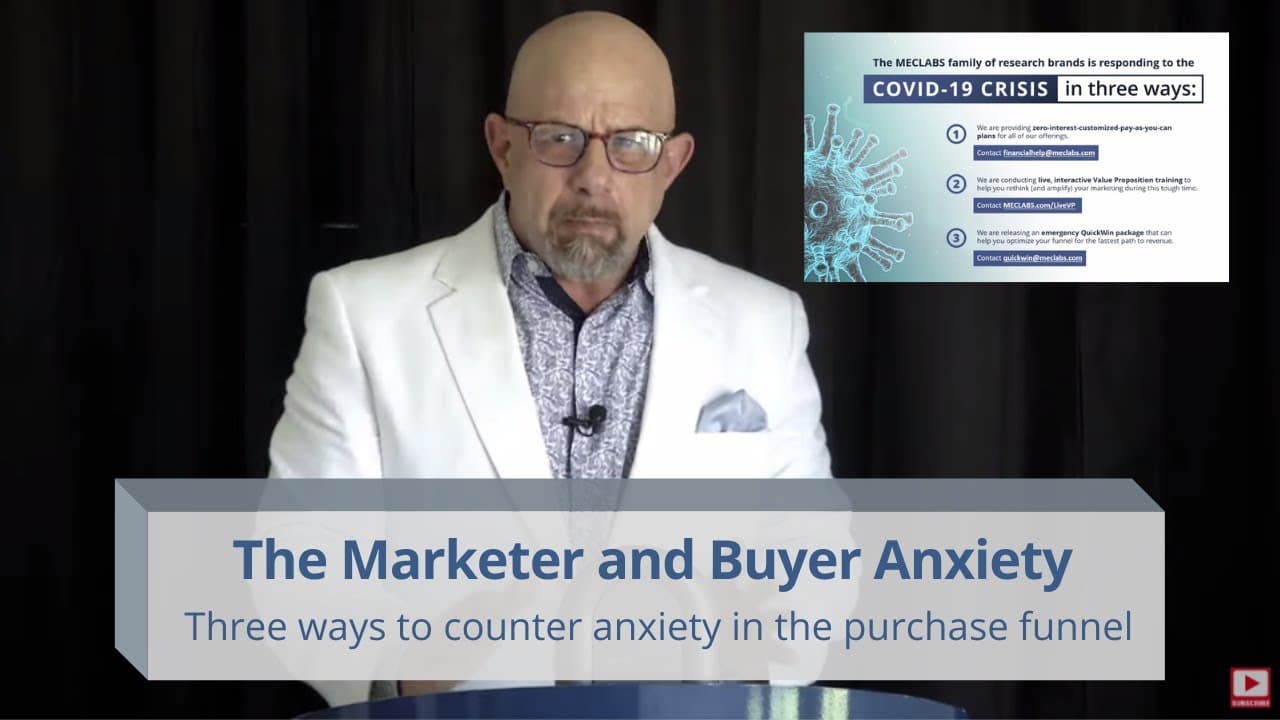
The Marketer and Buyer Anxiety: How Can Marketers Counter Anxiety in the Purchase Funnel?
TL;DR
Marketers can reduce buyer anxiety by separating psychological concern from purchase friction, identifying the buyer’s underlying fear, and providing specific, visible safeguards rather than relying only on rational assurances. A featured treatment that dramatically reduced anxiety increased the lead rate by 262 percent over the control. Read on for practical examples involving tamper-proof packaging, limited human contact, and reassurance tied directly to feared outcomes.
Transcript
good afternoon everyone it's good to be back I see some familiar faces already Henry thanks for being on live we're glad to have you max good to see back Shawn Kristie sarva and Marcus from from Grenada good let's look at a page together and get right into the content you'll see two versions I'm asking the audience and I know you're just still sort... Read More
Key Insights
- Buyer anxiety is a psychological concern that must be distinguished from friction, which is described as psychological resistance. Treating both problems identically can lead marketers to address the wrong obstacle and overlook the internal uncertainty preventing a customer from proceeding.
- Anxiety can drive behavior that appears irrational even when rational information is available. The shortage of toilet paper is presented as an example of behavior influenced by an underlying concern that cannot be fully understood or corrected through a simple logical explanation.
- The purchase process is especially vulnerable to anxiety because prospective customers may react differently to psychological concern than to practical resistance. Marketers need to identify which concern is operating before selecting page changes, messages, or reassurances intended to improve conversion.
- The featured treatment generated a 262 percent increase in lead rate compared with the control. The experiment sought more affirmative responses in the quote element of a site, and the substantial performance difference was attributed to a dramatic reduction in buyer anxiety.
- The deepest source of anxiety can be a customer's lack of trust in their own judgment. The central formulation, "I don't trust you because I don't trust me," reframes apparent distrust of the seller as uncertainty within the prospective buyer.
- Rational reassurance is not always sufficient to resolve emotional concern. Saying that everything will be fine, citing an absence of cases, or listing preparations may all be truthful, yet still fail to relieve the anxiety felt by another person.
- Effective reassurance can require an action that goes beyond verbal explanation. In the personal example, assurances about safety would not calm a worried mother, while returning home by plane directly addressed the outcome underlying her concern.
- Visible operational safeguards can counter anxiety more effectively than vague promises. Chipotle's free delivery and tamper-proof packaging, along with notices about limited human contact with newspapers, are presented as concrete responses designed to overcorrect for customer concern.
Install to Summarize YouTube Videos and Get Transcripts
Explore YouTube Video Summarizer or Get YouTube Transcript Extractor
Questions & Answers
Q: What is buyer anxiety in a purchase funnel?
Buyer anxiety is a psychological concern that can prevent a prospective customer from moving forward. It can drive behavior that appears irrational, so marketers need to identify the concern beneath the customer’s response instead of assuming that a logical explanation will resolve it.
Q: How is buyer anxiety different from purchase friction?
Buyer anxiety is described as psychological concern, while friction is psychological resistance. The distinction matters because customers may respond irrationally to anxiety rather than reacting to it as they would to friction.
Q: How much did reducing buyer anxiety improve the lead rate?
The treatment in the featured test increased the lead rate by 262 percent compared with the control. The difference was attributed primarily to a dramatic reduction in anxiety.
Q: What can cause buyer anxiety at its deepest level?
A buyer may appear to distrust a company while actually distrusting their own judgment. The idea is summarized as, “I don't trust you because I don't trust me,” meaning the buyer may be uncertain about their ability to choose safely.
Q: Why can rational reassurance fail to reduce buyer anxiety?
Anxiety is not always caused by missing factual information, so truthful explanations may not resolve the underlying concern. In the personal example, assurances about safety, preparations, or the absence of cases did not calm a worried mother, while returning home by plane directly addressed her feared outcome.
Q: How should marketers address a buyer’s lack of self-trust?
Marketers should examine what makes customers doubt their own ability to make a safe decision. Specific actions and visible safeguards tied to the underlying concern can provide stronger reassurance than general credibility claims.
Q: What business examples show how to counter customer anxiety?
Chipotle offered free delivery and tamper-proof packaging as specific, visible responses to customer concern. The Wall Street Journal placed notices on its front page explaining that its newsprint was safe to handle and that human contact with the paper was limited.
Q: Why should marketers overcorrect for anxiety in a sales process?
Anxiety can be especially damaging in a sales process and may produce behavior that appears irrational. Overcorrecting with concrete, visible action can address the feared outcome more effectively than simply saying everything will be fine.
Summary & Key Takeaways
-
Buyer anxiety is a psychological concern that differs from friction, which is described as psychological resistance. During periods of widespread uncertainty, anxiety can produce behavior that appears irrational. Marketers therefore need to examine purchase funnels for unaddressed concerns and recognize that ordinary rational explanations may not provide enough reassurance to change customer behavior.
-
A featured test compared two versions of a quote-related page with the goal of generating more affirmative responses. The treatment produced a 262 percent increase in lead rate over the control. The performance difference was attributed primarily to dramatically reducing anxiety, demonstrating how strongly psychological concerns can affect conversion behavior within a sales process.
-
The deepest source of anxiety may be an inversion of trust. A prospective buyer can appear to distrust a company while actually distrusting their own judgment or ability to choose safely. The statement, "I don't trust you because I don't trust me," summarizes why marketers must address internal uncertainty rather than relying only on external credibility claims.
Read in Other Languages (beta)
Share This Summary 📚
Summarize YouTube Videos and Get Video Transcripts with 1-Click
Try YouTube Summary with ChatGPT & Claude or YouTube Transcript Generator
Explore More Summaries from Flint McGlaughlin 📚

Summarize YouTube Videos and Get Video Transcripts with 1-Click
Try YouTube Summary with ChatGPT & Claude or YouTube Transcript Generator