How to Scale B2C Before Moving Into B2B

TL;DR
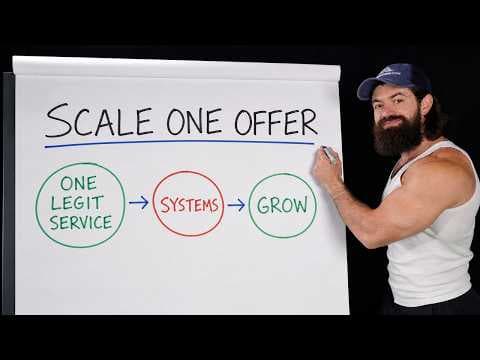
Scale the proven B2C business before pursuing enterprise clients, especially when unresolved sales and fulfillment constraints would affect both paths. The lowest-risk move is to improve lead magnets, advertising creative, page conversion, and sales efficiency until the existing market is exhausted, then consider adding another acquisition channel before changing customer types.
Transcript
So, my name is Weston, and I sell career coaching services to corporate executives. So, basically we help these people find their next role >> Okay. >> in the corporate space. So, we did 7.2 million in revenue last year. >> Congrats. >> About 2 million in profit. >> Amazing. >> And we know how to grow B2C. We know that we can do that, but we're rea... Read More
Key Insights
- The lowest-risk scaling move is to expand what already works. A company should identify the specific constraint preventing higher volume, then solve that constraint before pursuing a new customer type, offering, and acquisition process that have not yet been proven.
- B2B enterprise sales are higher leverage but operationally complex. A deal may require 10–15 touch points, involvement from multiple stakeholders on both sides, and more time from each salesperson, which reduces the number of deals one representative can manage.
- The existing B2C model had already produced $7.2 million in annual revenue and about $2 million in profit. Those results demonstrate a proven path, while the proposed enterprise path had not yet produced its first deal.
- Sales efficiency is a constraint that should be fixed directly. If weak lead handling or call-to-close performance prevents advertising spend from rising profitably, switching to enterprise customers preserves the problem while adding an unfamiliar sales motion.
- Fulfillment capacity affects both B2C and B2B growth. Coaching, writing, staffing, and service-delivery requirements remain relevant regardless of who pays, so moving to enterprise contracts does not eliminate the need to strengthen backend operations.
- Channel diversification is less risky than customer diversification. If the company wants a new growth path, adding a second acquisition channel keeps the established product and customer base more intact than simultaneously changing the offering, buyer, and sales process.
- Profitable advertising scale depends on improving the entire conversion system. Better lead magnets, stronger creative, higher page conversion rates, and improved sales efficiency can offset the declining return on ad spend that is likely to appear at higher spending levels.
- Business growth takes time because optimization requires focused iteration. Companies capable of spending $100,000 per day profitably differ from those spending $5,000 per day through the quality of their marketing, conversion, sales, and fulfillment systems.
- More videos from this channel:
- More from this channel: MoreMozi
Install to Summarize YouTube Videos and Get Transcripts
Explore YouTube Video Summarizer or Get YouTube Transcript Extractor
Questions & Answers
Q: Is B2B more scalable than B2C?
B2B can provide larger accounts and higher leverage, but it is not automatically a more scalable choice. Enterprise sales may require 10–15 touch points, multiple stakeholders on both sides, and more work per salesperson. If a proven B2C business still has room to improve acquisition, conversion, sales efficiency, and fulfillment, expanding that model is presented as the lower-risk path.
Q: When should a company expand from B2C into B2B?
A company should consider B2B after it has a strong reason that the existing consumer path cannot keep expanding. The discussion recommends first identifying and removing constraints in advertising, sales, and fulfillment, then determining whether the consumer market is genuinely exhausted. Merely reaching a milestone such as a million-dollar month does not establish that a new customer type is necessary.
Q: Why should a business scale what already works first?
Scaling an established model carries less uncertainty because the company already understands its customers, acquisition method, service, and economics. Starting an enterprise path can introduce a new buyer, offering, acquisition process, and stakeholder structure. When existing operational problems would affect both paths, solving them inside the proven model offers a better risk-adjusted opportunity than building an untested one.
Q: What makes enterprise sales more difficult than consumer sales?
Enterprise sales involve more interactions and more decision-makers. The discussion estimates that a deal can require 10–15 touch points, while multiple stakeholders from the buyer and seller may need to participate. These relationships can increase conversion and customer retention, but they also reduce how many deals each salesperson can handle and make the overall sales process more demanding.
Q: What was limiting the career coaching company's growth?
The company identified front-end sales efficiency and backend fulfillment as important constraints. When advertising approached roughly $10,000 per day, salespeople needed to handle the incoming leads effectively, maintain acceptable call-to-close performance, and preserve profitability. The company also had to support coaching, writing, and other service costs, making reliable delivery capacity essential to further growth.
Q: How can a B2C company increase advertising spend profitably?
The recommended approach is to improve the components that protect returns as spending rises. Those components include a better lead magnet, stronger advertising creative, superior conversion rate optimization on landing pages, and improved sales efficiency. Because return on ad spend is likely to decline at higher volume, strengthening all four areas can make larger daily budgets economically sustainable.
Q: Should a company diversify channels before changing customers?
Yes, the discussion favors channel diversification over changing customer types when a business wants an additional growth path. A second channel can preserve the existing product, customer profile, and operational knowledge. Moving from consumers to enterprise clients risks changing the offering, acquisition approach, sales process, and stakeholder structure at once, which makes the transition closer to starting a new business.
Q: Why does profitable business scaling take time?
Profitable scaling takes time because growth depends on improving several connected systems, including lead generation, advertising creative, page conversion, sales performance, and fulfillment. These elements generally need focused testing and adjustment rather than simultaneous uncontrolled changes. The difference between spending $5,000 and $100,000 per day profitably is attributed to how well the company executes across those functions.
Summary & Key Takeaways
-
A career coaching company generated $7.2 million in annual revenue and about $2 million in profit, yet its owner considered enterprise sales more scalable. The advice was to challenge that assumption and determine why the proven consumer model could not grow further before investing in a new, unproven business path.
-
The immediate constraint was not consumer demand but operational efficiency. Advertising had reached roughly $10,000 per day before sales efficiency and fulfillment capacity became concerns. Because those same service, staffing, and delivery costs would also exist in enterprise work, changing customer types would not remove the underlying problems that limited profitable growth.
-
Enterprise selling can create larger accounts, but it also requires more touch points, more stakeholders, and fewer deals per salesperson. The recommended scaling path is to strengthen the existing acquisition system, improve conversion and sales performance, and diversify acquisition channels only when necessary, rather than introducing a new offering and sales process prematurely.
Read in Other Languages (beta)
Share This Summary 📚
Summarize YouTube Videos and Get Video Transcripts with 1-Click
Try YouTube Summary with ChatGPT & Claude or YouTube Transcript Generator
Explore More Summaries from MoreMozi 📚


Summarize YouTube Videos and Get Video Transcripts with 1-Click
Try YouTube Summary with ChatGPT & Claude or YouTube Transcript Generator