How Does BlackRock's Rick Rieder Think Investors Should Position for Fed Rate Cuts?
TL;DR
Investors should capture fixed-income yields before Fed cuts reduce available income, focusing on the front through the middle of the yield curve while selectively extending maturities where real rates are attractive. BlackRock’s Rick Rieder says portfolios can still generate about 6% income and expects equities to keep rising on strong earnings and market technicals. Read on for his rate-cut forecast, economic outlook, and views on Fed policy.
Transcript
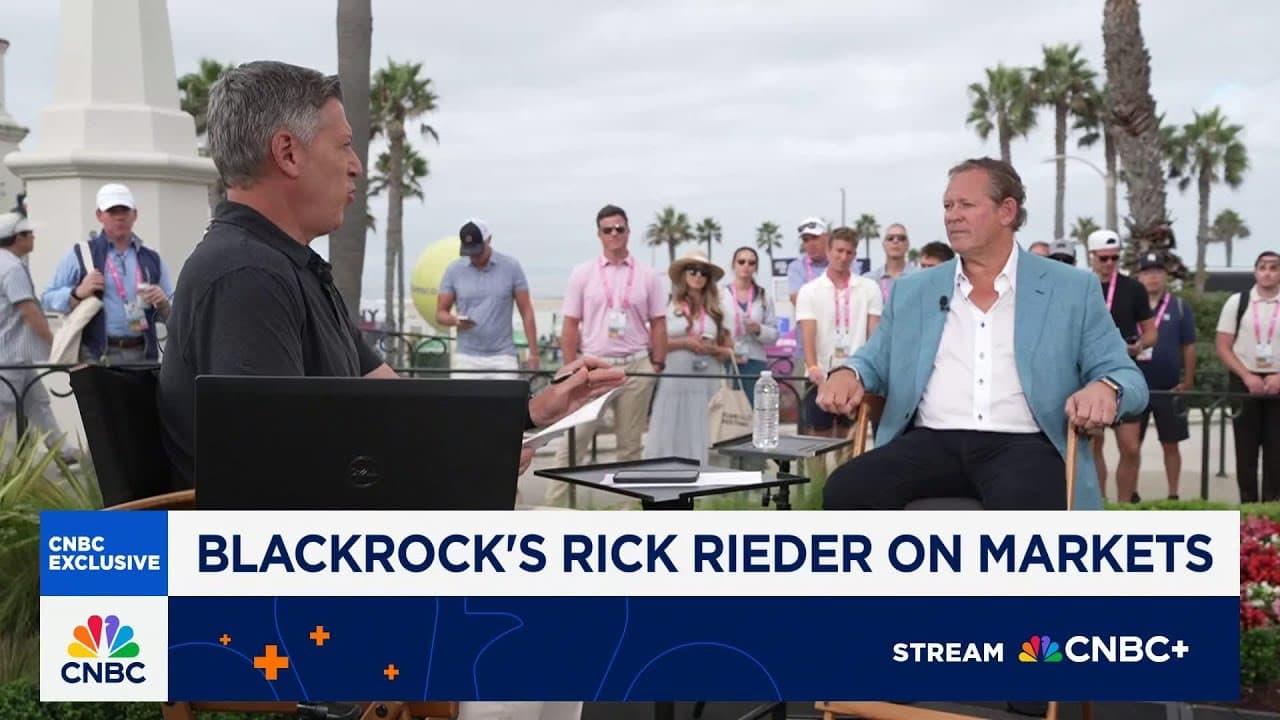
Welcome back. Live here to Future Proof in Huntington Beach, California. Our next guest recently called the Current Investing Environment one of the best he's ever seen. Rick Rieder is BlackRock's CIO of global fixed income, also its head of its global allocation team. He joins us now. It's good to see you out here by the beach. Wow. Pretty nice... Read More
Key Insights
- The current investment environment offers opportunities across technology stocks, fixed income, public markets, private markets, gold, and Bitcoin. Rieder calls it especially attractive because investors can find both earnings growth and income while differentiating among companies whose performance is increasingly bifurcated.
- Fixed-income portfolios can still generate about 6% income before Federal Reserve easing lowers available yields. Rieder says investors can remain in the front through the middle of the yield curve while extending selectively where real rates have become more attractive.
- A 25-basis-point Federal Reserve cut is Rieder's expected outcome, although he believes a 50-basis-point reduction would be more appropriate. He expects rates to continue moving lower afterward as monetary policy progresses toward a neutral setting.
- Stagflation is a very low concern in Rieder's outlook because he projects roughly 2% real GDP growth, or slightly less, alongside inflation. He estimates nominal GDP near 4.6% for the year, which he views as helpful given the country's debt burden.
- Federal Reserve independence is critical because the United States must fund debt globally and preserve confidence in its currency and debt management. Rieder nevertheless believes an independent central bank can use its balance sheet, liquidity, and yield-curve positioning more creatively.
- Labor-market weakness is becoming a more important secular issue than modestly elevated inflation. Rieder points to payroll revisions, negative job growth after excluding health care, and difficulty finding work among young people and people in urban settings.
- Equity strength reflects solid earnings and unusually favorable market technicals. Rieder says cost cutting supported much of the recent earnings performance, while massive cash balances and buybacks that dwarf the initial public offering calendar provide additional support.
- The bond market is signaling that the federal funds rate is too high rather than necessarily forecasting a recession. Rieder estimates neutral near 3%, possibly lower because of technology and productivity, and expects policy to approach that level over roughly the next year and a half.
Install to Summarize YouTube Videos and Get Transcripts
Explore YouTube Video Summarizer or Get YouTube Transcript Extractor
Questions & Answers
Q: How should investors position for Federal Reserve rate cuts?
Rieder says investors can capture fixed-income income before policy rates decline by focusing on the front through the middle of the yield curve. He says portfolios can still generate about 6% income and that selective maturity extensions are becoming attractive because real rates farther out on the curve have improved.
Q: How large a Federal Reserve rate cut does Rick Rieder expect?
Rieder expects the Federal Reserve probably to cut its overnight policy rate by 25 basis points, although he believes a 50-basis-point cut would be more appropriate. He says the forthcoming CPI report could affect the decision and expects rates to continue moving lower afterward.
Q: Why does Rick Rieder consider the current investment environment so attractive?
Rieder sees opportunities across technology stocks, fixed income, public markets, private markets, gold, and Bitcoin. He highlights strong earnings at selected technology companies, widening differences among businesses, and abundant fixed-income income as reasons investors have many compelling choices.
Q: Why does Rick Rieder believe interest rates should fall?
Rieder says lower rates would better support the economy, especially lower-income households facing expensive borrowing and higher goods costs. He argues that raising borrowing costs in response to tariff-related inflation adds pressure to people already struggling, while elevated mortgage rates are hurting many households.
Q: Is stagflation a major concern for Rick Rieder?
No. Rieder places stagflation near the extreme low end of his concern scale and projects real GDP growth of about 2%, or slightly less. He estimates nominal GDP at roughly 4.6% for the year, which he considers helpful given the country’s debt burden.
Q: Where along the yield curve does Rick Rieder see value?
Rieder favors the front through the middle, or belly, of the yield curve for capturing available yield. He has also extended somewhat farther because real rates have become more attractive, particularly if inflation is running around 3%.
Q: Why does Rick Rieder expect the equity market to keep rising?
Rieder expects equities to rise because market technicals are extraordinary and selected technology companies are delivering strong earnings growth. He also points to increasing performance differences across companies, which create opportunities for investors to distinguish between stronger and weaker businesses.
Q: What monetary-policy tools does Rick Rieder think deserve more attention?
Rieder says changing the overnight funding rate by 25 basis points is only one part of monetary policy. He believes the Federal Reserve can think more creatively about its balance sheet, liquidity, different parts of the yield curve, and its mortgage holdings, particularly while mortgage rates remain too high.
Summary & Key Takeaways
-
Rieder describes the investing environment as unusually rich in choices rather than making a narrow prediction about stocks. Technology-driven change, strong earnings at selected companies, abundant fixed-income income, public and private assets, gold, and Bitcoin give investors several ways to construct portfolios and distinguish between businesses with different prospects.
-
Fixed income remains attractive because investors can still construct portfolios yielding about 6% before Federal Reserve cuts reduce available income. Rieder favors the front through the middle of the yield curve and has extended somewhat farther because real rates have become more appealing, especially if inflation remains around 3%.
-
Rieder considers Federal Reserve independence critical for maintaining global confidence in United States debt and currency management. However, he believes monetary policy should respond more forcefully to labor weakness, high borrowing costs, and technology-driven job displacement, while using the balance sheet and liquidity tools creatively without abandoning inflation discipline.
Read in Other Languages (beta)
Share This Summary 📚
Summarize YouTube Videos and Get Video Transcripts with 1-Click
Try YouTube Summary with ChatGPT & Claude or YouTube Transcript Generator
Explore More Summaries from CNBC Television 📚




Summarize YouTube Videos and Get Video Transcripts with 1-Click
Try YouTube Summary with ChatGPT & Claude or YouTube Transcript Generator